The 2026 FIA World Endurance Championship (WEC) season finale at Monza has been overshadowed by a frightening accident involving two historic endurance racing prototypes, with one iconic machine suffering devastating damage in a high-speed collision during the Legends of Le Mans support race.
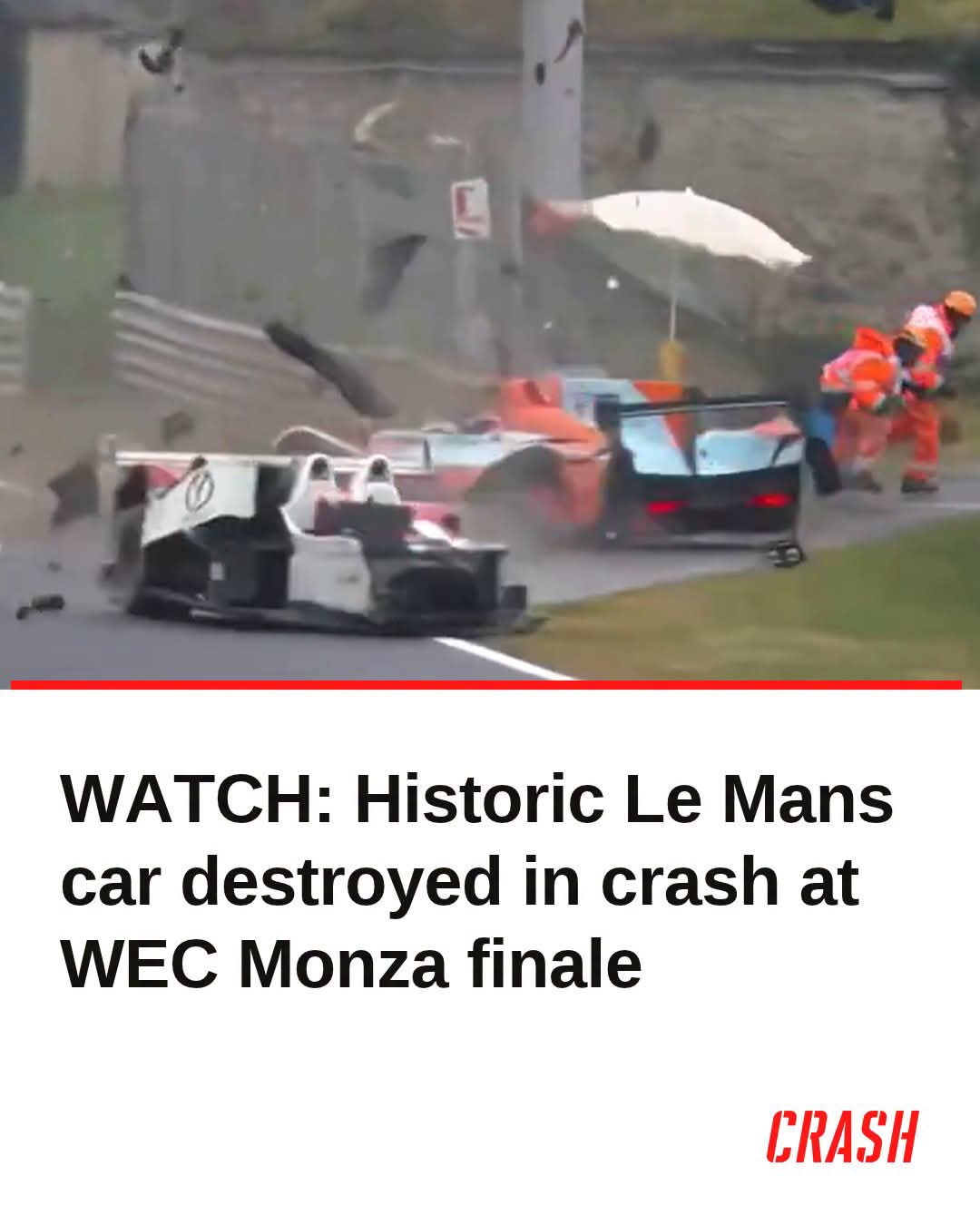
The dramatic incident brought proceedings to an abrupt halt after a collision between Marcel Aebi and Christophe D’Ansembourg sent Aebi’s Lola prototype crashing heavily into the barriers at the famous Autodromo Nazionale Monza.
Although the accident resulted in substantial damage to the historic machinery, the initial reports provided some encouraging news: Aebi managed to climb out of his wrecked car without assistance.
Nevertheless, the incident has raised fresh concerns about the risks associated with historic endurance racing, particularly when powerful former Le Mans prototypes are pushed hard on demanding circuits.
HOW THE TERRIFYING MONZA CRASH UNFOLDED
The accident happened during Saturday’s Legends of Le Mans race, which formed part of the support programme for the 2026 WEC season finale.
Aebi was competing in a Lola B06/10 entered by Race Performance and had established himself among the leading competitors. He was running fourth overall and third in the LMP1 category when he encountered D’Ansembourg’s OAK-Pescarolo prototype.
D’Ansembourg was reportedly a lap behind but attempted to defend his position as the two cars approached the Variante della Roggia chicane.
However, the situation quickly deteriorated.
The OAK-Pescarolo slowed earlier than Aebi apparently anticipated, leaving the Lola driver with limited room to react. Unable to avoid contact, Aebi struck the other prototype before losing control and heading towards the barriers at considerable speed.
The resulting impact was particularly violent, leaving the Lola heavily damaged and causing significant destruction to the circuit’s safety barriers.
Track marshals were also forced to react quickly to avoid being caught in the path of the out-of-control prototype.
The incident was serious enough to bring the racing programme to a temporary standstill while officials assessed the situation and arranged repairs to the damaged barriers.
ENCOURAGING NEWS AS MARCEL AEBI ESCAPES THE WRECKAGE
Despite the frightening nature of the collision, the most important development was the driver’s condition.
Aebi managed to exit the severely damaged Lola under his own power, providing an encouraging initial indication that he had avoided the worst consequences of the accident.
However, he was expected to undergo medical checks at the circuit’s medical centre.
The condition of the drivers was naturally the immediate priority following the incident, particularly given the speed and violence of the impact.
Modern motorsport safety systems have made enormous progress over the years, and incidents like this demonstrate the importance of continued investment in driver protection, circuit barriers and emergency response procedures.
While the physical damage to the Lola was substantial, the fact that Aebi could walk away from such a frightening accident was the most positive aspect of the afternoon.
WHY THE DESTRUCTION OF THE LOLA B06/10 MATTERS
The Lola B06/10 is more than simply an old racing car.
It represents an important period in endurance racing history, when independent manufacturers and privateer teams played significant roles in challenging established factory-backed competitors.
Lola has a particularly important place in sports car racing, having produced numerous successful prototypes across different generations of international endurance competition.
The B06/10 belongs to the LMP1 era, when manufacturers and privateer operations competed with sophisticated prototypes designed for the demands of races such as the 24 Hours of Le Mans.
These machines are now valuable pieces of motorsport heritage.
Consequently, seeing one suffer such extensive damage is disappointing for collectors, enthusiasts and everyone involved in preserving historic racing machinery.
Repairing a prototype of this generation is not necessarily straightforward. Replacement components can be difficult to source, while certain aerodynamic and structural elements may require specialist fabrication.
The damage could therefore represent a significant financial and logistical challenge for the Race Performance operation.
However, it is important to distinguish between a badly damaged racing car and one that is beyond repair. A full assessment will be needed before its long-term future becomes clear.
THE DIFFICULT BALANCE BETWEEN COMPETITION AND HISTORIC PRESERVATION
Historic motorsport occupies an interesting position within the racing industry.
Fans want to see legendary machines operating at speed rather than sitting permanently inside museums. At the same time, owners and organisers have a responsibility to protect vehicles that cannot easily be replaced.
This creates an unavoidable challenge.
If historic racing becomes too cautious, it risks losing the competitive atmosphere that makes these events attractive. But if drivers approach these races with exactly the same mentality as a modern professional championship, the consequences of mistakes can be extremely expensive.
The Monza incident illustrates why drivers must maintain awareness of the cars around them, particularly when dealing with significant differences in pace and experience.
Defending a position while a faster prototype approaches requires careful judgement. Equally, the responsibility of the following driver is to anticipate unpredictable situations and avoid unnecessary risks.
Neither consideration should be overlooked.
The incident may encourage organisers to examine driver conduct, overtaking procedures and the management of traffic during future Legends of Le Mans events.
WHY MONZA IS SUCH A DEMANDING CIRCUIT FOR ENDURANCE MACHINERY
The Autodromo Nazionale Monza is one of the most recognisable venues in international motorsport.
Known for its long straights, heavy braking zones and high-speed corners, the Italian circuit places enormous demands on drivers and machinery.
The Variante della Roggia, where the incident occurred, is particularly challenging because competitors arrive at the chicane at significant speed before attempting to negotiate a tight sequence of corners.
Braking performance, positioning and awareness are essential.
Even relatively small differences in braking points can create dangerous situations when several cars approach the same section of track.
This becomes particularly important in multi-class and historic racing, where vehicles from different generations can have considerably different braking characteristics and aerodynamic performance.
The Monza accident is another reminder that experience and familiarity with a circuit cannot completely eliminate the risks associated with high-speed competition.
WEC SEASON FINALE ALREADY UNDER UNUSUAL CIRCUMSTANCES
The crash also comes during an unusual weekend for the FIA World Endurance Championship.
The 2026 season was originally scheduled to conclude with the 8 Hours of Bahrain. However, continuing conflict in the Middle East forced the championship to abandon that arrangement, with the season’s title battles instead being decided at the 6 Hours of Monza.
The Legends of Le Mans category was included in the weekend’s support programme, bringing historic endurance prototypes to the Italian circuit.
That combination created an attractive opportunity for fans to experience different generations of endurance racing in one place.
Unfortunately, the dramatic accident has provided an unwelcome interruption to the festivities.
For the WEC organisers, the priority remains ensuring that all racing activities can proceed safely after the necessary inspections and barrier repairs.
WHAT HAPPENS NEXT FOR THE DAMAGED LOLA?
The immediate question concerns the future of Aebi’s Lola B06/10.
Given the severity of the impact, the team will need to conduct a comprehensive inspection of the chassis, suspension, aerodynamic components and other critical systems.
The most important consideration will be whether the car’s underlying structure has remained intact.
If the damage is primarily concentrated around replaceable bodywork and mechanical components, a restoration could be possible.
However, significant structural damage would make the process considerably more complicated.
For historic racing teams, rebuilding a damaged prototype is often about more than returning a vehicle to competitive condition. It is also about preserving a piece of motorsport history.
No definitive information about the full extent of the damage or the car’s repair prospects should be assumed until the team completes its assessment.
FINAL VERDICT: A FRIGHTENING REMINDER OF MOTORSPORT’S RISKS
The frightening collision at Monza has delivered an unfortunate moment during what should have been a celebration of endurance racing history.
Marcel Aebi’s escape from the wreckage is undoubtedly the most encouraging aspect of the incident, although his medical assessment remains important.
For Race Performance, attention will now turn towards understanding the extent of the damage to its Lola prototype and determining whether the historic machine can return to competition.
More broadly, the accident highlights the delicate balance between competitive racing and the preservation of historic motorsport machinery.
Fans want to see these legendary prototypes racing as they were intended to, but incidents like this demonstrate why safety, discipline and responsible driving must always come first.
Monza has witnessed another dramatic chapter in endurance racing history. Unfortunately, this time, one of its historic machines has paid a heavy price.SEO TITLE: Historic Le Mans Car Wrecked in Terrifying Crash at Monza WEC Finale
META DESCRIPTION: A historic Lola LMP1 prototype suffered devastating damage after a frightening collision during the Legends of Le Mans race at the 2026 WEC season finale in Monza. Marcel Aebi escaped the wreckage.
FOCUS KEYWORD: Historic Le Mans car crash at Monza
SUGGESTED TAGS: FIA WEC, Monza, Legends of Le Mans, Lola B06/10, Marcel Aebi, Christophe D’Ansembourg, Endurance Racing, Motorsport News
Editorial accuracy note: The crash occurred during the Legends of Le Mans support race, not the main WEC championship race. The Lola was heavily damaged, but its status as completely destroyed or beyond repair has not been established.
:::