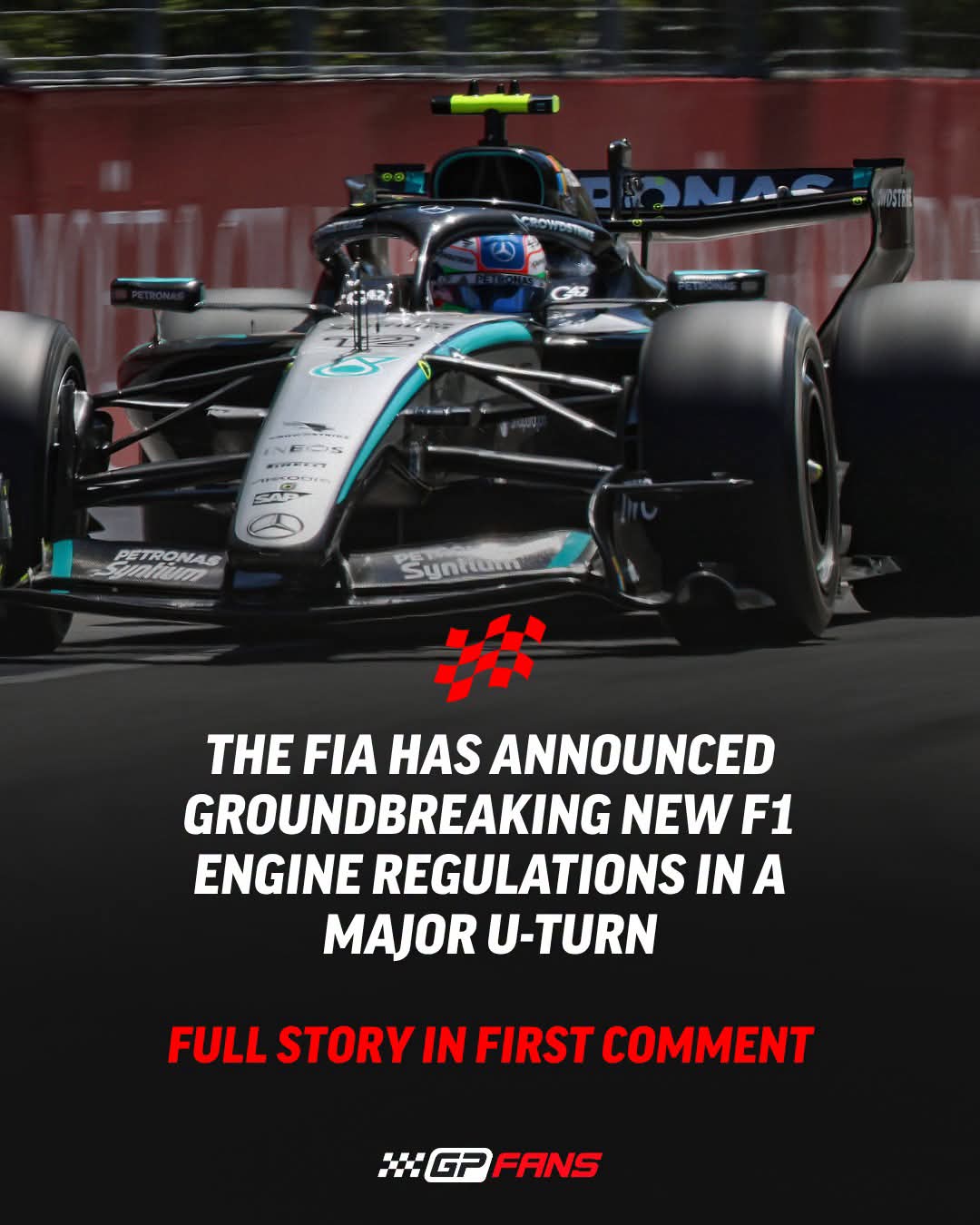
Formula 1’s new era is barely six races old, yet the FIA has already approved one of the most significant regulatory reversals in recent memory. Following growing concerns from drivers, teams, and manufacturers, the sport’s governing body has confirmed a revised engine roadmap that will gradually move Formula 1 away from the controversial power balance introduced for 2026.
The announcement represents a major shift in direction for the championship. While Formula 1 remains committed to sustainable hybrid technology, officials have acknowledged that the current approach requires refinement. The result is a phased plan that will increase the influence of the internal combustion engine while reducing some of the energy-management issues that have sparked criticism across the paddock.
For teams, drivers, and fans, this decision could have a profound impact on the future of racing.
WHY THE FIA DECIDED TO CHANGE COURSE
The 2026 regulations introduced the most dramatic power unit overhaul in years. Formula 1 adopted a near-even split between traditional engine power and electrical energy deployment, while also removing the MGU-H system that had been a key component of previous hybrid engines.
The objective was clear: create more sustainable racing, attract new manufacturers, and help Formula 1 reach its ambitious Net Zero 2030 target.
In many ways, the strategy worked. Audi entered the sport, Honda recommitted to Formula 1, and General Motors prepared for its future arrival. However, the racing consequences quickly became a major talking point.
Drivers repeatedly raised concerns about excessive energy management, lift-and-coast techniques, and the difficulty of pushing flat-out throughout a lap. Critics argued that the cars were becoming too dependent on battery conservation rather than pure racing performance.
Among the most vocal opponents was Max Verstappen, who famously compared the new machines to “Formula E on steroids” and questioned whether the regulations were delivering the kind of racing Formula 1 fans expect.
The FIA appears to have listened.
THE NEW ENGINE ROADMAP EXPLAINED
Instead of maintaining the current balance, Formula 1 will now gradually increase the contribution of the internal combustion engine over the next two seasons.
In 2026, the power split sits at approximately 53 percent combustion power and 47 percent electrical power.
That balance will shift in 2027 to 58/42 before reaching the FIA’s new target of 60/40 in 2028.
The changes are substantial.
Internal combustion engine output will increase from 400kW in 2026 to 420kW in 2027 and then to 450kW in 2028. Fuel flow allowances will also rise, providing additional performance potential.
Meanwhile, MGU-K output will drop from 350kW to 300kW beginning in 2027 and remain there through 2028.
Energy harvesting capabilities will continue to improve, but the overall package is designed to make drivers less dependent on battery management and more capable of attacking throughout qualifying laps and races.
WHY DRIVERS WILL WELCOME THE CHANGES
One of the biggest complaints about the current generation of cars has been the need to constantly manage electrical energy.
Drivers have often found themselves balancing speed against battery reserves, sometimes sacrificing outright pace to ensure enough power remains available later in the lap.
The revised regulations aim to reduce that problem.
By increasing combustion power and creating greater flexibility in energy deployment, drivers should have more freedom to push aggressively without constantly worrying about energy limitations.
This could make qualifying sessions particularly exciting.
The FIA specifically highlighted a desire to make qualifying laps more “flat-out,” something that many drivers and fans have been demanding since the new rules arrived.
For competitors like Verstappen, Lewis Hamilton, Charles Leclerc, and Fernando Alonso—drivers known for extracting maximum performance from a car—the changes could provide a more natural racing environment.
WHICH TEAMS STAND TO BENEFIT?
The competitive implications are enormous.
Engine manufacturers have already invested heavily in the current regulations, and any adjustment naturally creates winners and losers.
Mercedes, currently enjoying a dominant start to 2026 with Kimi Antonelli leading the championship, must now evaluate how these changes affect its long-term development plans. Any team that has mastered electrical efficiency may see some of its advantage reduced over time.
Meanwhile, manufacturers focused on traditional combustion performance could find themselves better positioned under the revised framework.
Red Bull, in particular, may feel encouraged by the FIA’s decision after publicly criticizing aspects of the current regulations. Ferrari and Honda will also be closely analyzing how the new balance affects future development opportunities.
The delayed introduction of the full 60/40 split until 2028 gives every manufacturer valuable time to adapt, reducing the risk of dramatic competitive disruption.
THE BIGGER PICTURE FOR FORMULA 1
This announcement sends an important message about Formula 1’s philosophy moving forward.
Rather than stubbornly sticking to a regulation package that faces widespread criticism, the FIA has demonstrated a willingness to evolve and respond to feedback.
That flexibility could prove vital as Formula 1 continues balancing sustainability goals with the need to deliver entertaining racing.
The sport’s leadership understands that technological innovation matters, but not at the expense of the on-track product. Fans want to see drivers attacking corners, fighting wheel-to-wheel, and pushing their cars to the limit—not constantly managing energy reserves.
The revised roadmap attempts to preserve the environmental objectives of the hybrid era while restoring some of the characteristics that made Formula 1 famous.
WHAT THIS MEANS FOR THE FUTURE
The regulation changes still require formal approval from the FIA World Motor Sport Council, but the direction now appears clear.
Formula 1 is not abandoning hybrid technology. Instead, it is recalibrating the balance between sustainability and performance.
The next two seasons could become a fascinating transition period as teams adapt to the evolving rules while continuing to chase championships.
For drivers, the promise of more aggressive, less restrictive racing will be welcomed. For manufacturers, the challenge of adapting to another technical shift begins immediately. And for fans, the prospect of faster, more attacking Formula 1 cars may be the most exciting outcome of all.
If the FIA’s gamble pays off, this could be remembered as the moment Formula 1 corrected course and ensured that the sport’s future remained both innovative and thrilling.