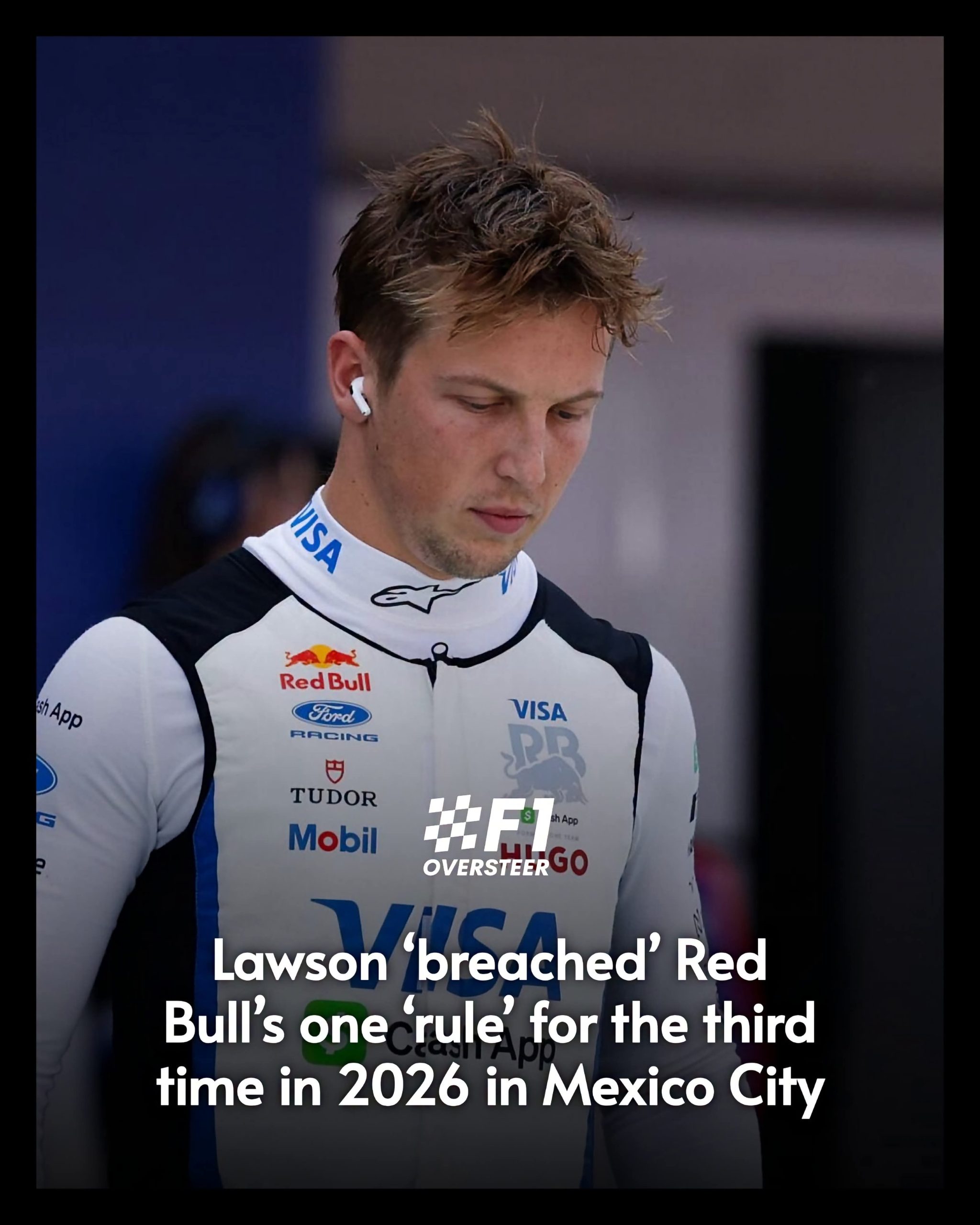
Liam Lawson’s future within the Red Bull family has come under renewed scrutiny following his controversial collision with Max Verstappen during practice at the 2026 Mexican Grand Prix. The incident reportedly marked the third time this season that the Racing Bulls driver has challenged Verstappen on track, reigniting allegations of an unwritten Red Bull rule that discourages its junior drivers from fighting the four-time world champion.
While both drivers received one-place grid penalties following their FP2 collision, the controversy extended beyond the stewards’ decision. Lawson reportedly attracted criticism from senior figures within Red Bull and Racing Bulls, with team management describing the incident as unacceptable. However, the circumstances surrounding the crash have also raised questions about whether Lawson was being unfairly blamed for refusing to surrender track position.
The New Zealander subsequently experienced another difficult moment during qualifying, where he was disqualified for failing to lift off the throttle immediately after his fastest Q2 lap. Despite starting the race from the pit lane following additional changes to his car, Lawson produced an impressive recovery to finish seventh.
His performance demonstrated that his determination to fight on track has not disappeared, even as uncertainty surrounding his future at Racing Bulls continues to grow.
LIAM LAWSON’S MEXICO INCIDENT WITH MAX VERSTAPPEN REIGNITES RED BULL CONTROVERSY
The collision between Lawson and Verstappen during FP2 became one of the most talked-about moments of the Mexican Grand Prix weekend.
The incident developed after the two drivers battled through Turn 12 and Turn 13. Lawson refused to surrender his position, while Verstappen attempted to continue the fight.
According to the supplied report, Verstappen subsequently rejoined the circuit in an unsafe manner after running over the inside kerb, resulting in contact with Lawson.
Both drivers received one-place grid penalties, but the decision did little to settle the disagreement over responsibility.
Verstappen reportedly urged Lawson to be smarter, particularly because the Racing Bulls driver is still fighting to establish his future in Formula 1.
That argument immediately attracted attention because Lawson is not simply competing against other drivers for positions. He is also attempting to demonstrate that he deserves a long-term place within the Red Bull organisation.
For a driver whose career depends heavily on performance and confidence, being told to avoid unnecessary battles with a rival can create a difficult dilemma.
Should Lawson protect himself and accept losing positions, or should he continue racing aggressively whenever an opportunity presents itself?
The Mexico incident has brought that question back into the spotlight.
RED BULL’S ALLEGED UNWRITTEN RULE AGAINST FIGHTING VERSTAPPEN
One of the most controversial claims surrounding Lawson’s incident is the suggestion that Red Bull has an unwritten rule discouraging its junior drivers from battling Verstappen.
The F1 Oversteer report, citing The Herald, describes the expectation as an open secret within the paddock.
According to that account, drivers within the Red Bull family are expected to avoid unnecessary battles with Verstappen, even when the Dutchman is responsible for creating a difficult situation on track.
It is important to distinguish between an alleged internal expectation and a confirmed team policy. There has been no publicly established formal Red Bull regulation presented in the supplied report that explicitly prohibits Lawson from racing Verstappen.
Nevertheless, the repeated incidents involving the two drivers have created a perception that Verstappen receives special treatment when competing against drivers connected to the same organisation.
That perception is particularly damaging because Formula 1 depends on the credibility of competition.
If drivers are expected to surrender positions simply because their opponent belongs to the parent team’s senior operation, questions about fairness become inevitable.
Lawson’s situation therefore represents more than an ordinary disagreement between two drivers. It has become a debate about whether Red Bull’s internal hierarchy influences how its drivers are expected to race.
MIAMI AND MALAYSIA INCIDENTS ADD TO LAWSON’S TROUBLES
Mexico was reportedly the third occasion in 2026 when Lawson challenged Verstappen in a situation that raised questions about the alleged unwritten rule.
The earlier incidents took place in Miami and Malaysia.
During the Miami Grand Prix, Lawson was reportedly ordered to yield track position to Verstappen despite the Dutchman having forced him off the road during their battle.
The decision raised questions about the reasoning behind the team orders, particularly because Lawson appeared to have earned his position through racing rather than receiving it through strategy.
The Malaysia Grand Prix provided another example of Lawson refusing to completely abandon his competitive instincts.
After making a stronger start, the Racing Bulls driver challenged Verstappen and appeared to have an opportunity to overtake him into Turn 4.
Lawson ultimately exercised caution, allowing Verstappen to retain his position before the Red Bull driver went on to win.
These incidents have created an uncomfortable pattern.
Lawson appears willing to compete aggressively when opportunities arise, but the consequences of challenging Verstappen could be considerably more complicated than an ordinary on-track battle.
For the young driver, every decision carries implications for his reputation, his relationship with Red Bull and his prospects of remaining in Formula 1.
RED BULL AND RACING BULLS MANAGEMENT WERE UNHAPPY WITH THE MEXICO COLLISION
The Mexican Grand Prix incident reportedly attracted criticism from both Red Bull and Racing Bulls management.
Laurent Mekies and Alan Permane were described as considering the collision unacceptable, with responsibility reportedly attributed to both drivers.
That response is significant because it demonstrates that the disagreement was not simply about Verstappen blaming Lawson.
Both organisations have an interest in protecting their drivers while ensuring that unnecessary incidents do not damage their competitive objectives.
However, the criticism also creates a difficult situation for Lawson.
The Racing Bulls driver must demonstrate that he can compete aggressively without becoming involved in incidents that attract unnecessary attention from senior management.
At the same time, he cannot afford to become excessively cautious and surrender opportunities to improve his results.
Formula 1 drivers are evaluated on their ability to deliver performances under pressure. If Lawson consistently avoids challenging established competitors, he risks undermining the very qualities that helped him establish himself in the championship.
The challenge is finding the correct balance between aggression and judgement.
LAWSON’S QUALIFYING DISQUALIFICATION MADE HIS MEXICO WEEKEND EVEN MORE DIFFICULT
The FP2 collision was not the only setback Lawson experienced in Mexico.
The Racing Bulls driver was subsequently disqualified from qualifying after failing to lift off the throttle immediately following his fastest Q2 lap.
The decision meant that his qualifying performance could not stand, forcing him into another difficult position ahead of the race.
Additional engine and suspension changes made under parc fermé conditions also contributed to his pit lane start.
For a driver already dealing with controversy surrounding his relationship with Verstappen, the qualifying disqualification represented another major obstacle.
However, Lawson’s response during the race was impressive.
Starting from the pit lane, he recovered through the field to finish seventh, demonstrating that his pace and determination remained intact despite the difficult circumstances.
That result could prove particularly important when Racing Bulls evaluates its drivers and considers the direction of its future line-up.
It also provides Lawson with a reminder that his strongest argument for remaining in Formula 1 is still his performance behind the wheel.
NIKOLA TSOLOV’S FP1 APPEARANCE ADDED ANOTHER LAYER TO LAWSON’S FUTURE
Lawson’s position at Racing Bulls has also attracted attention because Nikola Tsolov drove his car during FP1 in Mexico.
The Bulgarian teenager made his Formula 1 weekend debut as Racing Bulls fulfilled part of its rookie-session obligations.
According to the supplied report, the team was pleased with Tsolov’s work and believed he had completed the necessary objectives.
His appearance inevitably generated speculation about the future of Lawson’s seat.
However, participating in an FP1 session does not automatically mean a driver is being prepared to replace an existing race driver.
Teams regularly use rookie sessions to evaluate young talent, fulfil regulatory requirements and gather information about potential future prospects.
Nevertheless, when a race driver’s future is already under scrutiny, even routine development activities can become part of a wider conversation.
Lawson therefore faces a situation in which his own performances, his relationship with Verstappen and Racing Bulls’ future planning are all attracting attention simultaneously.
SHOULD LIAM LAWSON BE PENALISED FOR RACING MAX VERSTAPPEN?
This is where the Mexico controversy becomes particularly interesting.
Lawson is a Formula 1 driver competing for championship positions. His responsibility is to race fairly, respect the regulations and avoid dangerous manoeuvres.
If he believes he has a legitimate opportunity to defend or gain a position, refusing to surrender automatically should not be considered an offence.
The same principle should apply to Verstappen.
A driver should not receive preferential treatment simply because he is the leading figure within a particular organisation.
If Red Bull genuinely expects Lawson to avoid battling Verstappen, the team should be transparent about its expectations rather than allowing an alleged unwritten rule to influence competition.
However, Lawson must also recognise that racing aggressively against a driver who represents the parent team’s championship ambitions can carry consequences beyond the immediate result.
The key question is whether those consequences are justified by legitimate sporting considerations or whether they represent an unfair hierarchy within the organisation.
The Mexico incident has not definitively answered that question.
But it has made the debate considerably harder to ignore.
LAWSON’S FUTURE AT RACING BULLS COULD DEPEND ON HOW HE RESPONDS
The most important issue emerging from Mexico is what happens next.
Lawson has demonstrated that he can recover from difficult circumstances and produce strong race results. His seventh-place finish in Mexico is evidence that he remains capable of delivering valuable performances.
However, the repeated controversies involving Verstappen could complicate his relationship with the Red Bull organisation.
If management believes Lawson is becoming involved in unnecessary incidents, it could place greater pressure on him to demonstrate maturity and consistency.
If Lawson believes he is being unfairly restricted, he may feel compelled to continue defending his positions aggressively.
Neither situation is particularly comfortable for a driver whose future depends on maintaining the confidence of his team.
The strongest path forward would involve clear communication between Lawson and Racing Bulls, ensuring that expectations about racing conduct are understood and that legitimate competition is not unnecessarily restricted.
THE VERDICT: RED BULL MUST CLARIFY ITS EXPECTATIONS
Liam Lawson’s Mexico collision with Max Verstappen has become another flashpoint in the debate surrounding Red Bull’s internal driver hierarchy.
The allegation that Lawson breached an unwritten rule for the third time this season remains a claim reported by F1 Oversteer and attributed to The Herald, rather than a confirmed formal policy.
Nevertheless, the repeated incidents in Miami, Malaysia and Mexico have created a perception that Lawson faces unusual expectations whenever he competes against Verstappen.
That perception deserves attention.
Formula 1 cannot reasonably expect drivers to race aggressively against everyone else while automatically treating a teammate or affiliated driver differently without clear sporting justification.
Lawson must take responsibility for his own decisions, but Red Bull also has a responsibility to ensure its expectations are fair and transparent.
His seventh-place finish in Mexico demonstrated that he still has the ability to deliver strong results despite the controversy.
Whether that performance is enough to secure his future remains uncertain.
One thing, however, is becoming increasingly clear: Lawson’s willingness to fight Verstappen has turned an ordinary practice collision into a much bigger debate about fairness, team orders and the future of Red Bull’s driver hierarchy.