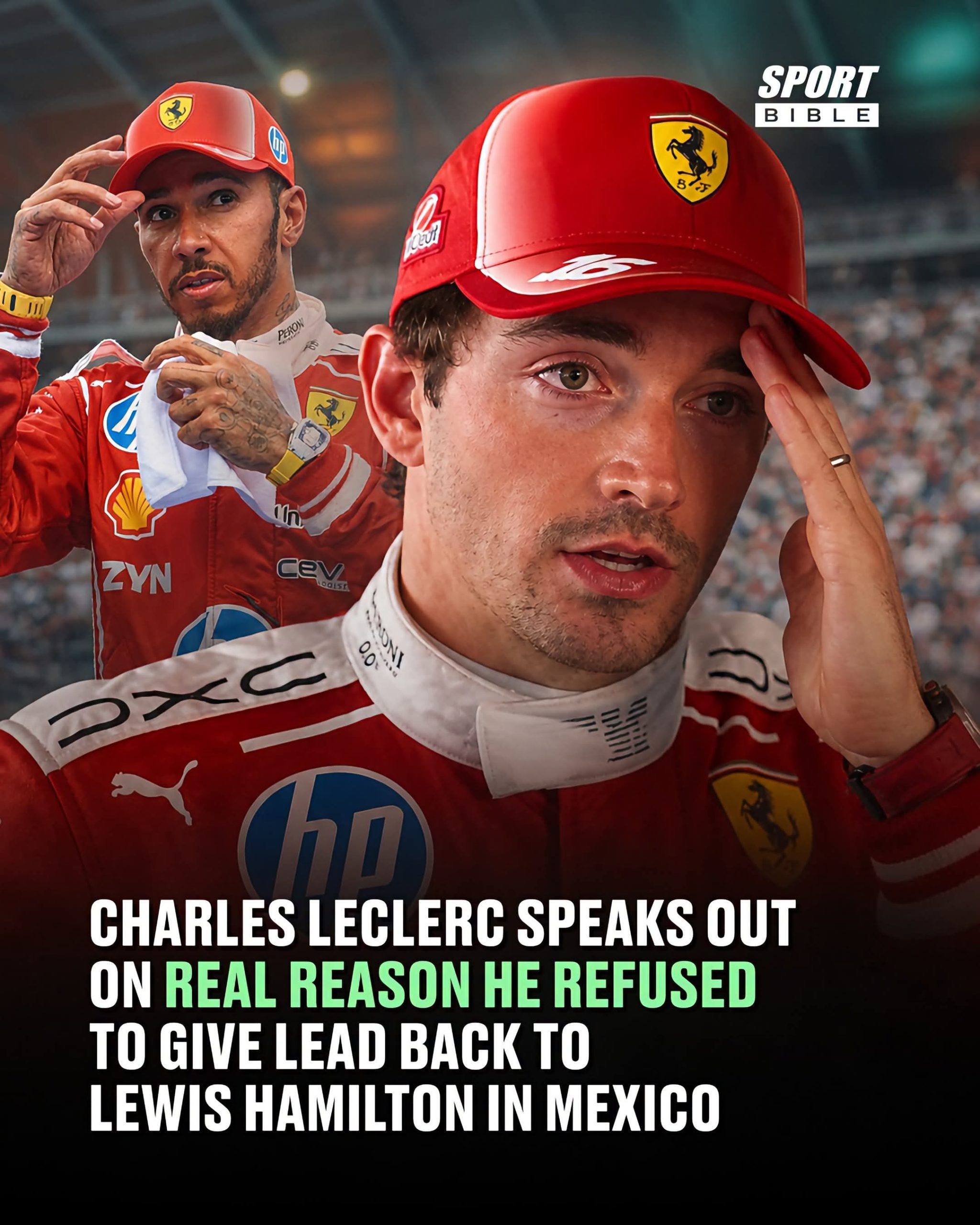
Charles Leclerc has finally explained why he refused to surrender his position to Lewis Hamilton following their controversial opening-lap battle at the 2026 Mexican Grand Prix. The Ferrari teammates became involved in a tense fight at Turn 1 and Turn 4, with the incident eventually triggering a five-second penalty for the Monegasque driver. However, Leclerc’s latest explanation suggests that the presence of Max Verstappen and confusion over Ferrari’s instructions played a major role in his decision to keep the position.
Hamilton was furious after the incident, believing his teammate had compromised Ferrari’s opportunity to secure a one-two finish. His frustration was evident over team radio when he complained: “Got pushed out by my own teammate.” Verstappen subsequently capitalised on the situation to take victory, while Hamilton finished second and Leclerc crossed the line in fourth after his penalty.
VERSTAPPEN’S POSITION CHANGED EVERYTHING FOR LECLERC
Leclerc explained that he saw an opportunity to challenge Hamilton around the outside at Turn 1. He believed he had sufficient speed to make the move, but the limited space approaching Turn 2 made the battle increasingly difficult.
Both Ferrari drivers braked late and failed to negotiate the corner properly. Leclerc cut the track, but the situation became even more complicated when Verstappen managed to get between the two Ferraris.
The Monegasque explained that Verstappen’s presence made it difficult to determine exactly which position he was supposed to surrender.
“Then Lewis and I both tried to brake very late. We both didn’t make the corner; I obviously cut the track, which, eventually, after Turn 5, there was Max in between, which made the situation more confusing,” Leclerc said.
That detail is important because Leclerc was not simply deciding whether to give Hamilton a position. He was also trying to understand where he would fit into the running order after Verstappen had moved ahead.
FERRARI’S INSTRUCTIONS LEFT LECLERC WITHOUT A CLEAR ANSWER
Leclerc also admitted that communication with Ferrari was not particularly clear during the incident. He said he contacted the team because he wanted to understand what action was expected of him.
“I asked, ‘What shall I do now?'” he explained.
According to Leclerc, the situation created uncertainty over whether he should surrender second place, third place or another position. He eventually decided to continue without giving Hamilton the position back.
He admitted that the matter would need further discussion during Ferrari’s next driver briefing, suggesting that the team had not established sufficiently clear procedures for handling such situations.
This is where Ferrari’s internal management comes under serious scrutiny. When two teammates are fighting for the lead, the team must be prepared to make quick decisions. Leaving drivers to interpret complicated racing situations without clear instructions can create exactly the kind of controversy witnessed in Mexico.
HAMILTON BELIEVES LECLERC COST FERRARI A POSSIBLE ONE-TWO
Hamilton’s interpretation of the incident was considerably more critical. The seven-time world champion accused Leclerc of “working against” him and argued that Ferrari had thrown away an opportunity to secure a major result.
Hamilton believes the difference between fighting for fourth and fifth and battling for first and second is enormous. In his view, teammates must understand when individual competition threatens the team’s overall result.
He also referred to previous battles between Leclerc and Carlos Sainz, arguing that their rivalry sometimes allowed competitors ahead to escape while the Ferrari drivers fought among themselves.
Hamilton suggested that Leclerc’s approach was more about individual victory than collective success.
“The guy’s 28 years old, so I don’t think it’s an age thing. I think it’s a mentality thing. It’s like ‘do or die. Like either I win or none of us do’, and it shouldn’t be that,” Hamilton said.
He further compared the Mexico incident with Silverstone, claiming he could have taken a more aggressive approach against Leclerc but chose to protect the team result instead.
For Hamilton, the central issue is not whether teammates should be allowed to race. It is whether they can compete without damaging Ferrari’s championship ambitions.
FRED VASSEUR’S ANGER SHOWS HOW SERIOUS THE SITUATION HAS BECOME
Ferrari team principal Fred Vasseur has also made it clear that he was unhappy with what happened. The Frenchman criticised both drivers, accusing them of showing a lack of respect for the Ferrari brand, the workforce and the effort invested in improving the car.
“I’m struggling to swallow it because, honestly, I think it’s a lack of respect, a lack of respect for the brand, a lack of respect for all the people working here and for the efforts we’re putting in,” Vasseur said.
His comments suggest that Ferrari considers the incident more than an ordinary racing disagreement. The team has made progress in performance, but its leadership believes the opportunity to convert that progress into a major result was wasted.
Vasseur’s challenge now is to ensure that the next disagreement does not produce another costly outcome. Ferrari needs clear rules about how its drivers should handle opening-lap battles, particularly when both cars are fighting for victory.
BRAZIL GRAND PRIX COULD REVEAL WHETHER FERRARI HAS LEARNED ITS LESSON
The championship situation makes the Ferrari dispute even more significant. Antonelli leads the standings with 380 points, followed by Verstappen on 261 and Hamilton on 259. Leclerc is fifth with 245 points, meaning both Ferrari drivers still have important individual objectives.
The Brazilian Grand Prix on November 8 will be the first opportunity for Ferrari to demonstrate that the Mexico controversy has not damaged its internal relationship.
Leclerc’s explanation offers some context, particularly regarding Verstappen’s position and the lack of clear communication from the team. However, it does not completely remove the responsibility to manage an advantage gained by leaving the track.
Ferrari cannot afford to let its drivers repeatedly turn promising race situations into internal battles. Hamilton wants the team to come first, while Leclerc clearly believes he had reasons to maintain his position in Mexico.
Ultimately, the responsibility now falls on Vasseur and Ferrari’s leadership. They must establish clear instructions before the next race rather than waiting for another controversial incident to expose the same weaknesses.
Ferrari has two highly competitive drivers, but having two fast cars means very little if their battles repeatedly hand victories to their rivals.