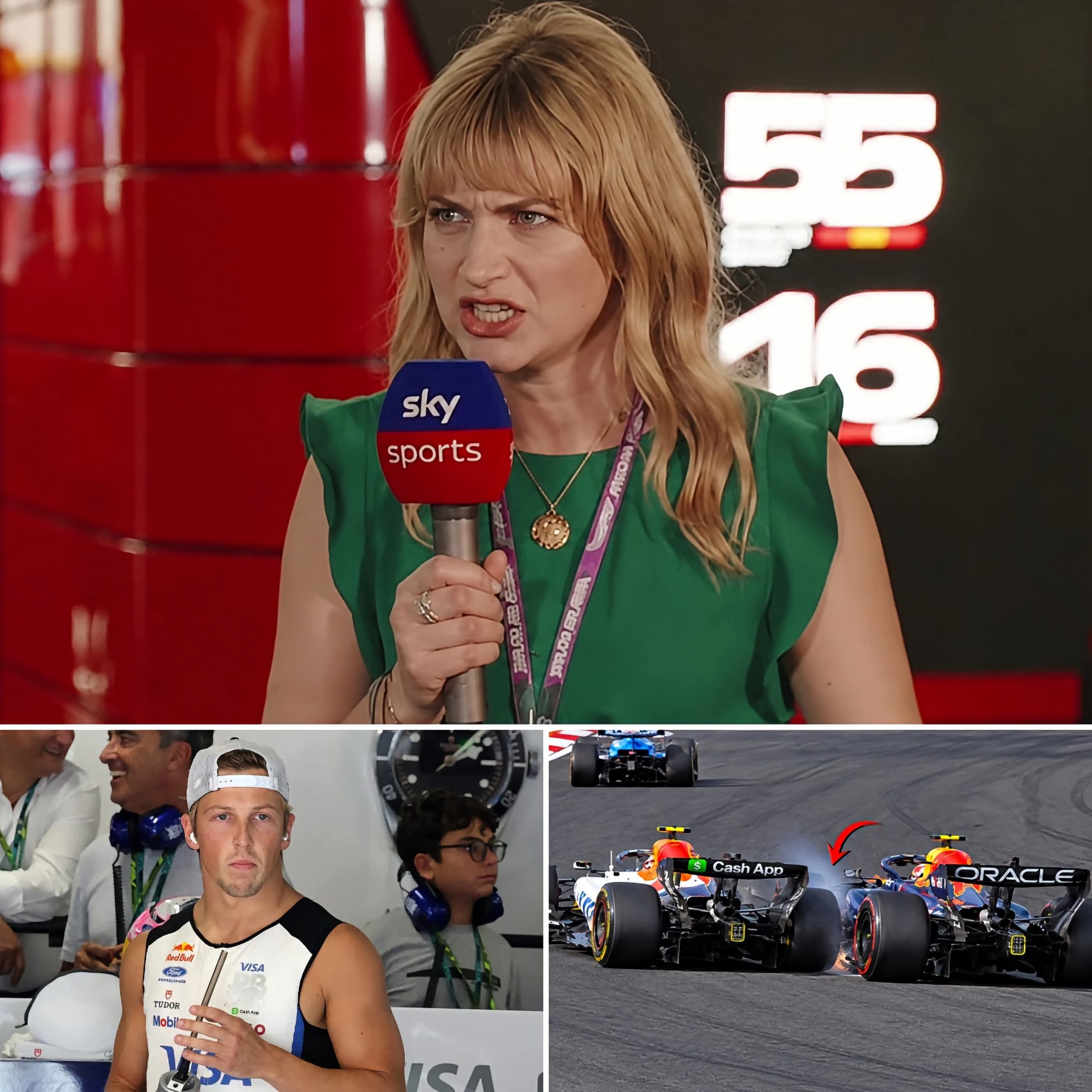
Max Verstappen’s controversial collision with Liam Lawson at the Mexican Grand Prix has sparked another heated Formula 1 debate, with Sky Sports analyst Bernie Collins challenging the attitude surrounding the incident. The former Aston Martin strategy engineer’s criticism has reignited an important discussion about whether established champions sometimes expect younger drivers to give them preferential treatment on track.
The clash between Verstappen and Lawson during Friday’s second practice session attracted considerable attention after the two drivers made contact while fighting for position. Both received one-place grid penalties, an unusual decision that Verstappen openly questioned. But beyond the FIA’s punishment, the incident exposed the pressure experienced by younger drivers competing against established stars, particularly those operating within the same Red Bull driver programme.
BERNIE COLLINS CHALLENGES THE IDEA THAT VERSTAPPEN OWNS THE TRACK
Collins’ analysis focused on an important principle of Formula 1: championship success does not give any driver automatic priority over everyone else on the circuit.
Verstappen is one of the most successful and aggressive competitors of his generation, but his reputation cannot mean other drivers must automatically surrender their position whenever they encounter him. Every competitor has a responsibility to understand the situation around them, judge available space and avoid unnecessary contact.
That is particularly important during practice sessions, when teams are collecting valuable information about tyre behaviour, fuel loads and car performance. Aggressive driving may be part of Formula 1, but unnecessary confrontations can compromise an entire team’s preparation.
The criticism also raises a broader question about how drivers communicate frustration. A world champion’s comments can attract enormous attention, potentially placing additional pressure on a younger competitor who is already fighting to establish himself.
LIAM LAWSON SHOULD NOT HAVE TO BACK DOWN BECAUSE OF VERSTAPPEN’S STATUS
Lawson’s position makes this controversy particularly interesting. The New Zealander has experienced considerable pressure within the Red Bull system, where every performance and public incident can influence discussions about his future.
Standing his ground against Verstappen is not automatically evidence of poor judgement. Equally, being a younger driver does not mean he should be excused from responsibility when an incident occurs.
The important distinction is that both competitors must be judged by the same standards. Lawson should not receive special treatment because he is fighting for his career, but Verstappen should not receive preferential treatment because he is a multiple world champion.
Formula 1 needs that balance if it wants younger drivers to compete confidently without feeling that challenging established names carries consequences beyond the sporting regulations.
THE RED BULL DRIVER RELATIONSHIP MAKES THE INCIDENT EVEN MORE COMPLICATED
There is another dimension to this controversy: Verstappen and Lawson are connected through the wider Red Bull organisation.
Drivers competing for the same company’s support often face complicated professional relationships. They are rivals on the circuit, but their performances can also influence decisions made by the same management structure.
For Lawson, that creates an uncomfortable environment. He must demonstrate that he can compete against established drivers while remaining aware that his future may depend on decisions made by Red Bull executives.
The Mexico collision therefore became more than an ordinary practice incident. It placed the relationship between an established champion and a driver still trying to secure his long-term position under the spotlight.
FIA STEWARDS MUST APPLY THE SAME STANDARD TO EVERY DRIVER
The decision to penalise both Verstappen and Lawson by one grid position has generated additional debate because the stewards acknowledged that incidents of this nature would normally receive a warning.
Their explanation indicated that they wanted to make an example after similar driving behaviour had previously been discussed with team managers.
That approach raises an important responsibility for the FIA. If it intends to discourage unnecessary contact during practice, it must apply the same principles consistently across the grid.
Drivers should understand what behaviour is acceptable and what consequences follow when they cross the line. Championship standings, popularity and reputation must never determine how regulations are enforced.
Verstappen’s criticism of the decision may reflect his frustration, but the governing body also has to demonstrate that its decisions are based on clearly explained standards rather than individual personalities.
MEXICO’S DIFFICULT CONDITIONS MAKE DRIVER JUDGEMENT EVEN MORE IMPORTANT
The Autódromo Hermanos Rodríguez presents unusual challenges because of its position more than 2,200 metres above sea level. The thinner air affects aerodynamic performance, cooling and braking, while reduced downforce can make the cars feel less predictable.
These conditions make close encounters particularly demanding. Drivers have to manage their braking points, tyre temperatures and positioning carefully, especially when dealing with traffic during practice.
That does not mean every collision can be blamed on the circuit. It does, however, underline why patience and awareness are essential when two cars approach the same section of track.
VERSTAPPEN’S CHAMPION STATUS DOES NOT PUT HIM ABOVE CRITICISM
Verstappen’s achievements are undeniable, and his aggressive approach has helped establish him as one of Formula 1’s defining competitors. But being a champion also means accepting scrutiny when decisions or behaviour attract criticism.
Lawson is entitled to compete, defend his position and demonstrate his abilities. He should not have to approach every encounter with Verstappen as though the world champion automatically has the right to dictate where everyone else drives.
The strongest drivers are not simply those who can intimidate rivals. They are those who understand when to attack, when to defend and when a situation requires restraint.
The Mexico incident has exposed a debate that Formula 1 cannot ignore: young drivers must be allowed to challenge established stars, but every competitor must remain accountable for their actions. Verstappen’s reputation should command respect, not immunity from criticism.