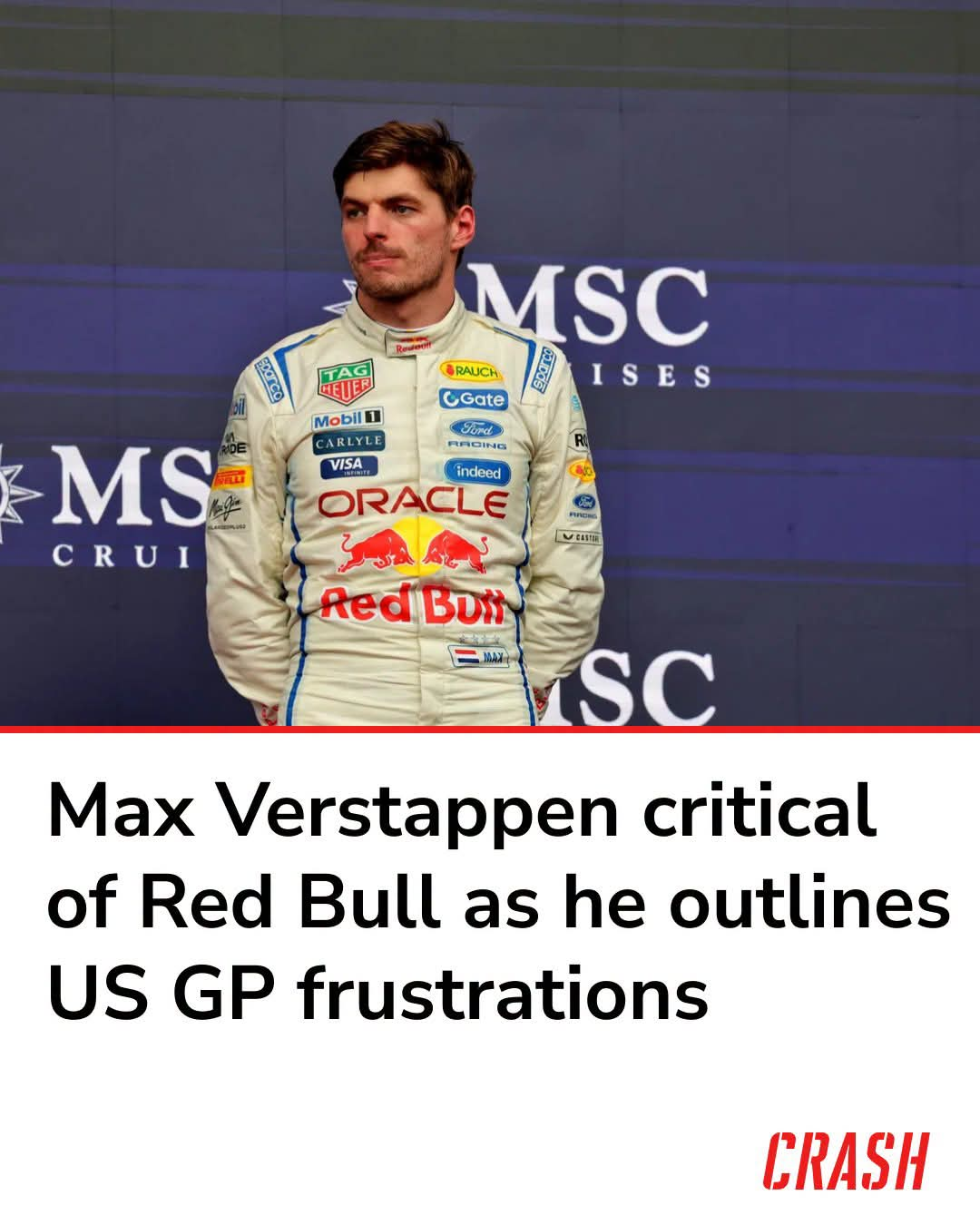
Max Verstappen has delivered a blunt assessment of Red Bull Racing after a frustrating United States Grand Prix, revealing that tyre strategy mistakes, inconsistent power-unit behaviour and a slow pit stop prevented him from extracting the maximum performance from his car in Austin.
The four-time world champion finished third at the Circuit of the Americas after battling Ferrari’s Charles Leclerc for second place, but the podium result did little to hide his disappointment. Verstappen had looked capable of challenging for victory at certain stages of the race, yet Andrea Kimi Antonelli proved difficult to catch as Mercedes secured another major result.
The outcome was particularly frustrating for Verstappen because he arrived in the United States following dominant victories in Malaysia and Singapore. Those results had raised expectations that Red Bull could continue its momentum, but Austin exposed weaknesses that the team will need to address if it hopes to maintain its challenge in the remaining races.
MAX VERSTAPPEN QUESTIONS RED BULL’S TYRE STRATEGY
One of Verstappen’s biggest frustrations centred on Red Bull’s decision to commit to an aggressive two-stop strategy. The team stopped him early and relied on a tyre sequence that ultimately failed to deliver the expected advantage.
Verstappen suggested that Red Bull misjudged the performance of the softer compounds, which did not provide the grip or pace the team had anticipated. Meanwhile, drivers using harder tyres appeared to find stronger performance as the race developed.
“Pretty frustrating, to be honest. Just not a really good race for us,” Verstappen explained after the Grand Prix.
He also acknowledged that hindsight makes strategic decisions easier to criticise, but argued that Red Bull should have responded more effectively when it became apparent that the harder compounds were performing well.
The Dutchman believed the team remained too committed to its assumptions from previous races, where softer tyres had proved effective. That approach left Red Bull struggling to adapt when the circumstances in Austin demanded a different response.
For a team fighting for championship positions, tyre strategy can make the difference between securing a podium and challenging for victory. Verstappen’s comments suggest that Red Bull will need to examine its pre-race predictions, tyre data and decision-making process to understand why its calculations did not produce the expected result.
POWER UNIT INCONSISTENCY LEFT VERSTAPPEN WITHOUT RHYTHM
The strategy problems were not Verstappen’s only concern. He also revealed that inconsistent behaviour from the power unit affected his ability to drive the car confidently through the corners.
According to the Red Bull driver, the car behaved differently from one corner to another, making it difficult to establish a consistent rhythm. Such unpredictability can be especially damaging for a driver who relies on precise braking, throttle application and confidence when pushing the limits.
“Every lap, every corner, different behaviour,” Verstappen said when describing the problem.
He explained that the inconsistency prevented him from building the rhythm required to extract the maximum performance from the car. When a driver cannot reliably predict how the car will respond, it becomes harder to attack corners consistently and manage the tyres effectively.
The issue also complicates race strategy. Even a theoretically competitive tyre choice can lose its advantage if the driver cannot use the available grip consistently or deploy the car’s performance as expected.
Verstappen made clear that Red Bull must investigate the problem rather than treat the result as a simple case of choosing the wrong tyres.
SLOW PIT STOP ADDS TO RED BULL’S FRUSTRATION
Red Bull also lost valuable time during a slow pit stop, another problem Verstappen believes hurt his battle with Leclerc.
In a close fight for position, every second matters. A slow stop can leave a driver vulnerable to an undercut, force them to fight through traffic or reduce the time available to catch a rival later in the race.
Verstappen acknowledged that Red Bull is usually strong in this area, making the mistake particularly disappointing.
“It’s just seconds that you throw away, right? When you’re fighting a close battle for second, it hurts your performance,” he said.
The pit-stop issue was especially costly because Verstappen was already dealing with tyre performance concerns and inconsistent power delivery. The combination of several smaller problems left him unable to execute the race as effectively as he had hoped.
Although the team still secured a podium, Verstappen’s assessment made it clear that Red Bull did not maximise its opportunities in Austin.
VERSTAPPEN ADMITS RED BULL IS NOT THE FASTEST IN ANY CORNERING AREA
Perhaps the most revealing part of Verstappen’s post-race comments concerned Red Bull’s underlying performance compared with its rivals.
The Dutchman suggested that the team was neither the fastest through high-speed corners nor the strongest in low-speed sections. At a circuit where different combinations of corners demand different aerodynamic and mechanical characteristics, that lack of a clear advantage can leave a car vulnerable.
“We are not the fastest in high-speed, we’re not the fastest in low-speed,” Verstappen explained.
His assessment highlights a potential problem that cannot necessarily be solved through strategy alone. A team may recover time through tyre management, pit-stop execution and race decisions, but sustained competitiveness also depends on the car’s fundamental performance.
Verstappen suggested that Red Bull was somewhat average in Austin, rather than dominant in a particular area. He conceded that a different tyre choice might have helped him finish second, but acknowledged that such conclusions are easier to make after the race.
The broader concern is whether Red Bull can develop a more balanced package capable of competing across different circuit layouts. If the car lacks a strong point in either high-speed or low-speed corners, its opportunities to challenge Mercedes and Ferrari could remain limited.
RED BULL MUST LEARN FROM AUSTIN BEFORE THE MEXICAN GRAND PRIX
Despite his frustration, Verstappen’s comments were not simply a rejection of Red Bull’s performance. He identified several specific areas for investigation, including tyre selection, power-unit consistency and pit-stop execution.
That gives the team a clear set of priorities ahead of the next round in Mexico City. Red Bull will need to assess whether the Austin problems were caused by circuit-specific circumstances or whether they exposed weaknesses that could affect its performance elsewhere.
The Mexican circuit presents a different set of challenges, including its altitude and the resulting demands on engine performance, cooling and aerodynamic efficiency. The team will therefore need to establish which lessons from Austin can be applied directly and which require a different technical approach.
With the championship battle continuing, Red Bull cannot afford to rely on previous victories as evidence that its problems will resolve themselves. Verstappen’s success in Malaysia and Singapore showed the team’s potential, but Austin demonstrated how quickly the competitive picture can change when several issues emerge together.
A PODIUM WAS NOT ENOUGH FOR MAX VERSTAPPEN
Verstappen’s third-place finish provided valuable points, but his post-race assessment revealed a driver who believes Red Bull left too much performance unused.
The tyre strategy did not deliver the expected result, the power unit failed to provide consistent behaviour and a slow pit stop cost precious time in the fight with Leclerc. Together, those problems prevented the Dutchman from mounting a stronger challenge.
For Red Bull, the message is straightforward: the team must analyse the details rather than focus solely on the podium. Fixing the inconsistencies and improving strategic flexibility could be crucial to its prospects in the remaining rounds.
Verstappen has already demonstrated that he can win when the package works in his favour. The challenge now is ensuring that Red Bull gives him a car and race strategy capable of delivering that performance more consistently.