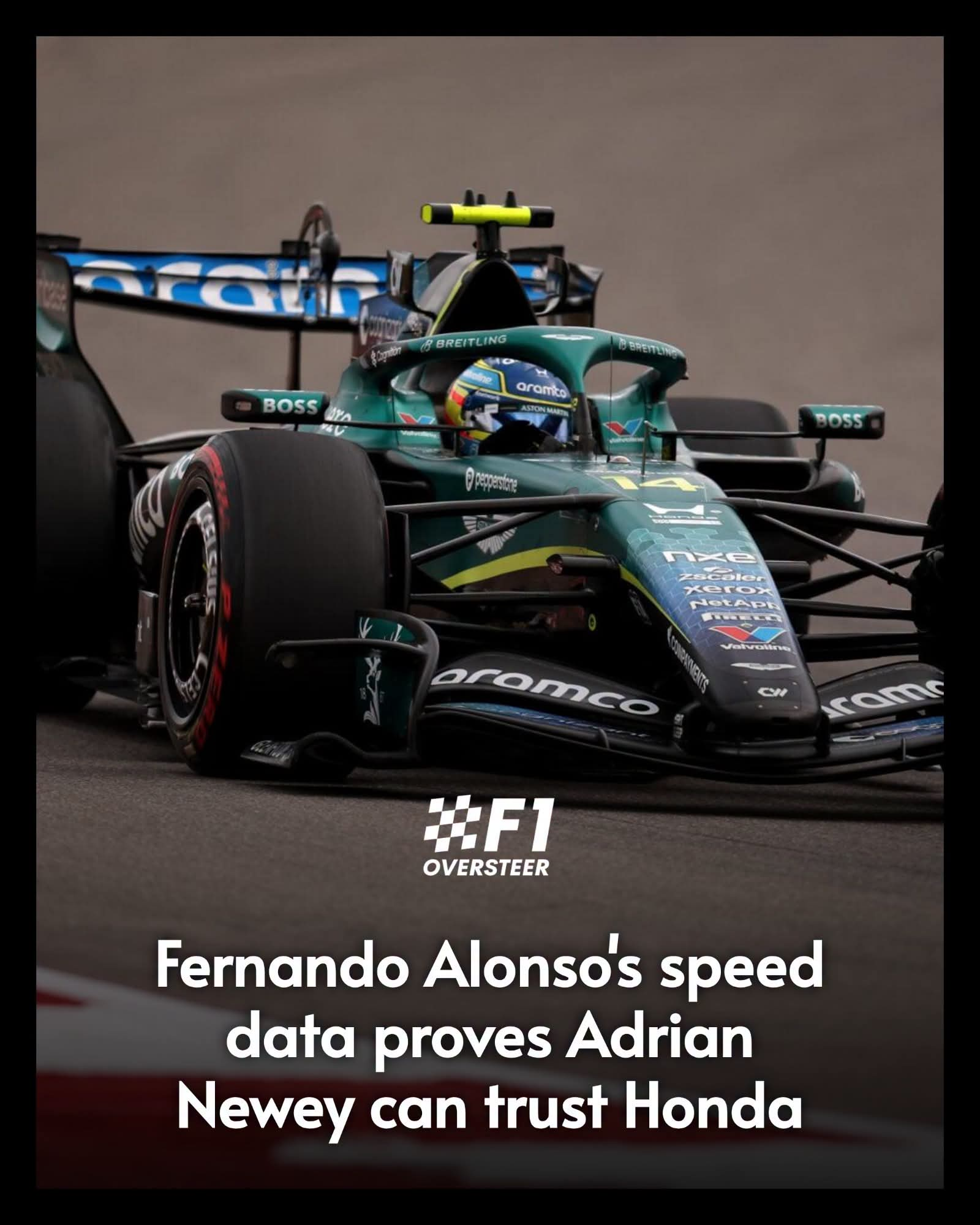
Fernando Alonso may have finished 16th at the United States Grand Prix, but his top speed at the Circuit of the Americas has provided an encouraging talking point for Aston Martin and Honda. The Spaniard reportedly reached 351 km/h in Austin, matching the highest recorded speed of the weekend and offering a potential sign that the team’s power-unit performance is not as far behind its rivals as some criticism has suggested.
The result comes at an important time for Aston Martin. The team is working to improve its competitiveness, while technical chief Adrian Newey and two-time world champion Alonso have previously raised concerns about the performance of Honda’s power unit. Although one race cannot settle questions about engine performance, Alonso’s speed in Austin gives the team a positive data point to examine as it prepares for the challenges ahead.
FERNANDO ALONSO MATCHES THE FASTEST SPEED IN AUSTIN
According to figures highlighted by F1BigData, Alonso recorded a top speed of 351 km/h during the United States Grand Prix weekend. George Russell, Arvid Lindblad and Franco Colapinto reportedly matched that figure, putting the Aston Martin driver alongside competitors using different power-unit packages.
Alonso’s teammate, Lance Stroll, also recorded a competitive top speed of 346 km/h. That figure adds another encouraging detail for Aston Martin, although top speed alone cannot establish how competitive a car is across an entire circuit.
Straight-line speed depends on several factors, including engine output, aerodynamic drag, rear-wing configuration, energy deployment and the conditions in which the speed is measured. A car with lower drag can achieve a strong maximum speed without necessarily having the best overall power unit.
Nevertheless, Alonso’s 351 km/h figure provides a reason for Aston Martin to investigate what worked well in Austin and whether the same characteristics can be reproduced at other circuits.
WHY ADRIAN NEWEY WILL BE WATCHING HONDA CLOSELY
Newey’s arrival at Aston Martin raised expectations that the team could build a more competitive package around its technical resources. However, even an exceptionally designed chassis cannot compensate for every weakness if the power unit, energy deployment or overall car balance falls short.
Honda’s partnership with Aston Martin is therefore a major part of the team’s longer-term ambitions. The manufacturer must deliver an engine package that combines competitive power with efficiency, reliability and effective integration into the car.
Alonso has previously highlighted concerns about the power deficit Aston Martin faces against rivals. Newey has also questioned aspects of Honda’s experience and preparations, making the relationship between the team and its engine supplier an important storyline.
The Austin speed figures offer some encouragement, but they should not be interpreted as proof that every concern has been resolved. To judge Honda’s progress properly, Aston Martin will need to assess acceleration, speed-trap data across multiple circuits, energy deployment and performance over a complete race distance.
ALONSO’S 16TH-PLACE FINISH DOES NOT TELL THE FULL STORY
Alonso’s final position in Austin was disappointing, particularly given his experience and the team’s desire to move further up the field. However, the race result was affected by significant damage to his Aston Martin following contact with Alex Albon.
That incident complicates any attempt to judge the car’s underlying pace using the finishing position alone. Damage can affect aerodynamic performance, tyre behaviour and the driver’s ability to attack or defend, meaning the final result may not accurately represent the car’s potential before the incident.
Alonso nevertheless demonstrated his trademark determination, continuing to fight despite the difficult circumstances. At 45, the Spaniard remains one of the most experienced drivers on the grid, and his technical feedback will be valuable as Aston Martin evaluates its performance.
For the team, the challenge is to turn isolated positive signs into consistent results. A competitive speed-trap reading is useful, but Aston Martin ultimately needs stronger qualifying performances, better race pace and fewer weekends in which damage or other setbacks undermine its chances.
HONDA’S 2027 TARGETS COULD BE CRUCIAL
Honda’s future development programme will be central to Aston Martin’s hopes of closing the gap to the front of Formula 1. The report points to an ambitious target of increasing power by around 50 horsepower for 2027, a figure that would represent a significant development goal if achieved.
However, that target should be treated as a reported objective rather than a guaranteed improvement. Engine development involves complex compromises between performance, reliability, efficiency and the wider technical regulations. Any gains must also work effectively with the chassis and the car’s energy-management systems.
If Honda can deliver meaningful improvements while Aston Martin develops its aerodynamic package, the team could have a stronger foundation for the next stage of its project. Newey’s technical expertise may help maximise the overall package, but the power unit must still deliver the performance required to compete consistently.
The key question is whether Honda can translate its targets into measurable gains on the track.
ONE PROMISING FIGURE, BUT ASTON MARTIN NEEDS MORE PROOF
Alonso’s reported 351 km/h top speed is an encouraging detail from a weekend in which his 16th-place finish might otherwise dominate the discussion. Matching the fastest recorded speed suggests Aston Martin was capable of producing competitive straight-line performance under the conditions in Austin.
Yet maximum speed is only one part of Formula 1 performance. Lap time depends on braking, cornering, traction, tyre management, aerodynamic efficiency and the ability to deploy power effectively throughout a lap.
For Newey and Honda, the real test will be consistency. If Aston Martin can repeatedly demonstrate competitive speeds while improving its performance through corners and over race distances, confidence in the partnership could grow.
Alonso’s Austin data point gives the team something positive to build on. Whether it signals a genuine turning point for Honda, however, will only become clear when Aston Martin demonstrates similar progress across more races and prepares for its 2027 ambitions.