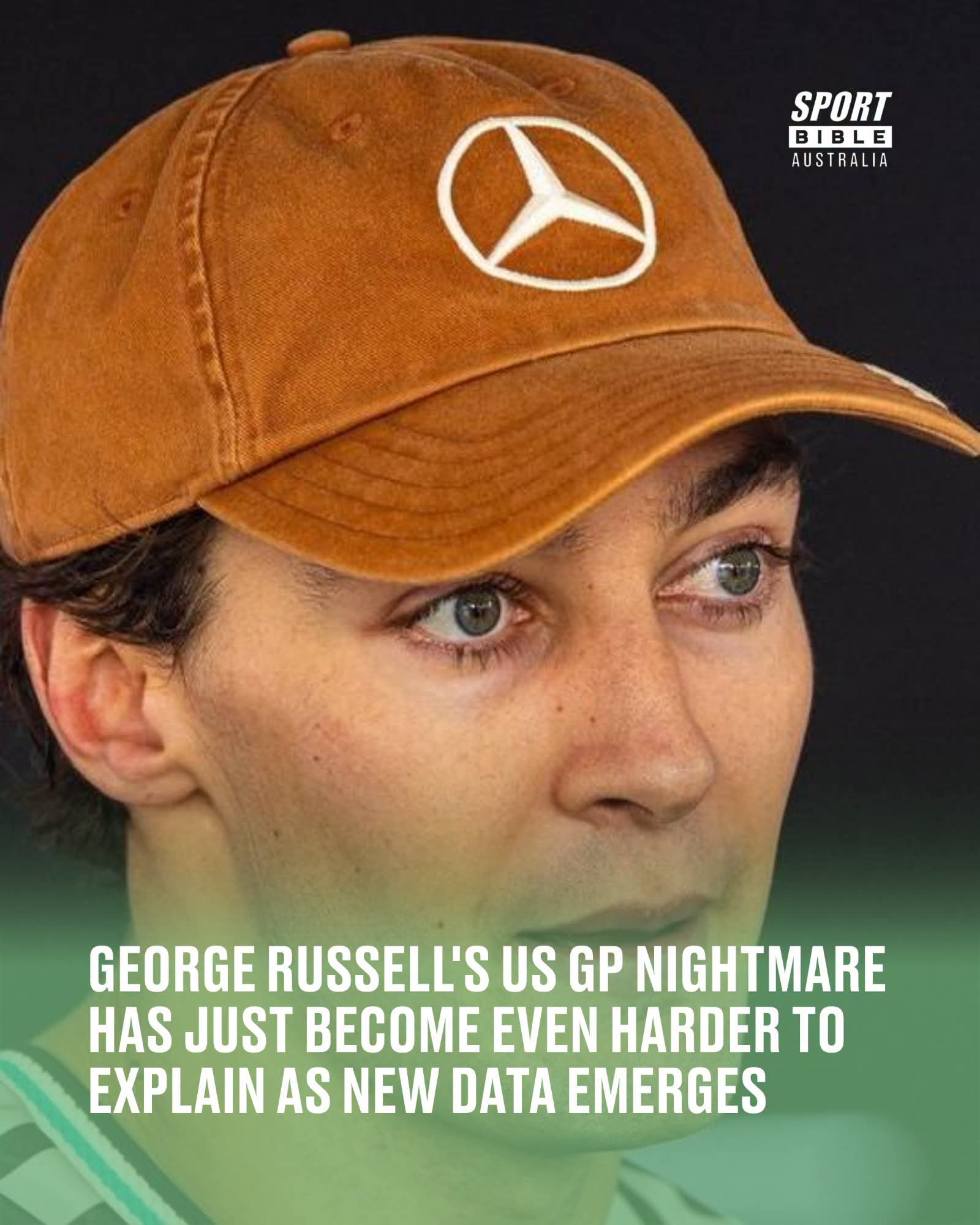
George Russell’s disappointing performance at the 2026 United States Grand Prix has come under renewed scrutiny after data from Kimi Antonelli’s dominant race highlighted the difference between the two Mercedes drivers in Austin.
While Antonelli delivered a commanding performance at the Circuit of the Americas, Russell endured a difficult afternoon, finishing eighth after receiving an early five-second penalty. The contrast has intensified questions about Russell’s form, his ability to adapt to Mercedes’ latest upgrades, and whether the young Italian has gained a decisive advantage in their intra-team battle.
However, the available data also comes with important caveats that make a direct comparison between the teammates more complicated than it first appears.
KIMI ANTONELLI’S TYRE MANAGEMENT BECOMES A MAJOR TALKING POINT
According to the report, data recovered from Antonelli’s Mercedes showed remarkably limited tyre degradation during the Austin race. The figures attracted attention because they appeared to demonstrate how effectively the car managed its tyres over a demanding Grand Prix distance.
Mercedes introduced upgrades intended to improve aerodynamic efficiency and performance through medium- and high-speed corners. Antonelli’s victory offered an encouraging indication that the changes could deliver the expected gains, particularly when the car was operating in favourable conditions.
His ability to maintain consistent pace while keeping tyre wear under control was another impressive element of his performance. For a driver competing at the front of the field, managing degradation without sacrificing speed can make the difference between controlling a race and being forced into defensive strategies.
Nevertheless, low tyre degradation alone does not establish that Antonelli’s car was fundamentally superior to Russell’s. Track position, traffic, driving style, tyre management and the demands placed on each car can all influence the data.
WHY GEORGE RUSSELL’S EIGHTH-PLACE FINISH LOOKS WORSE
Russell’s result was particularly frustrating because Mercedes appeared to possess the pace needed to challenge near the front. Yet the British driver struggled to reproduce the performance delivered by his teammate.
Russell admitted after the race that his pace had been poor, describing the day as a deeply disappointing experience. His five-second penalty added another complication, but it does not necessarily explain the full extent of the gap between the two Mercedes drivers.
A significant factor was Russell’s time spent behind Oscar Piastri. Running in traffic can compromise a driver’s ability to exploit aerodynamic performance, overtake efficiently and manage tyre temperatures. That makes his race different from Antonelli’s experience at the front.
Even so, Russell had access to the same broad package of Mercedes upgrades and the same opportunity to demonstrate that he could extract performance from the car. His inability to match Antonelli’s overall result therefore provides Mercedes with plenty to examine before the next round.
THE IMPORTANT DIFFERENCE BETWEEN RACING IN CLEAN AIR AND TRAFFIC
Although Antonelli’s performance deserves considerable credit, the circumstances surrounding his victory must be considered before drawing conclusions about Russell’s ability.
The report notes that Antonelli spent much of the race more than 10 seconds ahead of Charles Leclerc and Max Verstappen. Once he established that advantage, he could concentrate on maintaining a controlled rhythm instead of constantly fighting for position.
Clean air generally makes it easier for a Formula 1 driver to manage tyres and maintain aerodynamic performance. A car following another closely can lose downforce in turbulent air, making it more difficult to attack corners and potentially increasing tyre stress.
Russell faced a different challenge while caught behind Piastri. Even if the Mercedes upgrade package offered similar potential in both cars, the British driver had fewer opportunities to demonstrate that potential in unrestricted conditions.
That does not erase the gap between the teammates, but it means the comparison should account for their different race circumstances rather than treating the tyre data as definitive proof of a performance problem.
TOTO WOLFF CONTINUES TO BACK GEORGE RUSSELL
Mercedes team principal Toto Wolff has continued to express confidence in Russell despite the growing attention surrounding Antonelli’s performances.
Wolff acknowledged that the car may not currently suit Russell particularly well. He also pointed to the psychological challenge of entering a season with high expectations before watching a highly talented young teammate begin to challenge those ambitions.
Russell has established himself as a capable Formula 1 driver, but the pressure is increasing as Antonelli continues to deliver results that strengthen his reputation within Mercedes.
Wolff nevertheless believes Russell retains the ability to fight for a championship if the team provides him with a competitive car. His public support suggests Mercedes is not ready to judge the British driver solely on a difficult afternoon in Austin.
The crucial question is whether Russell can identify what is limiting his performance and work with the engineers to improve the balance and behaviour of the car to suit his driving style.
MERCEDES’ TEAMMATE BATTLE COULD BECOME A DEFINING STORY IN 2027
Antonelli’s victory and Russell’s disappointing finish have added another layer to an increasingly important rivalry within Mercedes. If the Italian continues to deliver stronger results, the team may face growing questions about which driver should lead its championship ambitions.
For Antonelli, the immediate priority will be maintaining his momentum and converting his recent performances into sustained success. His ability to manage tyres, control races and take advantage of the car’s strengths will be tested under different circuits and conditions.
For Russell, the response matters just as much as the result itself. A difficult race does not define a driver’s entire season, but repeated gaps to a teammate can influence confidence, team dynamics and the way a driver is evaluated internally.
Mercedes must also establish whether the difference in Austin came primarily from driving performance, setup choices, traffic or a combination of factors. Detailed analysis across multiple races will offer a more reliable picture than one set of tyre-degradation figures.
Russell has made clear that his main priority is helping Mercedes secure the constructors’ championship, even as he hopes to finish as the highest-placed driver behind the title contenders. Yet his personal ambitions remain significant, particularly with Antonelli continuing to raise expectations.
The Austin data has given critics fresh material, but it has not settled the debate. The real test will come in the races ahead, when both Mercedes drivers have further opportunities to demonstrate what they can extract from the same machinery.
If Antonelli continues to outperform Russell under comparable conditions, the pressure on the British driver will grow considerably. If Russell can adapt and close the gap, however, Austin may ultimately be remembered as a difficult weekend rather than a defining verdict on his championship potential.