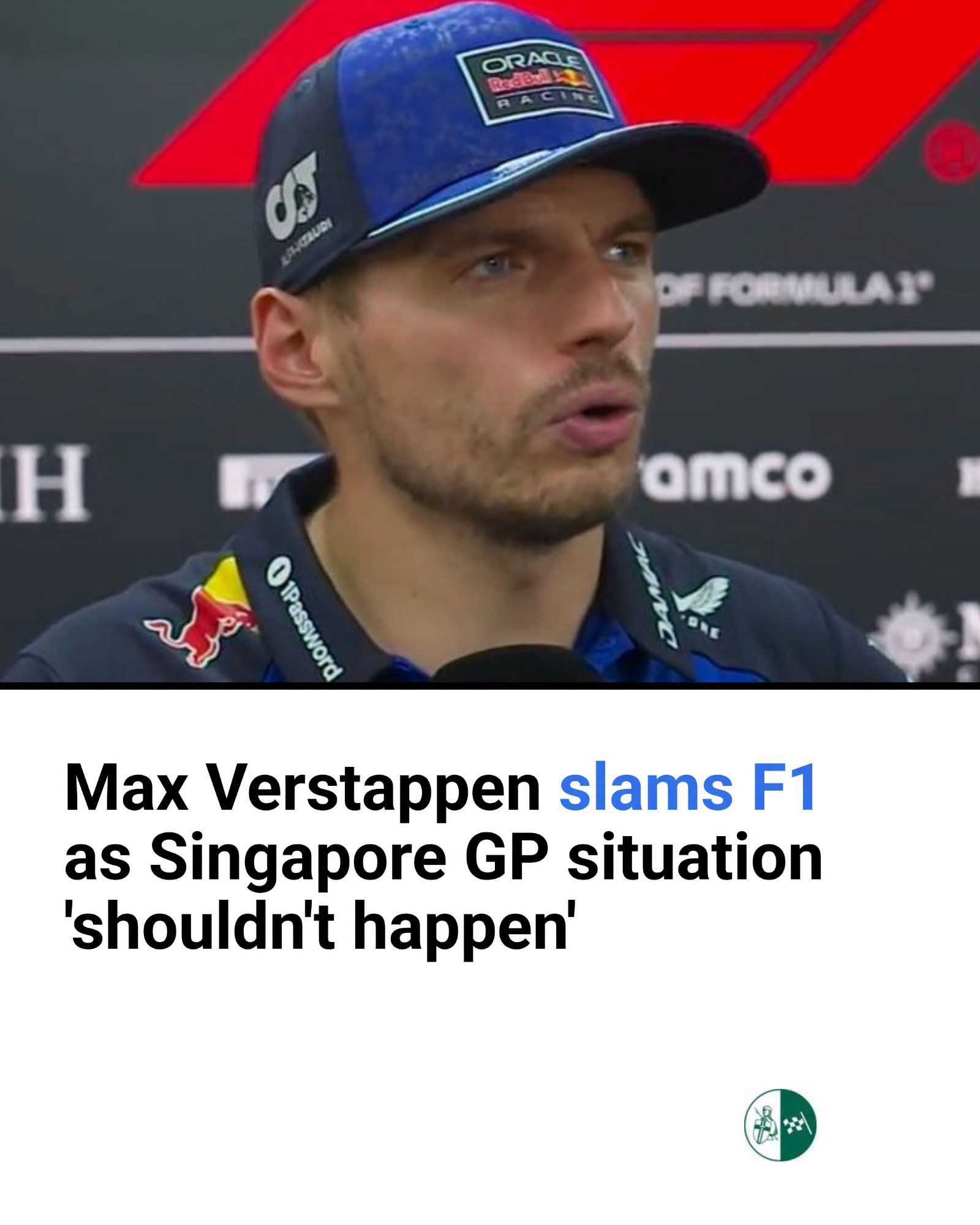
Max Verstappen claimed his first victory of any kind at the Marina Bay Circuit by winning the Singapore Grand Prix Sprint, yet the four-time world champion left the track still criticising the decision to hold short-form races at venues where overtaking is severely limited. Despite the result, Verstappen made clear that the current combination of circuit characteristics, Sprint format and hybrid regulations produces racing he does not enjoy.
The Dutchman’s comments underline a growing tension between Formula 1’s commercial format experiments and the on-track product drivers are being asked to deliver.
### VERSTAPPEN WINS BUT REMAINS UNCONVINCED
A heavy downpour delayed the Sprint by roughly 30 minutes and left the circuit slippery in places. Verstappen started on pole but lost the lead to George Russell at the start. He regained it on lap two when Russell clipped a wet painted line, spun and crashed heavily on the start-finish straight.
Verstappen then controlled the race under pressure from Lewis Hamilton to take the win. It marked his first success in Singapore in any format at a track that has long been considered one of his weaker venues. Even so, he was quick to separate the personal achievement from his broader dissatisfaction with the format.
### “WE SHOULDN’T HOST A SPRINT WHERE YOU CANNOT PASS”
Verstappen’s central argument was straightforward. Sprint races, in his view, only make sense at circuits that allow genuine overtaking. Marina Bay, with its tight layout and limited passing opportunities, does not meet that standard.
“We shouldn’t host a sprint where you cannot pass,” he said. “You have tracks where you can race and can overtake, but of course, in some places you cannot pass and we are going to have sprints there also next year. I’m fine, I just do my thing, but it’s not what I like.”
He also pointed to the limited effectiveness of the current overtake mode at this circuit. With the hybrid system providing little meaningful straight-line advantage, the usual tools drivers rely on to close and pass are blunted.
### CALL FOR CIRCUIT CHANGES AT MARINA BAY
While describing the track itself as “great,” Verstappen argued that Marina Bay needs modifications if it is to produce better racing. He called for a longer straight or a more conventional hairpin to create a bigger speed differential and clearer overtaking opportunities.
“We need to have a longer straight or more of a proper hairpin to overtake. Even with that also, we need a bigger delta on the straight.”
The comments reflect a wider driver sentiment that some calendar venues, while spectacular and commercially valuable, do not naturally support the close racing Formula 1 is trying to promote through the Sprint format.
### RUSSELL’S COSTLY ERROR ADDS TO THE CHAOS
Russell’s crash while leading denied him what may have been his best chance of a strong result on a weekend already compromised by a heavy grid penalty for the main Grand Prix. The Mercedes driver admitted the mistake was a miscalculation involving unexpected battery deployment that pushed him onto the low-grip painted line.
The incident triggered a safety car and contributed to an attritional Sprint in which several cars failed to finish. Verstappen’s ability to stay clear of trouble under pressure from Hamilton proved decisive.
### THE DEEPER PROBLEM WITH THE CURRENT RULES
Verstappen’s criticism extended beyond the choice of venue. He linked the lack of overtaking to the broader limitations of the current power-unit regulations, particularly the reduced impact of overtake mode and battery deployment on street circuits. In his view, the technical rules are compounding the natural difficulties of tracks such as Marina Bay rather than alleviating them.
Coming after a week already marked by software issues in Malaysia and a human-error controversy with overtake mode in Sprint qualifying, the comments add to the sense that the 2026 regulations are struggling to deliver consistent, entertaining racing.
### WHAT IT MEANS FOR F1’S SPRINT FUTURE
Formula 1 has committed to continuing Sprint races at a mix of venues, including some where passing is inherently difficult. Verstappen’s repeated public opposition will not change the commercial calendar overnight, but it increases the pressure on organisers to either improve the racing spectacle at those tracks or reconsider which circuits are suitable for the format.
For now, Verstappen continues to do his job and collect the points. His victory in Singapore removes a personal bogey and strengthens Red Bull’s hand. Yet his post-race assessment was unambiguous: winning a Sprint at a track where overtaking is minimal is not the same as producing the kind of racing he believes the sport should prioritise. In that sense, even a win left him unsatisfied.