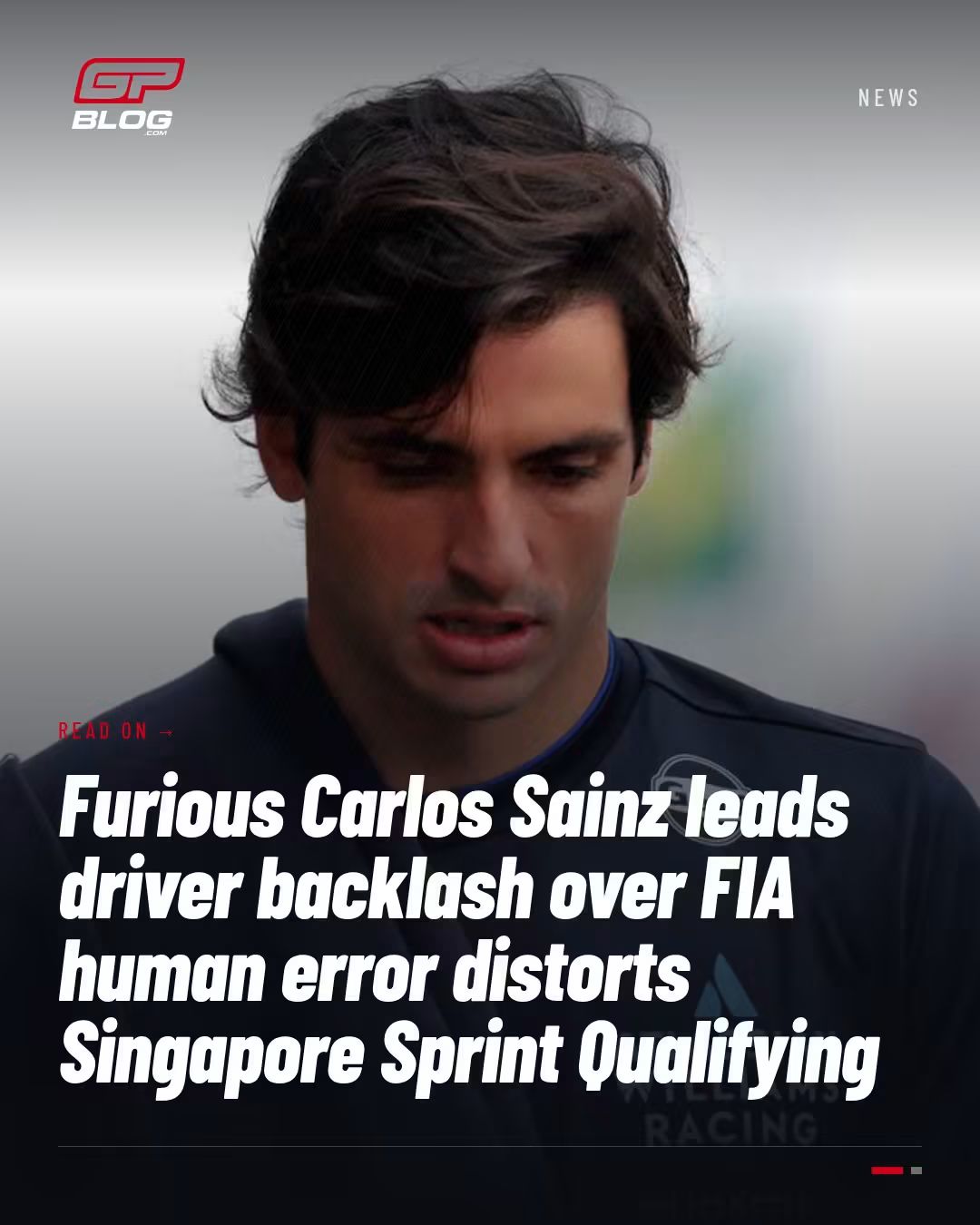
Carlos Sainz is not one to stay quiet when something feels off. After a chaotic Sprint Qualifying session at the Singapore Grand Prix, the Williams driver has publicly questioned the FIA’s handling of technical issues that left some cars with a clear performance advantage over others. For Sainz, this was not an isolated glitch. It was the latest example of a recurring problem that has now marked multiple weekends in 2026.
The Spaniard finished last in SQ1 after a red-flag interruption caused by Sergio Pérez’s crash. What followed was a human error in race control that left Overtake Mode unavailable for parts of the session, then briefly activated for just 27 seconds before being switched off again. The result? Some drivers completed their flying laps with roughly half a second more power available than others, depending purely on when they were on track and where they were on the circuit.
Sainz made his frustration clear. “There was another software issue with the cars this time around, and we were on the bad end of it,” he said. “And for whatever reason, the FIA, like in Malaysia, didn’t decide to do sporting equity, and were happy to do half of the cars in qualifying with a higher power than the other half of the cars. So a bit confused why the sport keeps doing different things depending on who is out in Q1 or who is out in Lap 1.”
WHY THIS MATTERS FAR BEYOND ONE QUALIFYING SESSION
In Formula 1, fairness is not a soft concept. It is the foundation of the entire championship. When a governing body acknowledges a human error that directly alters lap times in a knockout session, the integrity of the result comes under scrutiny. Singapore’s tight street circuit already makes overtaking extremely difficult. Starting from the back of the grid in the Sprint, as Sainz will, turns an already tough weekend into a near-impossible recovery mission for points.
The pattern Sainz is highlighting goes deeper than one missed activation. The previous weekend in Malaysia (hosting the Bahrain Grand Prix) saw similar power-unit and software complications that affected formation-lap procedures and left questions about consistent application of the rules. Drivers and teams on the wrong side of those decisions felt the impact in the results. Now Singapore has delivered another version of the same problem within seven days. When the same type of issue keeps appearing and the response varies depending on who is affected, trust erodes.
For midfield and lower teams such as Williams, these moments are especially costly. Front-running squads often have the pace buffer to absorb a half-second deficit and still progress. Smaller outfits live and die by every tenth. A single compromised lap can mean the difference between Q2 and an early exit, or between a points-scoring finish and another zero. In a season where every point counts toward championship position, prize money, and future investment, these inequities compound.
THE HUMAN AND COMPETITIVE COST FOR DRIVERS AND TEAMS
Sainz has been open about the additional problems that compounded the power shortfall: brake issues carried over from free practice, tyre struggles, and the limited opportunity for only one meaningful flying lap after the red flag. He was careful not to use the FIA error as a complete excuse, noting that Williams might still have struggled to advance. That honesty strengthens his broader point. Even when a driver accepts some responsibility for their own performance, the governing body still has a duty to ensure every car is operating under the same conditions.
The impact is not only on the stopwatch. Drivers prepare meticulously for these sessions. Engineers dial in energy deployment, battery management, and tyre preparation around the assumption that Overtake Mode will be available as normal. When that assumption collapses mid-session because of a race-control mistake, the entire strategy is compromised in real time. Radio messages become frantic. Confidence drops. And the final classification no longer purely reflects driver skill or car performance.
Teams further down the order feel this more acutely. Williams has already endured a difficult 2026 campaign adapting to the new regulations. Every lost opportunity to score or gather data hurts development momentum. When the FIA’s own systems introduce variables that cannot be controlled or anticipated, the competitive balance shifts in ways no amount of engineering can fix on the spot.
A PATTERN THAT DEMANDS CLEARER STANDARDS
What makes Sainz’s comments land is the sense of inconsistency. In one case the governing body may prioritise getting the race started. In another it may accept that some cars ran with different power levels and simply move on. The phrase “sporting equity” is not rhetorical. It is a direct challenge to the idea that the same set of rules and the same standard of correction should apply regardless of which drivers or teams are involved.
Formula 1 has grown into a global entertainment product with massive commercial stakes. That growth brings pressure to keep sessions running and to avoid lengthy delays. Yet the core product remains a sport. Fans, drivers, and teams still expect that the result on the timing screens is a fair reflection of who was fastest under equal conditions. When that expectation is repeatedly tested, the credibility of the championship takes a hit.
Sainz occupies a useful position as both a race driver and a Grand Prix Drivers’ Association director. His willingness to speak publicly puts the issue on the record in a way that private complaints rarely achieve. Other drivers have privately shared similar frustrations this season. Making the pattern visible is the first step toward forcing clearer protocols.
WHAT NEEDS TO CHANGE AND WHAT COMES NEXT
The FIA has already admitted the human error in Singapore. That transparency is welcome. The next requirement is preventive action. Overtake Mode activation after red flags should be automatic and fail-safe, not dependent on a single decision in race control under time pressure. When an error does occur that creates a measurable performance disparity, the default response should lean toward sporting equity: either a full session restart, a voiding of affected times, or a clear, consistent policy applied the same way every time.
Looking ahead, the rest of the 2026 season will test whether this remains a recurring theme or becomes a turning point. Singapore is a high-profile venue with global audiences watching every detail. Continued issues of this nature will only amplify calls for tighter operational standards. Teams will keep logging data. Drivers will keep speaking when they feel the process is uneven. And the FIA will face growing pressure to demonstrate that “sporting equity” is more than a phrase used after the fact.
Carlos Sainz’s recovery drives and tactical intelligence have earned him respect across the paddock. When a driver of his experience says the pattern is becoming hard to ignore, the sport would do well to listen. Fairness is not a luxury in Formula 1. It is the minimum requirement for the championship to retain its meaning. Singapore was the latest reminder that the standard still needs work.