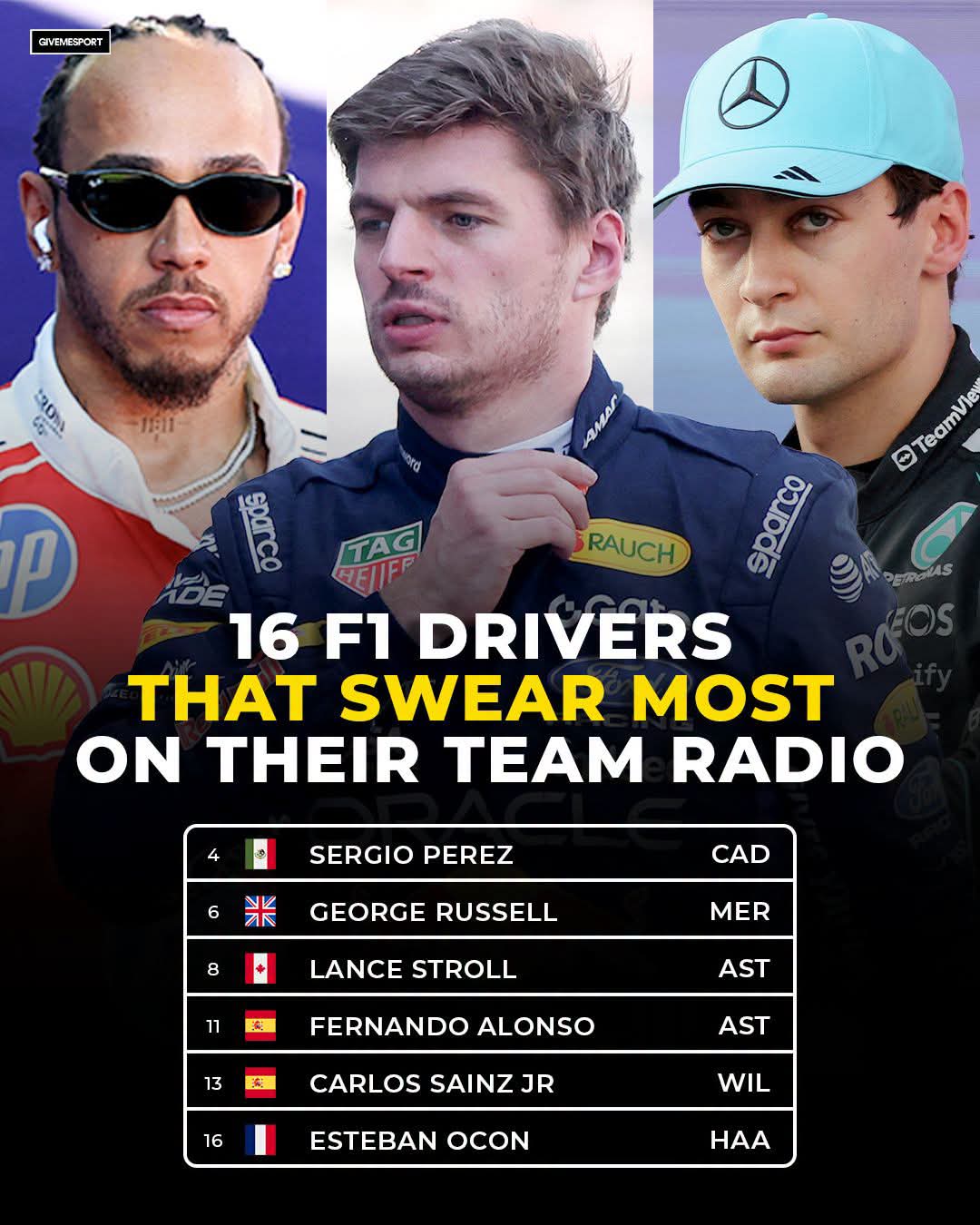
Eight full seasons of Formula 1 team radio messages have been transcribed, and the drivers that swear the most have been exposed…Eight Full Seasons of Formula 1 Team Radio Reveal Which Drivers Swear the Most
Formula 1 has always been about speed, pressure and split-second decisions, but behind the polished television coverage lies another side of the sport that fans rarely get to see in full.
For eight complete seasons, Formula 1 team radio messages have captured drivers at their most frustrated, emotional and competitive. Now, after thousands of radio exchanges were transcribed and analyzed, the drivers who swear the most have reportedly been revealed.
The findings offer an entertaining look at the personalities behind the helmets, while also highlighting just how intense life can be inside a Formula 1 cockpit.
Team Radio Gives Fans a Different View
Team radio has become one of the most popular parts of modern Formula 1 coverage. Drivers communicate constantly with their engineers during races, discussing strategy, tyre performance, traffic, penalties, car balance and everything happening around them.
However, those conversations can quickly become heated.
A driver traveling at more than 300 km/h while battling another competitor has little time to carefully choose every word. When something goes wrong, frustration can immediately come through over the radio.
From missed overtakes and questionable strategy calls to mechanical problems and incidents with rival drivers, there have been countless moments when emotions have boiled over.
The eight-season transcription project provides a much larger sample than individual viral radio clips. Instead of focusing on one race or one memorable outburst, the analysis examined years of communication to identify broader patterns.
Which Drivers Swear the Most?
According to the reported analysis, some drivers have developed reputations for using strong language more frequently than others.
The results are particularly interesting because drivers often have very different communication styles. Some remain relatively calm even when their races are falling apart, while others are much more expressive.
For certain drivers, an angry message can become one of the defining moments of a Grand Prix.
A frustrated “What are we doing?” or an angry complaint about another driver can quickly become a social-media headline. In other cases, a driver may unleash a much stronger reaction after suffering a crash, losing positions or being affected by a strategy decision.
The data collected across eight seasons attempts to move beyond individual memorable moments and identify which drivers consistently use profanity during team-radio conversations.
Why Drivers Lose Their Temper
Formula 1 is an unusually stressful environment.
Drivers are required to maintain extraordinary concentration while dealing with physical exhaustion, intense competition and constant instructions from their teams.
At the same time, they know that a tiny mistake can destroy an entire weekend of preparation.
A poor pit stop can cost several positions. A safety-car decision can change the entire race. A damaged front wing can ruin a driver’s pace. A penalty can turn a podium opportunity into disappointment.
That pressure helps explain why team radio occasionally contains language that would never be used during a formal press conference.
The driver’s engineer is effectively their closest communication partner during the race, meaning the radio often becomes the place where frustration is released.
Some Radio Moments Become F1 History
Over the years, team radio has produced some of the most memorable moments in Formula 1.
Drivers have complained about rivals, questioned decisions from race control, criticized their own cars and demanded answers from their engineers.
Some messages have even become part of F1 culture.
Fans frequently share dramatic radio clips on social media, while broadcasters use selected exchanges to tell the story of a race. A single sentence can sometimes explain the emotions of an entire Grand Prix better than several minutes of television commentary.
The popularity of these moments has also changed how fans understand drivers.
A competitor who appears quiet and reserved during interviews may sound completely different when fighting for victory at high speed.
Swearing Does Not Necessarily Mean a Driver Is Angry
One important point from any analysis of profanity is that frequency does not automatically equal aggression.
Drivers have different personalities and communication habits.
Some may use strong language as part of normal conversation, while others reserve it for moments of genuine anger. A driver might swear after making a mistake, while another might use similar language simply to emphasize a point.
The context therefore matters.
A raw number of swear words cannot fully explain a driver’s personality or attitude. It can, however, provide an entertaining statistical window into how drivers communicate under pressure.
Modern F1 Has Become More Transparent
The growing popularity of team radio has also changed the relationship between drivers and fans.
In previous generations, spectators had limited access to conversations happening inside the cockpit. Today, fans can hear drivers discussing almost every aspect of a race.
That access has made Formula 1 feel more personal.
Fans can hear the excitement when a driver takes pole position, the frustration after a mistake and the relief when a difficult strategy finally works.
It has also created a new form of entertainment.
A dramatic radio exchange can go viral within minutes, with fans turning individual quotes into memes, videos and social-media discussions.
The Eight-Season Study Highlights the Human Side of F1
The biggest takeaway from the transcription project may not actually be which driver finished first on the swearing list.
Instead, it demonstrates how emotionally demanding Formula 1 can be.
Behind every perfectly controlled television interview is a driver who may have just spent nearly two hours operating a highly complex machine at extraordinary speeds while fighting competitors separated by tiny margins.
Mistakes are costly, opportunities disappear quickly and decisions must often be made instantly.
In those moments, emotions naturally surface.
Team radio provides a rare opportunity to hear those emotions directly.
Fans Will Continue Listening
As Formula 1 continues to grow globally, team radio is likely to remain one of the sport’s most popular forms of behind-the-scenes content.
The conversations give fans something statistics and race results cannot always provide: personality.
Whether a driver is celebrating a victory, questioning a strategy call or angrily responding to an incident, the radio offers an unfiltered glimpse into the cockpit.
The eight-season analysis therefore provides more than a list of drivers who swear the most. It demonstrates how much emotion exists beneath the highly controlled image of modern Formula 1.
For fans, the findings will undoubtedly lead to plenty of debate.
Some supporters will argue that certain drivers deserve a higher position on the list, while others will point to memorable radio moments that may not be fully represented by the statistics.
Ultimately, Formula 1 remains a sport where milliseconds matter and emotions run high.
And after eight seasons of recorded team-radio conversations, one thing is clear: when the pressure reaches its highest point, even the world’s best drivers are not always able to keep their language clean.