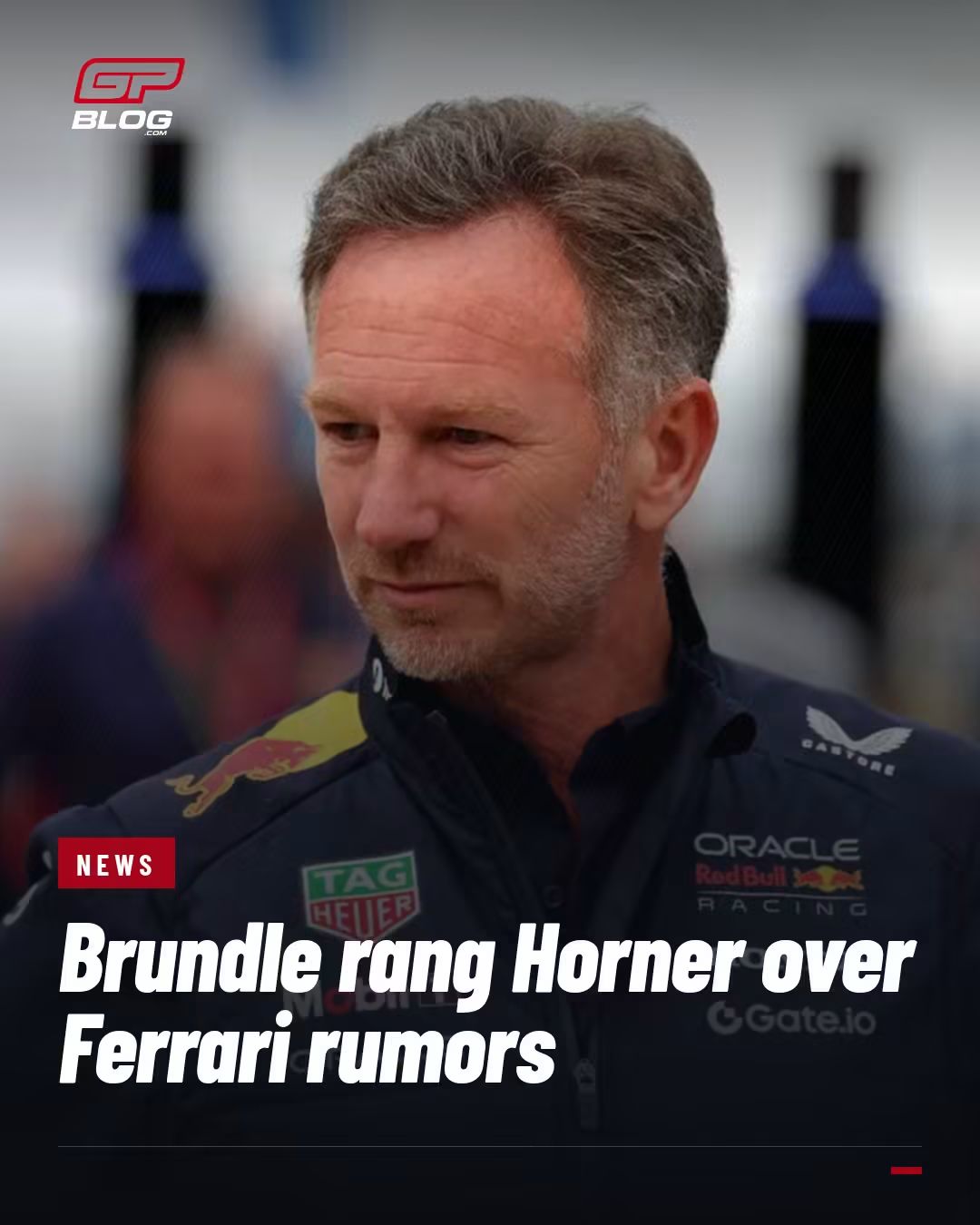
Formula 1 thrives on drama, speculation, and the endless carousel of “what if” stories. This week the paddock got another classic chapter when Sky Sports F1 commentator Martin Brundle decided enough was enough. Faced with a fresh wave of reports linking former Red Bull boss Christian Horner to Ferrari, Brundle simply picked up the phone and called the man himself.
Horner’s response was blunt and revealing. The comments that sparked the firestorm were, in his own words, just politeness. The rest was media mathematics that somehow turned two plus two into seven and a half.
HOW A SINGLE INTERVIEW IGNITED THE LATEST F1 RUMOUR MILL
The spark came from an interview Horner gave to *The Times* while promoting his memoir. In it he described Ferrari as “the dream” job in Formula 1 and the only team he would consider joining without an ownership stake. He called the Scuderia the biggest brand in the sport and a “sleeping giant.”
Coming from a man who spent two decades building Red Bull into a dominant force before his abrupt exit after the 2025 British Grand Prix, the words carried weight. Horner has been on the open market for more than a year. No team has yet offered the combination of control and opportunity he appears to want. In that vacuum, any positive remark about Ferrari was always going to be treated as a job application.
Ferrari, for their part, moved quickly to back current team principal Fred Vasseur. Both Lewis Hamilton and Charles Leclerc publicly supported their boss. The official line from Maranello was clear: there would be no sudden change at the top.
BRUNDLE’S PHONE CALL CUTS THROUGH THE NOISE
Speaking on Sky Sports F1 during the Bahrain Grand Prix weekend, Brundle explained why he felt compelled to check the story at source.
“Being the Ferrari driver or the Ferrari team principal is the best job in Formula 1 and the worst job in Formula 1, all at the same time,” he said. “Because the pressure and the hero-zero curve in that team are vertical sometimes… so you’ve got to navigate your way through that.
“There was a lot of talk of Christian Horner this week going [to Ferrari]. So I rang Christian to find out all about it, and he said, ‘I was just being polite and respectful about Ferrari in another interview I did, and it took on a whole…’ It was sort of two plus two equals seven and a half, I think, on that.”
That single phone call did more to deflate the rumour than any official statement. Horner was not angling for Vasseur’s job. He was answering a question about prestige teams with the diplomatic answer most people in the sport would give.
WHY THE HAMILTON FACTOR MADE THE STORY EVEN SPICIER
Brundle could not resist pointing out the delicious historical irony. Lewis Hamilton joined Ferrari for 2025. Horner and Hamilton’s camps clashed bitterly during the 2021 title fight. Putting the two men in the same organisation would have created one of the most awkward working relationships in modern F1 history.
“Can you imagine Christian and Lewis working together after 2021?” Brundle asked. “That might be an interesting dynamic for a while there.”
Interesting is one word for it. Explosive is another. The idea of Horner managing Hamilton after years of public and private friction was pure clickbait gold, which helps explain why the story grew so quickly.
THE DEEPER PROBLEM FERRARI CANNOT AFFORD TO IGNORE
Brundle’s most valuable observation had nothing to do with Horner. It was about Ferrari’s chronic tendency to treat team principals as disposable.
“There’s no point to keep changing key personnel, you see it in football,” he said. “The role of a team principal has also changed quite dramatically. They just need to stay calm and support each other.”
Ferrari’s history is littered with short-lived regimes. The pressure from the Italian media, the board, and the tifosi is uniquely intense. Success is expected immediately; anything less is treated as failure. That environment has chewed up talented leaders before. Continuity, not another revolution, is usually the smarter path.
Vasseur has stabilised the team and earned the public backing of both drivers. Throwing that away because one former rival made a polite remark would have been classic Ferrari self-sabotage.
WHAT THIS EPISODE REVEALS ABOUT THE MODERN F1 PADDOCK
Horner’s situation is fascinating in its own right. After 20 years of near-total control at Red Bull, he is discovering that the market for high-profile team principals is limited when the candidate insists on meaningful ownership or control. Most current owners are not looking to hand over the keys.
Ferrari remains the ultimate prestige destination, but the job comes with constraints that may not suit someone who ran his previous team with near-autocratic authority. Horner appears to understand that. His clarification to Brundle suggests he is not desperate enough to take any role simply to get back on the pit wall.
For the wider sport, the episode is a reminder of how quickly narratives form and how rarely they survive contact with primary sources. Brundle’s old-school approach — call the person and ask — feels almost radical in an age of anonymous briefings and social media amplification.
THE REAL STAKES FOR THE TEAMS INVOLVED
If Ferrari had genuinely pursued Horner, the consequences would have been enormous. Hamilton’s relationship with the team would have been tested immediately. Leclerc’s position as the long-term future of the Scuderia could have been complicated. Vasseur’s authority would have been destroyed overnight. The internal politics would have dominated the rest of the season.
By shutting the story down early, Ferrari protected the stability they claim to value. Whether that stability is enough to deliver the championships the team craves remains the bigger question. New regulations are always around the corner in F1, and Ferrari’s ability to exploit them will matter far more than any individual appointment.
Horner, meanwhile, continues to wait for the right opportunity. His brand remains powerful. His track record is undeniable. But the longer he stays outside the paddock, the more the sport moves on without him. The next generation of team principals is already in place. The power structures have shifted.
WHY THIS STORY STILL MATTERS BEYOND THE HEADLINES
On the surface this was a classic F1 rumour cycle: big name, big team, dramatic history, and a juicy quote. Brundle’s intervention turned it into something more useful — a rare moment of clarity in a sport that often prefers ambiguity.
It also highlighted the unique pressure of the Ferrari job. Few roles in motorsport carry the same mixture of prestige and peril. The hero-zero curve Brundle described is real, and it explains why so many capable leaders have struggled there.
For fans, the episode offered entertainment and a reminder that not every dramatic storyline is real. For the teams, it reinforced the value of messaging discipline and internal unity. For Horner, it was a chance to reset expectations about his immediate future.
Formula 1 will generate new rumours next week. Someone else will be linked to someone else’s job. The difference this time is that one of the most respected voices in the sport went straight to the source and got an answer. In an industry built on speculation, that still counts as progress.