LEWIS HAMILTON ESCAPES GRID PENALTY AFTER AZERBAIJAN GP IMPEDING INCIDENT
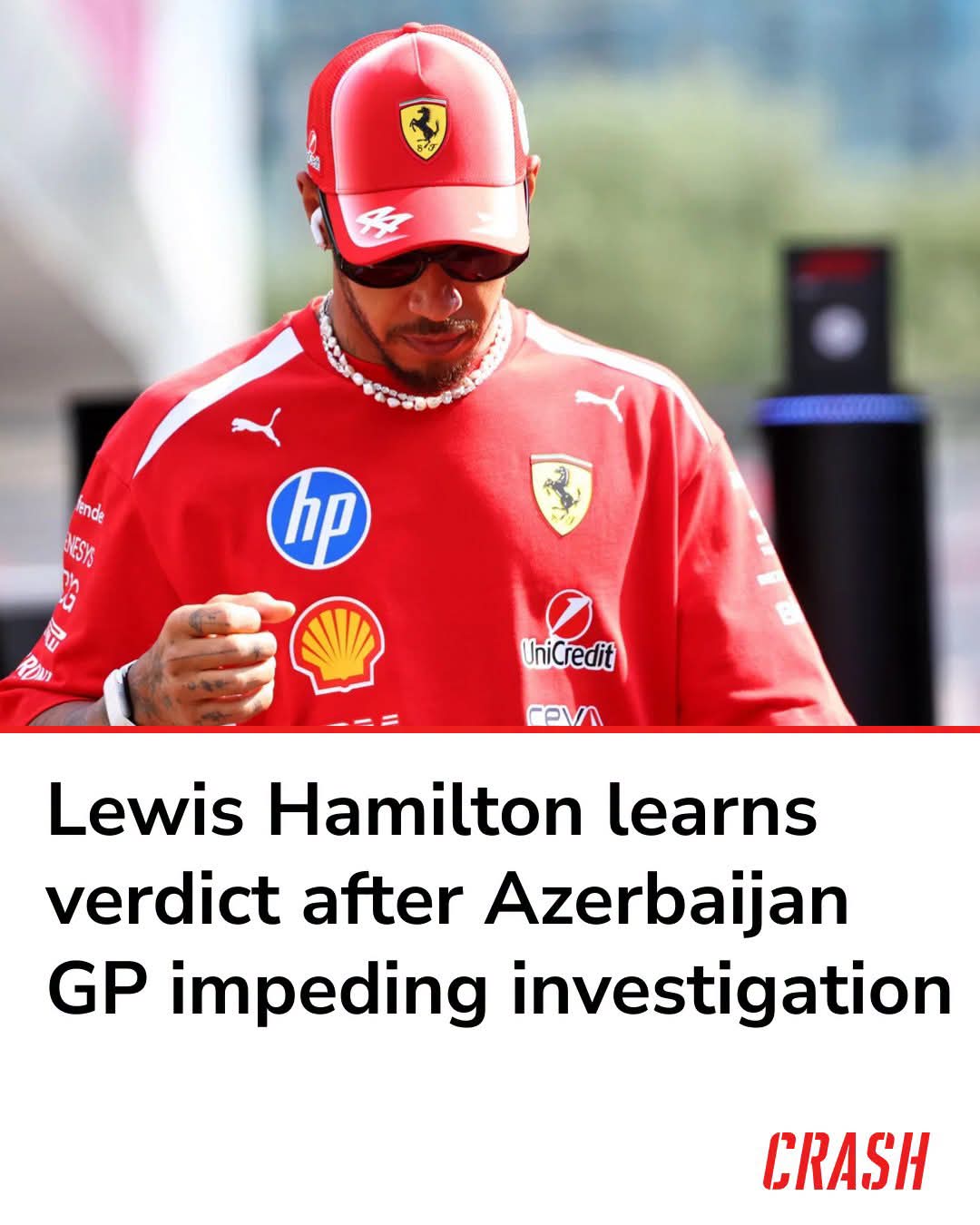
Lewis Hamilton has avoided a grid penalty at the Azerbaijan Grand Prix after Formula 1 stewards investigated an incident involving Racing Bulls driver Liam Lawson during second practice in Baku.
The seven-time world champion was handed a reprimand after stewards concluded that he unnecessarily impeded Lawson on a fast lap. Although the incident was considered serious because of the high-speed nature of the final sector, the FIA stopped short of imposing a grid drop on the Ferrari driver.
The decision brings an immediate end to speculation about whether Hamilton would carry a sporting penalty into qualifying and the race. However, the incident also highlights one of the unusual challenges facing drivers under Formula 1’s 2026 regulations: managing energy deployment while simultaneously controlling the speed difference between cars on very different types of laps.
WHAT HAPPENED BETWEEN HAMILTON AND LAWSON IN BAKU?
The incident occurred during FP2 at the Baku City Circuit.
Hamilton was completing an out lap while Lawson was approaching on a flying lap. Because Lawson was travelling significantly faster, the Racing Bulls driver rapidly closed on the Ferrari through the final section of the circuit.
Lawson was then forced to take avoiding action and lift slightly as he encountered Hamilton near the final part of the lap.
The situation immediately caught Lawson’s attention over team radio, where the Racing Bulls driver described the incident as extremely dangerous. Formula 1 subsequently summoned both drivers and reviewed video, timing, telemetry, team-radio and other available evidence.
The FIA’s official documentation confirms that Hamilton was investigated for allegedly impeding Car 30, Lawson’s Racing Bulls entry, during Turn 19.
WHY DID THE STEWARDS BLAME HAMILTON?
The key issue was not simply that Hamilton was travelling slowly.
Formula 1’s traffic-management instructions for Baku specifically required drivers on out laps or slow laps to stay to the extreme left through a designated section of the circuit and manage their gaps so that a faster car could pass through the final corners without being impeded.
According to the stewards’ assessment, Hamilton did not remain sufficiently far to the left and stayed on the racing line as Lawson approached.
That meant Lawson had to lift and brake slightly rather than continuing normally through the corner.
The stewards therefore determined that Hamilton had failed to follow the race director’s traffic-management instructions and had unnecessarily impeded Lawson.
HAMILTON’S ENERGY-DEPLOYMENT EXPLANATION
There was an important technical factor behind Hamilton’s defence.
The 2026 Formula 1 regulations have changed the balance between the internal-combustion engine and electrical energy systems. As a result, drivers can experience substantial differences in speed depending on how much electrical deployment remains available at different points of a lap.
Hamilton explained that he was harvesting energy through the final sector rather than simply cruising without regard for cars behind him.
That matters at Baku because the circuit combines slow corners with extremely fast sections. A driver who is managing energy at the end of a lap can potentially be travelling much slower than another driver who is completing a qualifying-style flying lap.
The stewards acknowledged this factor during their assessment. They also considered the speed difference between the two cars and the difficulty of managing energy deployment through that part of the circuit.
However, the technical difficulty did not completely remove Hamilton’s responsibility because Ferrari had already warned him that Lawson was approaching.
WHY WAS HAMILTON GIVEN A REPRIMAND INSTEAD OF A GRID PENALTY?
This is arguably the most important part of the verdict for Ferrari and Hamilton.
An impeding incident during practice does not automatically result in a grid penalty. The usual response can be a warning, but the circumstances of this particular incident were considered more serious because of the high-speed section of the Baku circuit and the specific traffic instructions issued for the session.
The stewards nevertheless determined that a reprimand was the appropriate punishment rather than a grid drop. They also found no evidence that Hamilton deliberately attempted to obstruct Lawson.
That distinction is important.
There is a major difference between deliberately compromising another driver’s lap and making a serious mistake while managing an out lap. In Hamilton’s case, the stewards’ decision reflected the severity of the obstruction without treating it as an intentional act.
WHAT DOES THE REPRIMAND MEAN FOR HAMILTON?
For the Azerbaijan Grand Prix itself, the immediate sporting consequence is limited.
Hamilton does not have a grid penalty from this incident, meaning the reprimand does not automatically push his Ferrari down the starting order for qualifying or the race.
However, reprimands can become significant when accumulated.
This was reported as Hamilton’s second driving reprimand of the 2026 season. Under the current system, accumulating five reprimands, with at least four relating to driving offences, can trigger a 10-place grid penalty.
That means Hamilton has no immediate grid-position punishment from the Lawson incident, but future driving-related reprimands could become considerably more consequential.
WHY BAKU MAKES IMPEDING PARTICULARLY DANGEROUS
The Baku City Circuit is not an ordinary venue when it comes to traffic management.
Its combination of tight corners, narrow sections and extremely high-speed running means that a large difference in speed between two cars can develop very quickly.
A driver completing a slow lap may appear to have plenty of space, only for a car on a flying lap to arrive at significantly higher speed moments later.
That makes communication between the driver and pit wall crucial.
In this case, the stewards specifically noted that Hamilton had been informed twice by Ferrari that Lawson was approaching. That makes the incident more significant than a simple situation in which a driver was unaware that another car was closing rapidly.
WHAT THIS MEANS FOR LIAM LAWSON
For Lawson, the incident was particularly frustrating because he was attempting to complete a competitive lap.
The New Zealander had returned to Racing Bulls for the Azerbaijan weekend after a three-race stint with Red Bull, and the Baku weekend therefore already carried additional significance for him. Formula 1 reported that Lawson had a solid return with Racing Bulls, although his FP2 session also included the Hamilton incident.
Being forced to lift or brake while committed to a fast lap can cost valuable time and potentially disrupt confidence through a high-speed sequence.
More importantly, Lawson’s reaction demonstrates why Formula 1 takes impeding seriously even when the incident occurs during practice. At circuits such as Baku, a seemingly small difference in positioning can create a much more serious situation.
THE BIGGER 2026 F1 LESSON
The Hamilton-Lawson incident also reveals an interesting consequence of Formula 1’s 2026 technical era.
Energy management is now an even more visible part of a driver’s decision-making.
A driver cannot always treat an out lap as simply driving slowly and staying out of everyone’s way. They may be harvesting energy, preparing tyres, managing temperatures or following a carefully planned lap strategy.
At the same time, the driver must remain aware of faster cars approaching from behind.
That creates a difficult balancing act for teams.
Ferrari’s warnings to Hamilton show that the pit wall has an important role in managing this traffic. But once the warning reaches the driver, the driver still has to position the car appropriately.
This is likely to remain an important issue throughout the 2026 season as teams and drivers continue adapting to the new generation of Formula 1 machinery.
COULD THIS AFFECT HAMILTON’S AZERBAIJAN GP WEEKEND?
The reprimand itself does not change Hamilton’s immediate starting position.
The bigger question is whether Ferrari can convert its practice pace into a strong qualifying performance.
Hamilton finished fifth in FP2, while George Russell topped the session for Mercedes. Lawson finished 12th during his return to Racing Bulls.
With qualifying still ahead, the practice incident is therefore unlikely to define Hamilton’s entire weekend.
Instead, attention will quickly move back to Ferrari’s performance, tyre preparation, energy management and Hamilton’s ability to extract a clean qualifying lap from the car.
THE VERDICT: A WARNING SIGN WITHOUT A GRID PENALTY
Hamilton has escaped the most serious potential consequence from his Baku incident.
The FIA stewards found that he unnecessarily impeded Lawson and failed to follow the prescribed traffic-management instructions, but they issued a reprimand rather than a grid penalty.
For Hamilton, the immediate priority is straightforward: avoid accumulating further driving reprimands while maintaining clear communication with Ferrari during busy practice and qualifying sessions.
For Lawson and Racing Bulls, the incident serves as another reminder of how quickly traffic can become dangerous around Baku.
And for Formula 1 as a whole, the episode offers a useful glimpse into one of the challenges of the 2026 regulations: drivers are not only racing each other—they are also managing increasingly complex energy strategies while trying to stay out of the way of competitors on maximum attack.