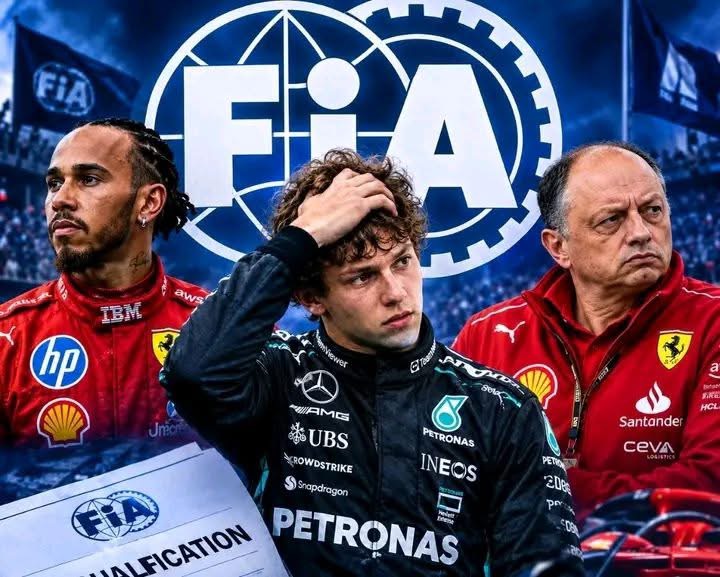
The FIA has confirmed a double punishment following the 2026 Spanish Grand Prix, throwing the official results and championship standings into fresh uncertainty. A detailed post-race investigation into both sporting and technical matters has led to significant sanctions that could reshape the points table just as the title battle intensifies.
What appeared to be a settled outcome in Madrid has now been reopened after stewards completed their review of telemetry, team communications and onboard footage.
TWO SEPARATE VIOLATIONS TRIGGER FIA ACTION
The governing body’s investigation focused on two distinct issues that emerged from the intense Madrid weekend. The first involved repeated track-limits breaches during a critical phase of the race. One driver was found to have gained an unfair advantage by exceeding the limits multiple times while under pressure, despite earlier warnings. Stewards responded with a retrospective time penalty that alters the final classification and reshuffles several positions.
The second and more serious finding concerned a technical infringement uncovered during routine post-race checks. Officials identified a component that did not fully comply with the regulations. Regardless of whether the issue stemmed from intentional design or a misinterpretation of the rules, the FIA applied a stricter sanction, with disqualification or a substantial points deduction among the possible outcomes.
WHY THE DECISIONS HAVE SPARKED PADDOCK DEBATE
Post-race penalties of this nature always generate strong opinions. Some within the paddock support the FIA’s zero-tolerance approach, arguing that strict enforcement is essential to protect the integrity of the championship. Others question the timing and cumulative impact of the double punishment, suggesting it risks overshadowing the on-track action and creating inconsistency in how regulations are applied.
Track limits have been a recurring flashpoint throughout 2026, while technical conformity remains one of the most sensitive areas of modern Formula 1. The combination of both issues in a single investigation has amplified the reaction.
CHAMPIONSHIP IMPLICATIONS COULD BE SIGNIFICANT
With points now subject to recalculation, both the drivers’ and constructors’ standings face potential disruption. Strong results earned on Sunday could be downgraded, while rivals stand to gain positions and valuable points without turning a wheel. In a season already defined by fine margins, even small shifts can alter strategic thinking for the races ahead.
Teams affected by the rulings are expected to review the decisions closely. Appeals remain a possibility, and engineering departments will inevitably revisit procedures to avoid similar issues in future events.
THE FIA DEFENDS ITS PROCESS
The governing body has stressed that every conclusion was reached on the basis of clear evidence and established procedures. Officials reiterated their commitment to maintaining a level playing field and ensuring that no competitor benefits from breaches of either sporting or technical regulations.
In an era of highly sophisticated cars and intense competition, the FIA’s willingness to act retrospectively underlines the message that success must be achieved within the rules.
WHAT COMES NEXT AFTER THE MADRID CONTROVERSY
As the Formula 1 circus prepares for the next round, the fallout from Spain is likely to linger. Teams will analyse the precise nature of the infringements, drivers will adjust their approach to track limits, and the championship narrative has gained another layer of complexity.
The 2026 Spanish Grand Prix will now be remembered not only for the racing but for the regulatory drama that followed. In modern Formula 1, the final classification is never fully confirmed until the stewards have completed their work — and on this occasion, that work has delivered a double blow with potentially lasting consequences.