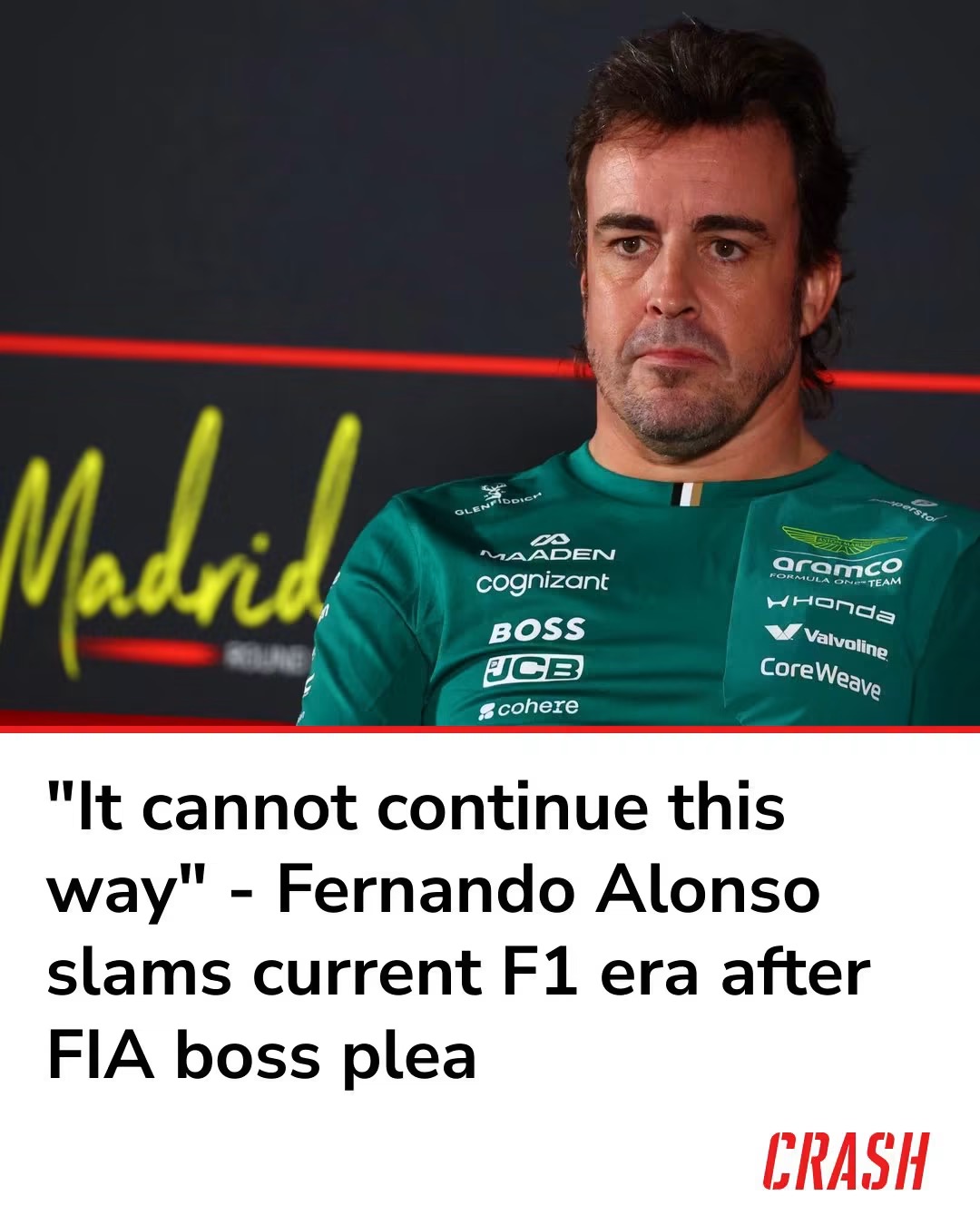
Fernando Alonso has delivered one of his most cutting assessments yet of the current Formula 1 era, declaring that “it cannot continue this way” after another disappointing qualifying at the Spanish Grand Prix. The two-time world champion’s frustration boiled over at the Madring as he continues to weigh up his future in the sport.
Alonso’s comments cut to the heart of a growing debate about driver influence, car performance and what Formula 1 should ultimately reward.
ALONSO’S BRUTAL ASSESSMENT OF DRIVER INPUT IN 2026
Speaking after both Aston Martin cars were eliminated in Q1, Alonso did not hide his dissatisfaction. He pointed to the challenging new Madrid circuit, with corners such as La Monumental (Turns 10-12), as an example of where pure driving skill should matter most.
Instead, he argued, the current generation of cars has reduced the driver’s role to a minimum. “Michael [Clayton, Aston Martin press officer] can drive in 10-12,” Alonso said. “You go flat with no [MGU-]K deployment, and then at one point the ‘K’ comes and then you go fast on the exits.”
In Alonso’s view, qualifying performance now depends more on “how much sock I have” — a reference to hybrid power and energy deployment — than on bravery, precision or individual talent. That reality, he made clear, is not sustainable for the long-term health of the sport.
THE FIA PRESIDENT’S UNUSUAL PUBLIC PLEA
Alonso’s remarks came only days after FIA president Mohammed ben Sulayem made a striking public intervention. Speaking at the New Economy Forum, ben Sulayem stated there was “no way we can allow Fernando Alonso, a great champion, to leave, just because of the circumstances.”
He confirmed he had personally asked Alonso what would be required to keep him in Formula 1 and what Aston Martin needed to improve its results. The comments were unusually direct from the sport’s governing body and underlined just how highly Alonso is still valued at the highest level.
ASTON MARTIN’S UPGRADES FAIL TO DELIVER IN MADRID
The timing of Alonso’s criticism is particularly pointed. Aston Martin arrived in Madrid with a significant aerodynamic upgrade package, while Honda introduced an upgraded power unit. The expected step forward failed to materialise. Both Alonso and Lance Stroll exited in Q1, with Stroll recording his 101st failure to escape the first part of qualifying.
For a team that has invested heavily and publicly targeted regular points and podium contention, the result was another sobering reminder of how difficult progress has become in the current regulatory cycle.
WHY ALONSO’S FRUSTRATION RESONATES ACROSS THE PADDOCK
Alonso is not the first driver to question the balance between technology and talent in the ground-effect hybrid era, but few carry his credibility. A two-time champion who has remained competitive deep into his forties, he has consistently demanded that Formula 1 reward the best drivers rather than the best combination of car and energy management.
His comments also arrive at a delicate moment for the championship. With major regulatory changes on the horizon for 2027, the sport is already under pressure to ensure the next generation of cars restores greater driver influence. Alonso’s willingness to speak so bluntly increases that pressure.
THE UNRESOLVED QUESTION OF ALONSO’S FUTURE
Despite earlier suggestions that a decision on his future would come around the summer break, Alonso has chosen to keep Aston Martin and the wider paddock waiting. He has still not committed beyond the end of the 2026 season.
The combination of on-track frustration, limited driver expression in the current cars, and an open-ended future creates genuine uncertainty. While ben Sulayem’s comments suggest the FIA is keen to keep him, Alonso has never been one to continue simply for the sake of it.
WHAT THIS MEANS FOR FORMULA 1 GOING FORWARD
Alonso’s broadside is more than the complaint of a frustrated driver after a bad Saturday. It is a challenge to the direction of the sport. If one of the greatest talents of his generation feels that bravery and skill are being sidelined by hybrid deployment and aerodynamic dependence, Formula 1 must take notice.
For Aston Martin, the comments increase the urgency to deliver genuine performance gains. For the FIA and the teams shaping the 2027 regulations, they serve as a high-profile reminder that driver appeal remains central to the championship’s popularity.
Whether Alonso ultimately stays or walks away, his message in Madrid was unambiguous. In his eyes, the current era has drifted too far from the fundamental principles of motorsport. And he is no longer willing to stay silent about it.