The debate surrounding transgender athlete participation in women’s sports continues to divide opinions across the United States, and the latest chapter unfolded ahead of the Indiana Fever’s matchup against the Seattle Storm. This time, the spotlight shifted from postgame interviews to pregame statements as Seattle veteran Stefanie Dolson made her stance visible after Indiana guard Sophie Cunningham’s recent comments reignited one of the most polarizing discussions in sports.
While the game itself featured two playoff contenders battling for valuable regular-season positioning, much of the conversation before tipoff centered on social issues rather than basketball, illustrating how today’s athletes increasingly use their platforms to express opinions on matters extending far beyond the court.
CUNNINGHAM’S COMMENTS CONTINUE TO GENERATE NATIONAL ATTENTION
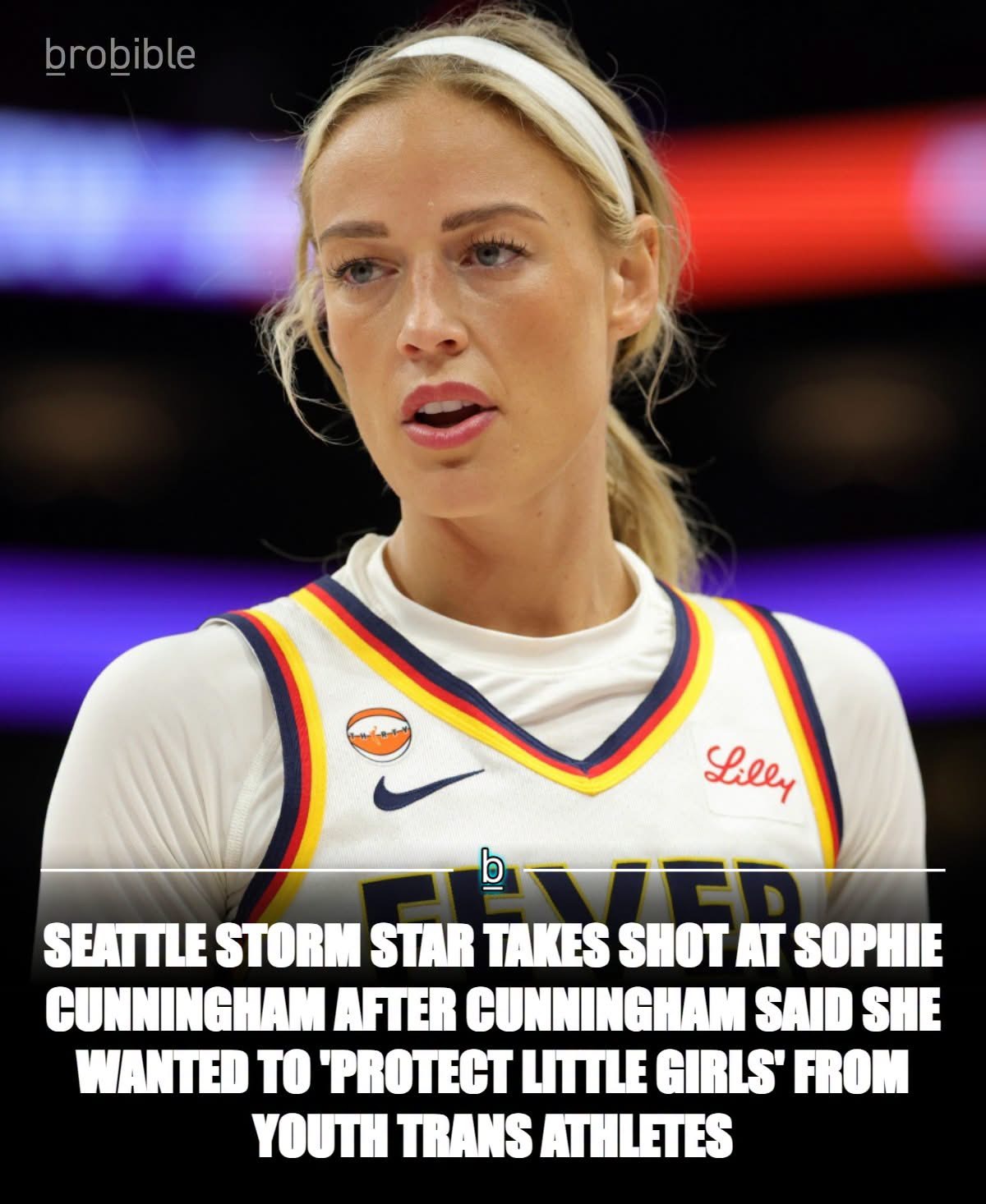
The controversy began after Cunningham addressed the issue of transgender athletes competing in girls’ and women’s sports during a recent interview.
The Indiana Fever guard emphasized that she does not harbor hatred toward transgender individuals, but believes biological girls should be protected in youth sports and locker rooms. Cunningham later reinforced her position when asked about the backlash, stating simply, “I said what I said.”
Her comments immediately generated widespread discussion across sports media and social media platforms. Some public figures and commentators supported her viewpoint, arguing that competitive fairness should remain a priority in women’s athletics. Others criticized her position, believing sports should be more inclusive for transgender athletes.
The differing reactions demonstrated just how deeply divided public opinion remains on an issue that extends far beyond the WNBA.
STEFANIE DOLSON RESPONDS WITH A VISIBLE MESSAGE
Ahead of Seattle’s home game against Indiana, Storm veteran Stefanie Dolson made her own position unmistakably clear.
During the team’s pregame arrival, Dolson wore a shirt displaying the message:
“TRANS RIGHTS ARE HUMAN RIGHTS.”
Although Dolson did not publicly mention Cunningham by name while entering the arena, many interpreted the shirt as a response to the Fever guard’s recent remarks.
Rather than engaging in a verbal exchange, Dolson chose a symbolic statement, reflecting a growing trend among professional athletes who use clothing, social media, and public appearances to communicate their beliefs on political and social issues.
The contrasting viewpoints between the two WNBA veterans immediately became another major storyline surrounding the league.
PROTESTS OUTSIDE THE ARENA HIGHLIGHT THE ISSUE’S GROWING IMPACT
The debate wasn’t confined to players.
Before fans entered the arena, demonstrators gathered outside in support of Cunningham’s position regarding transgender participation in women’s sports.
Their presence underscored how discussions that once remained largely within political or legal circles have increasingly found their way into professional sports venues.
As more states, governing bodies, and athletic organizations continue reviewing policies involving transgender athlete eligibility, high-profile leagues like the WNBA are likely to remain part of the national conversation—even when the league itself is not directly involved in establishing those broader regulations.
THE WNBA FACES THE CHALLENGE OF BALANCING SPORT AND SOCIAL ISSUES
Professional athletes today occupy a unique position in society. Their influence stretches beyond game results, allowing them to shape conversations involving culture, politics, equality, and public policy.
For the WNBA, this presents both opportunities and challenges.
On one hand, the league has long encouraged players to speak openly about issues they care about. On the other, highly divisive topics can shift attention away from the basketball product itself and create polarized reactions among fans.
The Cunningham-Dolson disagreement illustrates that players within the same league can hold fundamentally different views while sharing the same professional platform. Managing those differing perspectives without allowing them to overshadow competition remains an ongoing challenge for leagues across American sports.
WHAT COMES NEXT FOR THE FEVER AND THE LEAGUE?
Whether the public debate eventually fades or continues throughout the season remains uncertain.
Cunningham has shown no indication that she intends to walk back her remarks, while supporters and critics alike continue discussing the broader implications of transgender participation in women’s athletics.
For Indiana, the immediate focus remains winning basketball games and strengthening its playoff position behind stars Caitlin Clark, Aliyah Boston, Kelsey Mitchell, and Cunningham herself. Seattle likewise continues pursuing postseason success with an experienced roster determined to compete for another championship.
However, this episode serves as another reminder that modern professional athletes are increasingly influencing conversations that extend far beyond the scoreboard. As cultural debates continue intersecting with sports, moments like these are likely to become an even more common part of the WNBA landscape, leaving league officials, players, and fans to navigate difficult conversations while keeping the focus on the game itself.