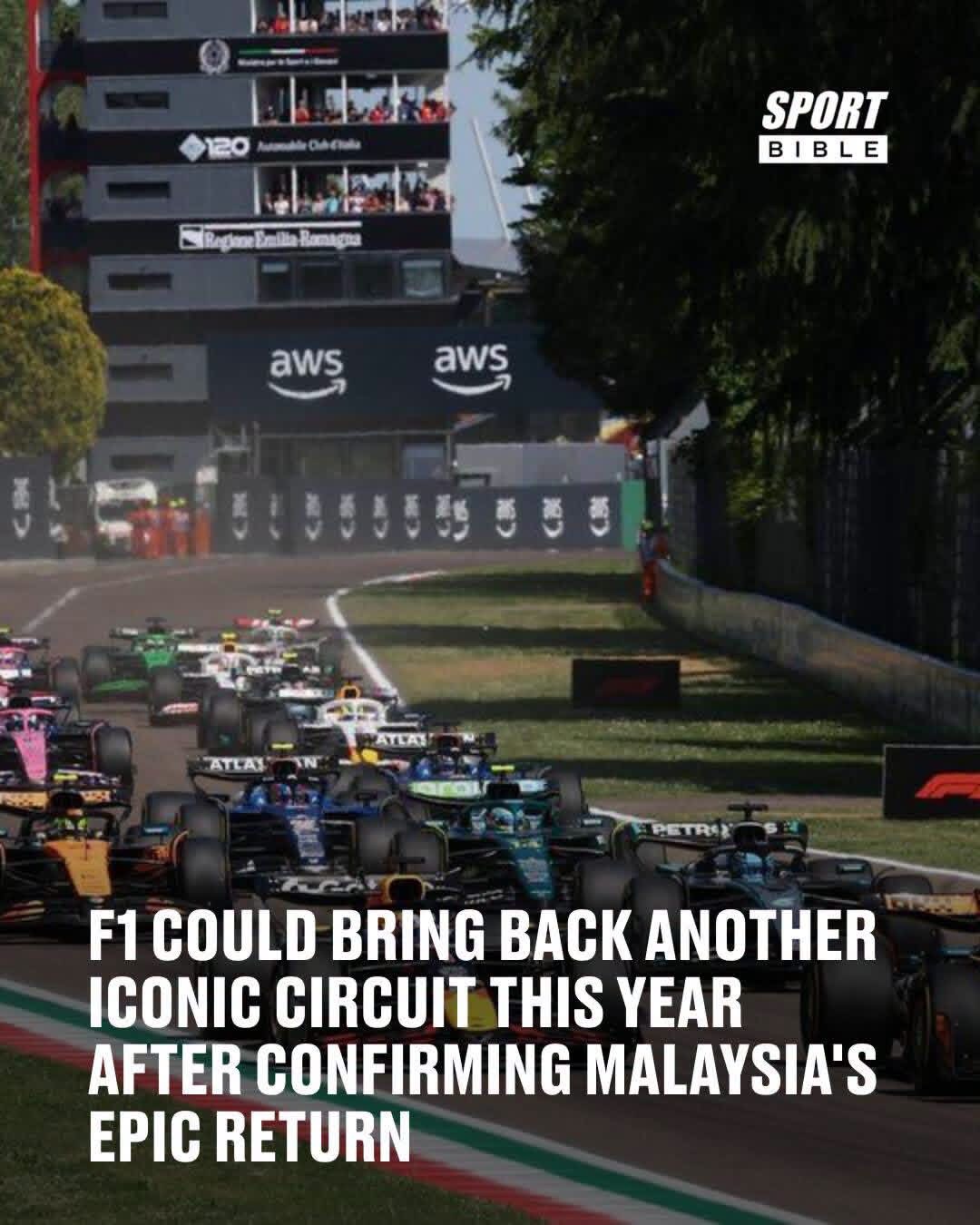
Formula 1 could be heading for another dramatic calendar shake-up in 2026, with the historic Imola circuit reportedly emerging as a leading candidate to host races if the championship’s Middle Eastern finale cannot go ahead.
The potential move comes after Sepang in Malaysia was lined up for a surprise return to the F1 calendar. The legendary Malaysian circuit is expected to host an event from October 2 to 4 as a replacement for the cancelled Bahrain Grand Prix, although the arrangement still requires the necessary formal approvals, including from the FIA.
Now, with uncertainty continuing to surround the final rounds of the season, F1 is reportedly examining further alternatives. Among the possibilities are two circuits with considerable Formula 1 history: Italy’s Imola and Portugal’s Portimao.
If the plans materialize, the 2026 season could look dramatically different from the calendar originally announced.
WHY F1’S 2026 CALENDAR HAS BEEN THROWN INTO UNCERTAINTY
The disruption to the 2026 Formula 1 season is linked to the cancellation of the Bahrain and Saudi Arabian Grands Prix amid escalating conflict in the Middle East.
While there had initially been optimism that the situation could improve before the end of the season, renewed instability has created fresh concerns about the championship’s planned conclusion in Qatar and Abu Dhabi.
That uncertainty presents a significant logistical and commercial challenge for Formula 1.
With 11 teams now competing in the championship, the sport’s calendar is tied closely to commercial agreements involving broadcasters, promoters and other partners. Reports indicate that F1 has contractual obligations requiring a minimum number of events, meaning the cancellation of additional races could create a serious problem for the championship.
That is why the possibility of bringing European circuits back into the spotlight is so important.
Rather than simply accepting a shortened season, Formula 1 appears to be considering established venues that can potentially step in at relatively short notice.
SEPANG’S RETURN COULD BE THE FIRST OF SEVERAL SURPRISES
Sepang’s potential comeback is already one of the biggest calendar stories of the 2026 season.
The Malaysian Grand Prix was removed from the F1 schedule after 2017, despite the circuit being widely respected by drivers and fans. Its combination of long straights, heavy braking zones and challenging high-speed corners made it one of the more demanding venues on the calendar.
Its return would already represent a major change to the championship’s schedule.
However, if the final races in Qatar and Abu Dhabi are also unable to take place, Formula 1 may have to go even further.
According to reports, Imola is currently considered a stronger option than Portimao, although both circuits are understood to be under consideration.
The situation demonstrates just how quickly an F1 calendar can change when external events force the sport to react.
IMOLA COULD BE THE IDEAL EMERGENCY SOLUTION
Of the two European venues reportedly being considered, Imola appears to make the most sense as a short-notice replacement.
The Autodromo Internazionale Enzo e Dino Ferrari has decades of experience hosting major international motorsport events and has a long-standing relationship with Formula 1.
Unlike some circuits that would require significant preparation to return to the championship, Imola already possesses much of the infrastructure needed to host an F1 weekend.
That could be a decisive advantage.
The circuit is also familiar to the current generation of drivers. Between 2020 and 2025, Imola hosted five races under the Emilia Romagna Grand Prix name, with Lewis Hamilton winning the first race after F1 returned to the venue before Max Verstappen dominated the following four editions.
That recent history means the teams would not be entering completely unknown territory.
From a sporting perspective, Imola would also provide a very different challenge compared with the traditional Middle Eastern finale. The narrow, fast layout places a premium on qualifying performance, aerodynamic efficiency and driver precision.
A race there could therefore create a fascinating conclusion to the championship.
THE SENNA CONNECTION MAKES IMOLA ONE OF F1’S MOST HISTORIC VENUES
Imola is not simply another circuit with a long history. It is one of the most emotionally significant locations in Formula 1.
The track will forever be associated with Ayrton Senna, who suffered his fatal accident at the circuit during the 1994 San Marino Grand Prix.
That weekend remains one of the darkest chapters in Formula 1 history, with Senna’s death coming after the fatal accident involving Roland Ratzenberger during the same event.
The circuit has since undergone major safety improvements, but its place in F1 history remains undeniable.
For many fans, a return to Imola would carry a sense of nostalgia while also highlighting how dramatically the sport has evolved over the decades.
The circuit’s significance is another reason why bringing it back for a potential late-season race could generate enormous global interest.
PORTIMAO IS ANOTHER INTRIGUING POSSIBILITY
Portugal’s Autodromo Internacional do Algarve is another potential option, although reports suggest it may be less likely than Imola.
Portimao hosted Formula 1 during the unusual 2020 and 2021 seasons, when the championship was forced to find alternative venues because of the global pandemic.
Both races produced memorable moments, and Lewis Hamilton won on each occasion.
The circuit’s undulating layout quickly earned praise from drivers. Its elevation changes, blind corners and flowing sequences make it a demanding track that rewards confidence and precision.
However, there is a practical reason why Portimao may not be the preferred option.
Portugal is already expected to return to the F1 calendar in 2027, and the circuit is reportedly preparing for a significant upgrade to its facilities. Hosting a surprise race in 2026 could complicate those preparations.
Imola, by comparison, may be in a stronger position to step in immediately.
PORTUGAL’S F1 HISTORY GOES FAR BEYOND PORTIMAO
Although Portimao’s modern F1 history is relatively short, Portugal has been part of Formula 1’s story for much longer.
The country’s first Grand Prix took place in 1951 at the Boavista circuit, where Ferrari’s Casimiro de Oliveira claimed victory.
Portugal later became a regular fixture through the Estoril era, with the Portuguese Grand Prix appearing on the calendar from 1984 through 1996.
That period featured some of the sport’s biggest stars, including Alain Prost, Michael Schumacher and Ayrton Senna.
The country’s return to the modern F1 calendar in 2020 and 2021 was therefore more than a pandemic-era solution. It revived a national connection with Formula 1 that had been dormant for years.
A permanent return in 2027 could give Portugal another opportunity to establish itself as a long-term part of the championship’s future.
A EUROPEAN FINALE COULD COMPLETELY CHANGE THE CHAMPIONSHIP BATTLE
If Imola replaces Abu Dhabi or another late-season race, the championship implications could be enormous.
The Middle Eastern venues traditionally provide hot conditions, modern facilities and layouts that place a particular emphasis on tyre management and straight-line performance. Imola would offer something completely different.
The Italian circuit is tighter and more technical, with overtaking opportunities that can be limited. That makes qualifying especially important.
A championship contender starting near the front could gain a significant advantage, while a driver forced to begin deep in the field might struggle to recover.
This could make the final race far more unpredictable than the teams initially expected.
The biggest winners may be drivers who excel at maximizing qualifying performance and maintaining consistency on technical circuits.
WHAT THE POTENTIAL CALENDAR CHANGE MEANS FOR THE TEAMS
For the teams, a sudden switch to Europe would create both opportunities and headaches.
The positive is that Imola is a known quantity. Teams have extensive data from recent races, meaning engineers can prepare simulations and setup strategies without starting from scratch.
The downside is timing.
A late-season change could force teams to rethink logistics, freight schedules and personnel movements. F1 operates on an incredibly complex global calendar, and moving from one region to another is far more complicated than simply selecting a different circuit.
There would also be questions surrounding car development.
By the end of the season, teams are normally focused heavily on the following year’s machinery. An unexpected race at a circuit like Imola could reward teams that still have the resources and motivation to bring late-season upgrades.
That could potentially influence the constructors’ championship as well as the drivers’ title fight.
THE BIGGEST QUESTION IS WHETHER THE FINAL RACES CAN GO AHEAD
For all the speculation surrounding Imola and Portimao, the most important factor remains the situation in the Middle East.
If Qatar and Abu Dhabi are able to host their scheduled events, the need for additional European replacements could disappear.
But if the security situation deteriorates further, Formula 1 will need a contingency plan.
Sepang’s potential return shows that F1 is already willing to think creatively. A second major calendar adjustment would be much more complicated, but the sport has demonstrated in recent years that it can adapt when circumstances demand it.
The key will be ensuring that any replacement maintains the sporting integrity of the championship while satisfying the logistical and commercial requirements of Formula 1.
MY PREDICTION FOR THE 2026 F1 SEASON FINALE
If another race has to be added to replace a cancelled Middle Eastern event, Imola looks like the logical favorite.
The circuit has recent F1 experience, a deep connection to the sport, established infrastructure and a layout capable of producing a serious championship challenge.
Portimao would arguably offer the more visually spectacular alternative, but its expected 2027 return and planned facility improvements could make an immediate comeback less practical.
The most fascinating possibility, however, would be a European finale after a season that was originally expected to end in the Gulf.
Formula 1’s modern calendar has increasingly expanded into new markets, but the potential return of Imola would remind fans that the sport’s historic European venues still possess enormous value.
For the championship itself, an Imola finale could create a completely different tactical battle. Qualifying could become crucial, strategy could be shaped by limited overtaking opportunities, and drivers who thrive on precision rather than raw straight-line speed could suddenly find themselves with a major advantage.
F1’S 2026 CALENDAR COULD BECOME ONE OF THE MOST UNPREDICTABLE IN YEARS
The potential return of Sepang was already enough to make the 2026 calendar one of the most unusual in recent memory.
Now, the possibility of Imola or Portimao joining the schedule adds another layer of intrigue.
Much will depend on developments surrounding the Middle East and whether Qatar and Abu Dhabi can safely host the final stages of the championship. Until those decisions are confirmed, teams, drivers and fans may have to wait for clarity.
But one thing is becoming increasingly clear: the 2026 Formula 1 season is proving that the calendar itself can become part of the story.
If Imola does return for a late-season showdown, it could provide one of the most memorable endings to an F1 campaign in years—and potentially give the championship a historic twist that nobody saw coming.