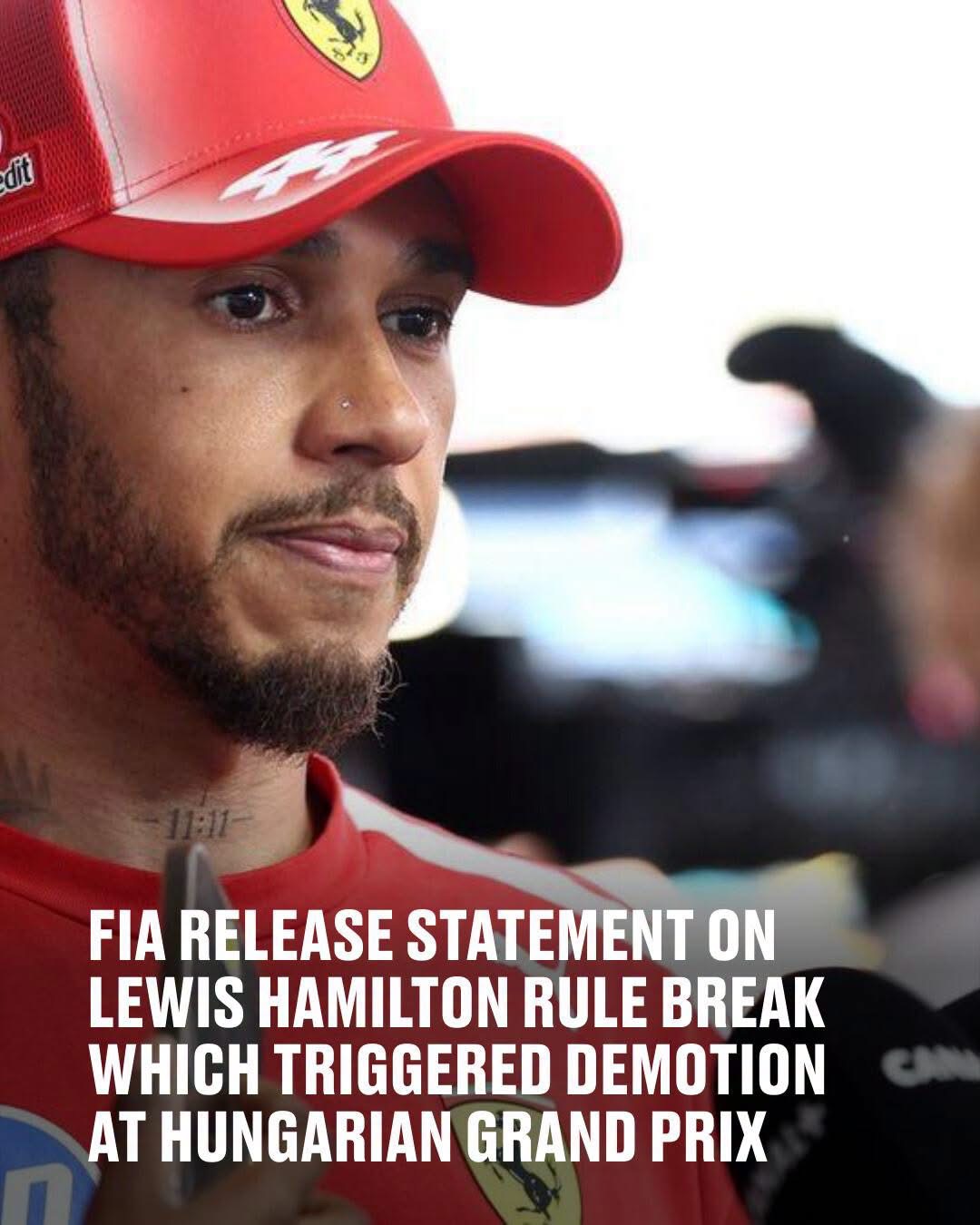
Lewis Hamilton’s pursuit of a crucial result at the Hungarian Grand Prix ended in frustration after the FIA handed the Ferrari driver a late five-second time penalty, dropping him from fourth to fifth in the final classification. The decision not only cost Hamilton valuable championship points but also widened the gap between him and Drivers’ Championship leader Andrea Kimi Antonelli as the 2026 Formula 1 season reached its halfway stage.
The seven-time world champion crossed the finish line in fourth after a determined recovery drive, but the post-race adjustment allowed Ferrari teammate Charles Leclerc to move ahead in the official standings. With Antonelli securing another podium for Mercedes, Hamilton now faces an even steeper climb in the title race.
WHY THE FIA PENALIZED HAMILTON
According to the FIA stewards, Hamilton’s penalty was not related to his earlier on-track battle with Antonelli under Virtual Safety Car conditions. While Ferrari instructed Hamilton to return the position after an apparent infringement exiting the pit lane, that incident was resolved without becoming the deciding factor in his final result.
Instead, the FIA ruled that Hamilton exceeded the pit lane speed limit during his stop.
In its official statement, the governing body confirmed:
“Car 44 exceeded the pit lane speed limit, which is set at 80 km/h for this event, by 0.1 km/h.”
Although the margin was incredibly small—just one-tenth of a kilometer per hour—the FIA applies strict liability to pit lane speed violations. The regulations leave very little room for discretion, regardless of whether the advantage gained is significant or virtually nonexistent.
HAMILTON’S FRUSTRATION BOILED OVER
Hamilton’s disappointment became clear over Ferrari’s team radio during the race. After already being asked to surrender a position under the Virtual Safety Car, he expressed disbelief that another penalty had followed.
His emotional reaction reflected the mounting frustration of a driver who believes several stewarding decisions this season have worked against him. For a championship contender, every point matters, and losing one position because of a marginal pit lane infringement only intensified those feelings.
Ferrari also faced questions over whether the team could have done more to ensure Hamilton stayed comfortably below the speed limit, especially given how precise modern Formula 1 pit lane systems have become.
THE CHAMPIONSHIP IMPLICATIONS ARE SIGNIFICANT
Hamilton’s demotion could have a larger impact than simply losing one finishing position.
Andrea Kimi Antonelli continued his remarkable rookie campaign by claiming another podium finish, extending his championship advantage over Hamilton to 50 points. At the halfway stage of the season, that gap is substantial, even though mathematically the title remains within reach.
For Hamilton, every race from this point forward becomes increasingly important. Ferrari cannot afford operational mistakes or avoidable penalties if it hopes to mount a serious championship challenge against Mercedes.
The Constructors’ Championship battle is also affected. Every point lost could prove decisive as Ferrari continues fighting Mercedes throughout the second half of the campaign.
WHY PIT LANE SPEED RULES ARE STRICT
Formula 1 enforces pit lane speed limits primarily for safety. Team personnel, mechanics, officials, and media operate within confined spaces where cars travel only a few meters away.
Because of those safety concerns, the FIA applies the rules consistently regardless of how small the excess speed may be. Whether a driver exceeds the limit by 0.1 km/h or several kilometers per hour, the principle remains the same: exceeding the limit constitutes a breach of the Sporting Regulations.
While some fans argue that such minimal violations deserve greater flexibility, the FIA maintains that consistent enforcement prevents subjective decision-making.
CAN FERRARI RECOVER IN THE SECOND HALF OF THE SEASON?
Despite the setback, Ferrari still possesses one of the fastest cars on the grid. Hamilton and Leclerc have both demonstrated race-winning pace throughout the season, and the team continues developing its package for the remaining Grands Prix.
However, outright speed alone will not be enough.
Mercedes has combined performance with operational consistency, allowing Antonelli to build a commanding championship lead. Ferrari must now eliminate costly errors, maximize strategy calls, and avoid penalties if Hamilton is to remain in contention.
With several races still remaining, momentum can change quickly in Formula 1. Yet Hamilton’s Hungarian Grand Prix serves as another reminder that championships are often decided not only by pace but also by precision. In a season where every point could determine the title, even exceeding the pit lane speed limit by 0.1 km/h can carry enormous consequences.