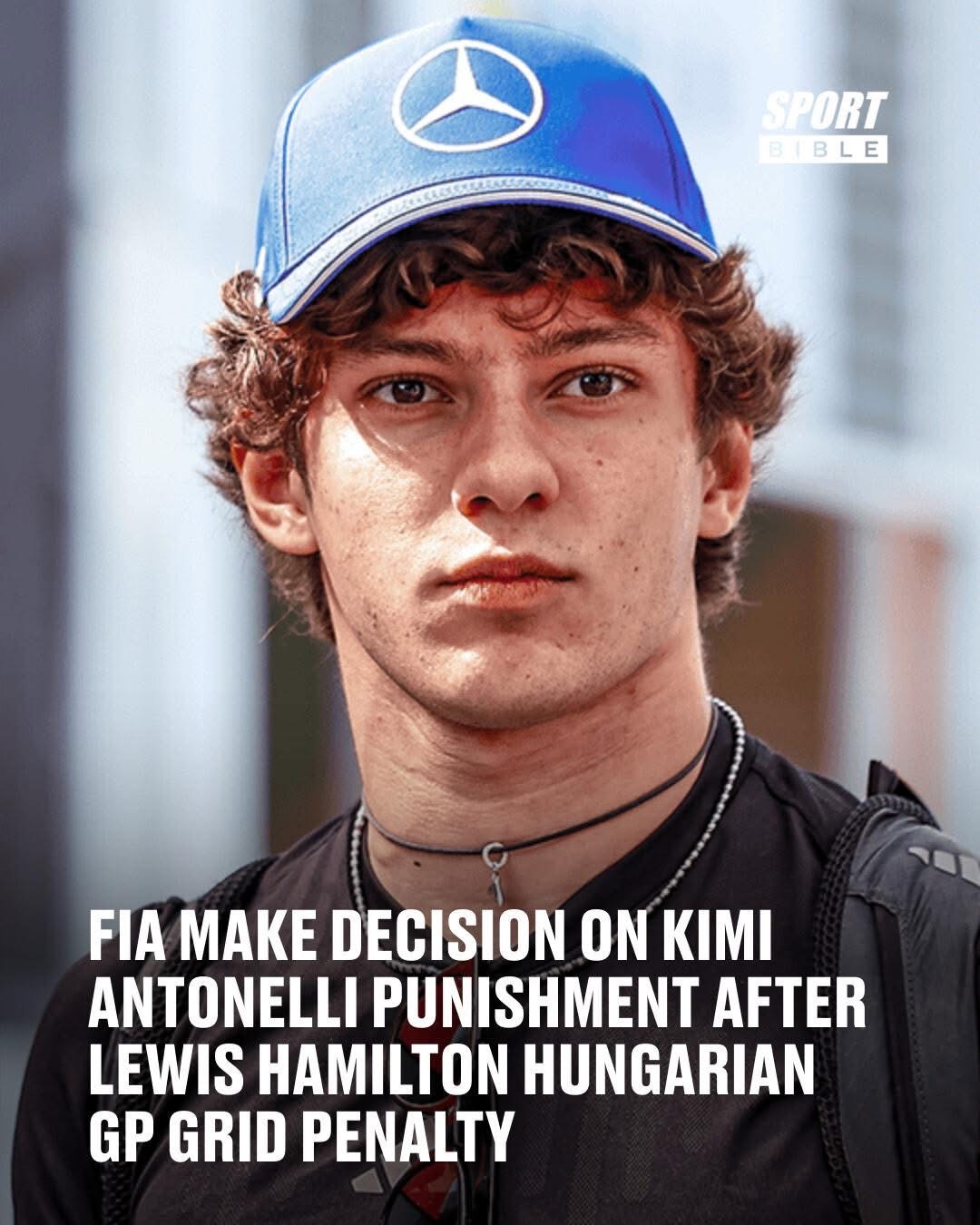
The FIA has dramatically reshaped the starting grid for the Hungarian Grand Prix after handing Mercedes championship leader Andrea Kimi Antonelli the same three-place grid penalty previously imposed on Ferrari’s Lewis Hamilton. What initially looked like a straightforward front-running battle has now turned into one of the most unpredictable races of the 2026 Formula 1 season, with two title contenders losing valuable starting positions before the lights even go out.
Antonelli’s punishment follows an FIA investigation into separate qualifying incidents, adding another twist to an already controversial Saturday at the Hungaroring. With both Hamilton and Antonelli now dropping three places, Sunday’s race could have major implications for the championship fight as rivals gain unexpected opportunities to capitalize.
FIA PENALISES ANTONELLI AFTER QUALIFYING INVESTIGATION
After qualifying concluded, Antonelli was called to the stewards alongside a Mercedes representative to answer questions regarding two separate incidents during the session.
The most serious investigation focused on whether the Italian driver had failed to slow sufficiently while yellow flags were being displayed on the circuit.
Following a review of telemetry, onboard footage, and other available evidence, the FIA concluded that Antonelli had breached the regulations governing yellow-flag procedures. As a result, the Mercedes driver received a three-place grid penalty for Sunday’s Hungarian Grand Prix.
The stewards also examined another incident involving an alleged failure to follow the Race Director’s instructions. In that case, Antonelli escaped with only a formal warning, avoiding any additional sporting penalty.
MATCHING PENALTIES FOR TWO TITLE CONTENDERS
Antonelli’s punishment came shortly after Lewis Hamilton received an identical three-place grid drop for impeding McLaren’s Oscar Piastri during the closing stages of qualifying.
Hamilton had initially qualified on the front row but was found to have unnecessarily blocked Piastri’s flying lap after failing to move off the racing line in time. Ferrari admitted the team had communicated too late to warn Hamilton about the approaching McLaren.
Now, both championship contenders will begin Sunday’s race lower than their qualifying performances deserved.
For Formula 1 fans, the matching sanctions create an unusual scenario in which two of the sport’s biggest names lose valuable track position for completely different infractions.
WHY ANTONELLI’S PENALTY MATTERS FOR THE CHAMPIONSHIP
The timing of Antonelli’s penalty could hardly be more significant.
The young Mercedes driver currently leads the 2026 Drivers’ Championship and has consistently demonstrated maturity beyond his years throughout the season. Every point now carries increased importance as rivals continue closing the gap heading into the second half of the campaign.
Dropping three places at the Hungaroring is particularly damaging because overtaking opportunities are traditionally limited on the narrow and technical Budapest circuit.
Instead of attacking from near the front, Antonelli now faces the challenge of navigating heavier traffic while attempting to limit the damage to his championship lead.
Although Mercedes has displayed strong race pace this weekend, recovering lost positions will require both strategic precision and flawless execution.
THE FIA’S CONSISTENCY SENDS A CLEAR MESSAGE
One of the biggest talking points to emerge from qualifying is the FIA’s willingness to apply regulations consistently, regardless of a driver’s championship position or reputation.
Hamilton’s penalty demonstrated that qualifying impeding will continue to be punished under established guidelines.
Antonelli’s sanction reinforces that message by showing that failures to respect yellow-flag procedures are treated just as seriously.
For Formula 1, consistency in stewarding has long been one of the sport’s most debated issues. Saturday’s decisions suggest the governing body is determined to apply the rules equally across the grid, even when it affects leading championship contenders.
While teams may disagree with individual rulings, consistent enforcement provides greater clarity for drivers moving forward.
RIVALS STAND TO BENEFIT FROM THE SHAKE-UP
The revised grid offers major opportunities for several of Formula 1’s biggest contenders.
McLaren’s Lando Norris, already starting from pole position, now enjoys an even stronger chance of controlling the race from the front.
Ferrari’s Charles Leclerc also benefits by moving higher up the order, improving the Scuderia’s chances of fighting for victory despite Hamilton’s setback.
Oscar Piastri, whose qualifying lap was compromised by Hamilton’s incident, also gains valuable track position after both penalties are applied.
For Red Bull and Max Verstappen, the reshuffled grid may also present an opportunity to gain crucial points during a season in which every result has become increasingly important.
SUNDAY’S HUNGARIAN GRAND PRIX BECOMES EVEN MORE UNPREDICTABLE
Before qualifying, the race appeared likely to feature a straightforward battle between Norris, Hamilton, Antonelli, and Leclerc.
Now, the competitive picture has changed dramatically.
Both Hamilton and Antonelli possess the pace to fight at the front, but they must first recover the positions lost through FIA sanctions. That raises the possibility of aggressive overtaking, alternative pit strategies, and unexpected tactical battles throughout the afternoon.
At a circuit where track position is traditionally everything, even a small grid penalty can fundamentally change the outcome of a race.
The FIA’s decisions have therefore done more than alter the starting order—they have transformed the strategic landscape of the Hungarian Grand Prix.
With two championship contenders now forced onto the back foot, Sunday’s race promises to be one of the most fascinating contests of the 2026 Formula 1 season, as Hamilton and Antonelli attempt to recover while their rivals seize an unexpected advantage.