Formula 1 has always been a battleground of engineering brilliance, where the brightest minds in motorsport constantly search for performance advantages that could shave tenths—or even full seconds—off lap times. While innovation is the heartbeat of F1, history shows there is a fine line between genius and gaining an unfair competitive edge. Whenever a technological breakthrough threatens to distort competition, increase costs, or compromise safety, the FIA steps in to rewrite the rulebook.
Over the decades, some of Formula 1’s most revolutionary ideas have disappeared almost as quickly as they arrived. From aerodynamic tricks to intelligent suspension systems, these inventions briefly transformed the sport before being outlawed. Yet many of these banned concepts later inspired technologies used in road cars or influenced future racing designs.
Here are ten Formula 1 innovations that pushed the limits too far and ultimately forced the FIA to intervene.
1. ACTIVE SUSPENSION (1994)
Perhaps no banned technology ever changed Formula 1 more dramatically than active suspension.
Unlike conventional suspension, this electronic hydraulic system constantly adjusted ride height and body movement throughout every corner, braking zone, and straight. Instead of relying purely on mechanical springs and dampers, computers optimized the car’s balance in real time.
Williams mastered the technology better than anyone. During the early 1990s, their cars appeared glued to the circuit, allowing drivers to attack corners with remarkable consistency.
Although incredibly effective, active suspension became prohibitively expensive and shifted too much of the performance advantage toward software rather than driver ability. The FIA banned it in 1994 to restore competitive balance and reduce escalating development costs.
2. F-DUCT (2011)
The F-Duct remains one of the cleverest aerodynamic ideas Formula 1 has ever seen.
Introduced by McLaren during the 2010 season, the system allowed drivers to stall the rear wing by blocking a cockpit air inlet using their hand, knee, or elbow. This dramatically reduced aerodynamic drag on straights, increasing top speed without sacrificing cornering performance elsewhere.
The innovation delivered valuable straight-line gains and was quickly copied across the grid.
However, the FIA concluded that requiring drivers to physically manipulate airflow while racing created unnecessary safety concerns. By 2011, regulations were rewritten to eliminate the concept entirely.
3. DOUBLE DIFFUSER (2011)
Few aerodynamic developments caused as much controversy as the double diffuser.
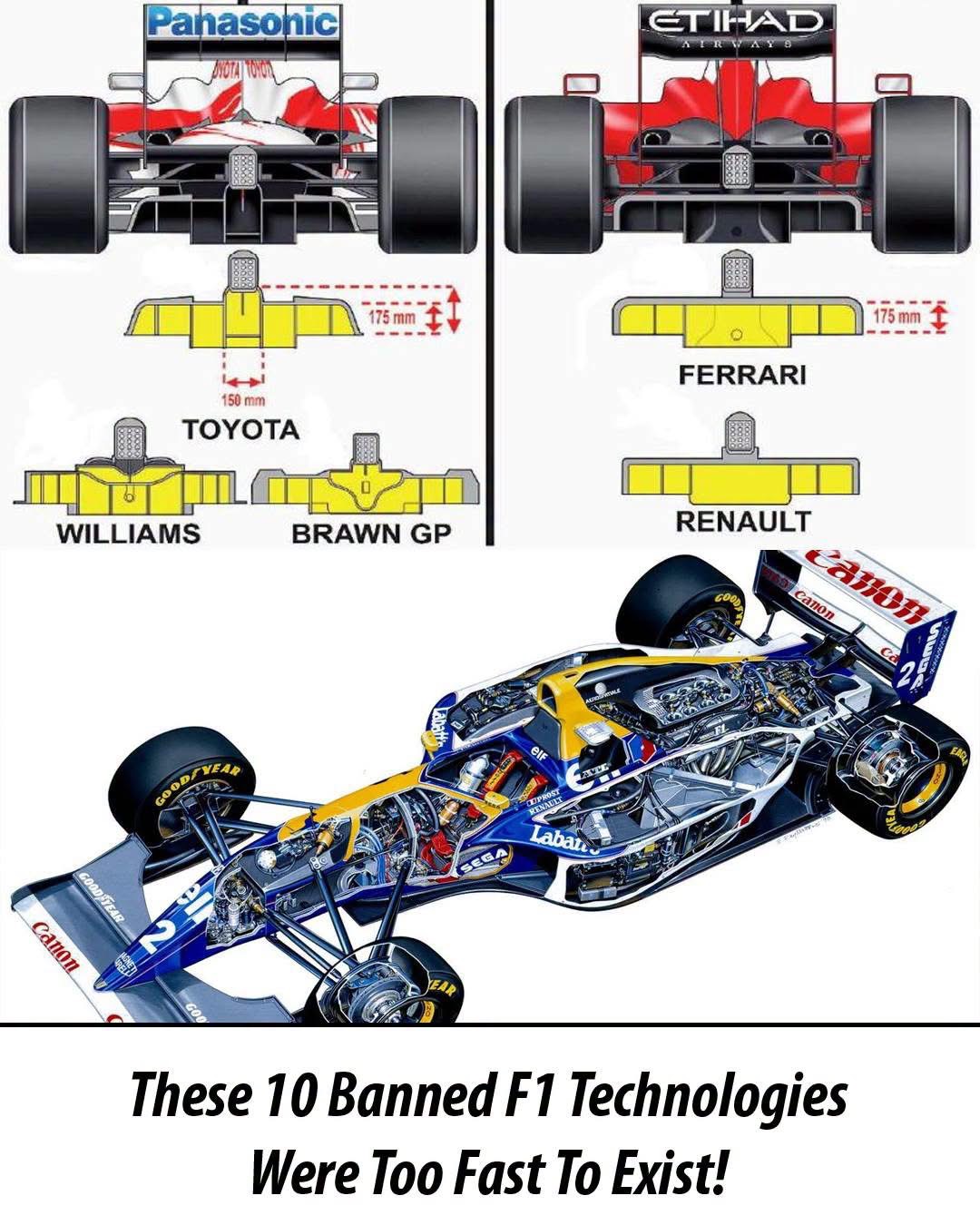
Discovered by Brawn GP, Toyota, and Williams in 2009, the design exploited a loophole in the regulations to dramatically increase rear downforce while technically remaining legal.
The additional grip transformed Brawn GP into one of Formula 1’s biggest success stories, helping Jenson Button secure the World Championship.
Although initially declared legal, the FIA closed the loophole before the 2011 season, ending one of the most influential aerodynamic innovations of the modern era.
4. MASS DAMPER (2006)
Sometimes the smallest components create the biggest advantages.
Renault’s mass damper consisted of a weighted device mounted inside the nose of the car that minimized chassis vibrations over bumps and during cornering.
The result was improved tyre contact with the track surface, giving drivers superior grip and consistency throughout a race.
Despite initially passing FIA inspections, the governing body later ruled the device acted as an aerodynamic aid rather than a suspension component, leading to its ban midway through the 2006 season.
5. FAN CAR (1978)
The Brabham BT46B remains one of Formula 1’s most legendary engineering experiments.
A massive fan mounted at the rear extracted air from underneath the car, creating enormous ground effect suction regardless of vehicle speed.
Unlike conventional aerodynamic downforce, the system worked almost instantly and allowed extraordinary cornering speeds.
The car famously won its only race before being voluntarily withdrawn amid growing political pressure from rival teams.
Although officially justified as an engine cooling solution, few doubted its true aerodynamic purpose.
6. SIX-WHEELED CARS
Formula 1 briefly explored the possibility that six wheels might outperform four.
The Tyrrell P34 featured four smaller front wheels designed to reduce aerodynamic drag while increasing front-end grip.
Initially successful, the concept proved increasingly difficult as tyre manufacturers focused development on conventional four-wheel cars.
Although the FIA eventually prohibited six-wheel designs, the experiment remains one of the sport’s boldest engineering ideas.
7. FLEXIBLE WINGS
Aerodynamics have always lived in Formula 1’s grey areas.
Flexible wings were engineered to remain rigid during FIA inspections but bend under high-speed aerodynamic loads. This allowed teams to enjoy greater downforce in corners while reducing drag on straights.
The constant battle between designers and regulators continues today through increasingly sophisticated load tests.
Modern regulations have become far stricter, effectively banning excessive wing flexibility while still allowing controlled elastic movement within defined limits.
8. BLOWN DIFFUSER (2012)
The blown diffuser demonstrated how engineers could transform engine exhaust into an aerodynamic weapon.
Instead of simply directing exhaust gases away from the engine, teams channelled hot airflow toward the rear diffuser to dramatically increase downforce.
Red Bull perfected the concept during Sebastian Vettel’s championship-winning years, producing exceptional grip throughout medium- and high-speed corners.
As development intensified, costs rose sharply and the FIA concluded that exhaust systems should not function primarily as aerodynamic devices, resulting in tighter restrictions.
9. DUAL-AXIS STEERING (DAS)
Mercedes surprised the Formula 1 world during pre-season testing in 2020 with Dual-Axis Steering.
Drivers could push or pull the steering wheel to alter the front wheels’ toe angle while driving, improving tyre temperatures and reducing wear over long stints.
Although the FIA ruled the innovation legal for the 2020 season, officials quickly amended the regulations to outlaw the concept from 2021 onward.
DAS highlighted how even legal innovations can disappear almost immediately once governing bodies close regulatory loopholes.
10. CVT TRANSMISSION
Formula 1 almost entered an entirely different technological era through continuously variable transmissions.
Unlike traditional gearboxes with fixed ratios, a CVT keeps the engine operating at its most efficient RPM throughout acceleration.
Williams successfully tested the technology during the early 1990s, producing astonishingly smooth and efficient power delivery.
Fearing massive performance disparities and rapidly escalating development costs, the FIA banned CVT systems before they ever reached competitive racing.
WHY THE FIA CONTINUES TO BAN INNOVATION
Every banned technology reflects Formula 1’s constant struggle to balance innovation with fair competition.
Engineers will always search for loopholes, while regulators must decide whether those breakthroughs enhance the sport or undermine it. Some technologies disappear because they are too expensive, others because they create dangerous situations, and some simply make one team too dominant.
Yet banning these systems has never slowed Formula 1’s creativity. Instead, it forces engineers to look elsewhere for performance gains, driving new breakthroughs season after season.
THE LEGACY OF FORMULA 1’S BOLDEST INVENTIONS
Many of Formula 1’s banned innovations ultimately influenced automotive engineering far beyond the racetrack.
Electronic suspension systems, advanced aerodynamics, lightweight materials, energy recovery technologies, and sophisticated control software all owe part of their development to ideas first explored in Formula 1.
While these ten technologies no longer compete on Grand Prix weekends, they remain powerful reminders that Formula 1 has always been more than a racing series. It is one of the world’s greatest engineering laboratories, where today’s impossible idea often becomes tomorrow’s everyday technology.
As Formula 1 enters new technical eras, history suggests one thing is certain: engineers will continue pushing the limits until the FIA once again decides they have gone just a little too far.