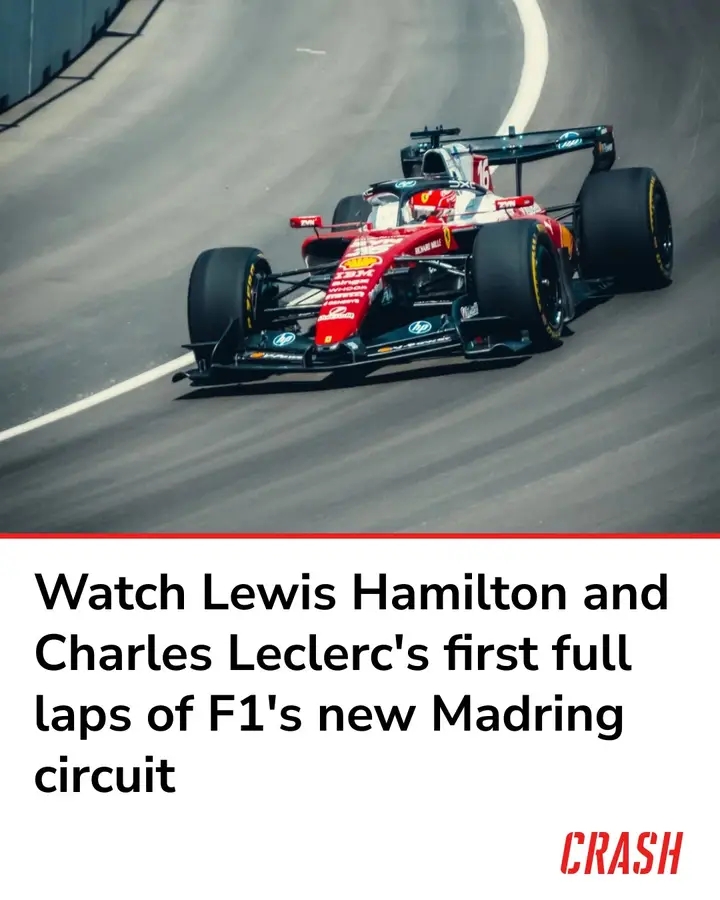
Formula 1 has officially taken its first major step toward a new era in Spain after Ferrari completed an exclusive filming day at Madrid’s brand-new Madring circuit. Lewis Hamilton and Charles Leclerc became the first current F1 race drivers to complete full laps of the venue, giving fans an early glimpse of what could become one of the championship’s most demanding and controversial tracks.
Although the session was limited to promotional running under Formula 1’s filming day regulations, the footage has already generated significant excitement across the paddock. With the Spanish Grand Prix preparing to leave the iconic Circuit de Barcelona-Catalunya for Madrid, every second of Ferrari’s on-track action has been closely examined by teams, analysts, and fans eager to understand what challenges await when the circuit hosts its first Grand Prix.
FERRARI BECOMES THE FIRST TEAM TO TEST THE MADRING
Ferrari’s filming day allowed the team to complete up to 200 kilometers of running using specially designed Pirelli demonstration tyres. Because these tyres do not reflect true race performance, neither Ferrari nor its rivals are expected to gain meaningful competitive data from the outing.
Instead, the objective was to capture promotional content while giving Hamilton and Leclerc valuable first impressions of the circuit’s layout. Even without pushing anywhere near qualifying pace, both drivers experienced the unique characteristics that could define racing in Madrid for years to come.
The event also marked another milestone in Hamilton’s first season with Ferrari. Every opportunity to familiarize himself with new circuits alongside his new team strengthens the seven-time world champion’s preparation as Ferrari continues its pursuit of championship success.
THE NEW MADRING LOOKS UNLIKE ANY OTHER MODERN F1 TRACK
The onboard footage immediately revealed several features that separate the Madring from many recent Formula 1 venues.
One of the most striking aspects is the circuit’s narrow design. Unlike many modern tracks that feature expansive runoff areas and multiple racing lines, Madrid appears considerably tighter, forcing drivers into precise positioning through much of the lap.
The pit exit itself is unusually narrow, while several corners feature significant elevation changes that create blind braking zones. Drivers often won’t have a full view of the apex until committing to the corner, increasing the importance of confidence, precision, and commitment.
Perhaps the biggest talking point is Turn 12, a steeply banked corner that already looks capable of placing enormous stress on the tyres. Even at reduced filming speeds, the banking suggests tyre degradation could become a major strategic factor during race weekends.
OVERTAKING COULD BECOME THE BIGGEST QUESTION MARK
While the circuit offers numerous braking zones that should allow drivers to recover energy efficiently under Formula 1’s hybrid systems, overtaking opportunities remain uncertain.
The combination of narrow sections, rapid direction changes, and limited runoff appears to encourage a single optimal racing line through many corners. That raises concerns that following another car closely could prove extremely difficult, particularly if turbulent air continues to affect performance despite Formula 1’s latest aerodynamic regulations.
If passing opportunities are limited, qualifying could become more important than ever. Teams may prioritize one-lap pace, while race strategy, pit-stop timing, tyre management, and undercut opportunities could ultimately decide the outcome of the Spanish Grand Prix.
However, appearances can sometimes be misleading. Several circuits initially criticized for limited overtaking have produced memorable races once Formula 1 cars actually competed at full speed. The true test will only come when the entire grid tackles the circuit under competitive conditions.
WHY THIS FILMING DAY STILL MATTERS
Although Ferrari was not collecting meaningful setup data, the session provided valuable operational experience.
Running through pit procedures, checking systems, familiarizing drivers with references, and exposing engineers to the circuit environment all contribute to smoother preparation ahead of race weekend. Even small details—such as visibility over crests, braking markers, and corner sequencing—can prove useful once competitive sessions begin.
For Hamilton, adapting to another completely new venue while continuing to build chemistry with Ferrari is another positive step during an important campaign. For Leclerc, early experience at a home European venue could provide a small but useful confidence boost.
FORMULA 3 WILL PLAY A KEY ROLE BEFORE F1 ARRIVES
Ferrari may have delivered the circuit’s first Formula 1 laps, but further development work is still required before the inaugural Spanish Grand Prix.
Formula 3 is scheduled to conduct an in-season test at the venue in the coming weeks. Those sessions will allow organizers to evaluate everything from track operations and safety systems to marshal procedures, timing equipment, and circuit infrastructure before Formula 1 arrives.
The feedback gathered from junior-category drivers and officials could also lead to small adjustments designed to improve safety or racing quality before the world’s fastest cars take to the circuit.
WHAT THIS MEANS FOR THE 2026 CHAMPIONSHIP
Introducing an entirely new circuit always creates opportunities for surprises.
Without years of historical data, teams begin on a more equal footing than they would at long-established venues. Engineers must rely heavily on simulator work, while drivers quickly adapt to changing grip levels and evolving racing lines throughout the weekend.
That environment often rewards adaptable drivers capable of learning rapidly—a category that certainly includes both Hamilton and Leclerc.
If Ferrari continues its recent improvement throughout the season, arriving at a completely new venue could offer the Scuderia another opportunity to challenge for crucial championship points. Equally, rivals such as Red Bull, McLaren, and Mercedes will be eager to exploit any uncertainty as the title fight intensifies.
FINAL THOUGHTS
Ferrari’s first laps around the Madring represent far more than a simple promotional event. They offered Formula 1 fans their earliest detailed look at a circuit that promises dramatic elevation changes, demanding corners, and strategic complexity.
Questions remain about overtaking and race spectacle, but the track’s technical nature could reward the most complete drivers on the grid. With Lewis Hamilton and Charles Leclerc already gaining valuable experience, Ferrari has taken an early step toward mastering one of Formula 1’s newest challenges.
When the Spanish Grand Prix finally arrives in Madrid, every team will face the unknown. And in Formula 1, it’s often those unknowns that produce the season’s most unforgettable weekends.