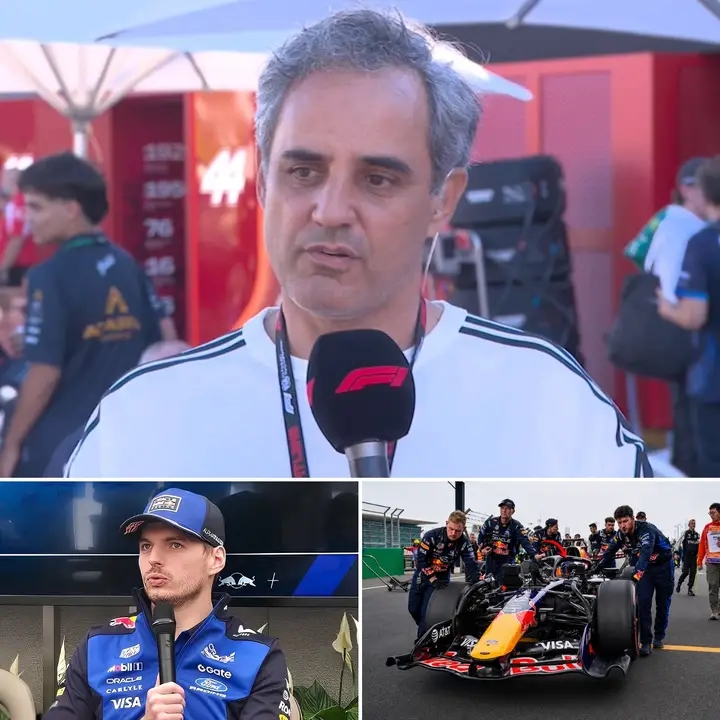
Formula 1 has another heated controversy on its hands after former Grand Prix winner Juan Pablo Montoya questioned Max Verstappen’s repeated criticism of Red Bull’s 2026 challenger. His comments have sparked widespread debate across the paddock, with fans divided over whether the reigning world champion is being too negative or simply exposing the team’s ongoing weaknesses.
Montoya argued that Red Bull has invested heavily in developing the RB22 throughout the season and suggested Verstappen should recognize those efforts rather than continually highlighting the car’s shortcomings. The former Williams and McLaren driver believes Red Bull has introduced more upgrades than almost any other team, making it difficult to justify the constant criticism directed at the car.
WHY MONTOYA BELIEVES VERSTAPPEN IS PUTTING RED BULL UNDER PRESSURE
Montoya’s view is based on the belief that Formula 1 development is never straightforward. Every team introduces updates, but not every package immediately delivers lap time. In his opinion, Red Bull has continued to push aggressively with the RB22 despite adapting to an entirely new technical era featuring Red Bull’s first in-house Ford-backed power unit.
From Montoya’s perspective, public criticism can unintentionally increase pressure on engineers who are already working around the clock to solve performance issues. When a four-time world champion repeatedly says the car is difficult to drive, it naturally raises questions about whether the team has lost its technical edge.
His comments also reflect the reality that Red Bull is no longer enjoying the overwhelming dominance it experienced in previous seasons. Instead, every small improvement has become crucial in a fiercely competitive championship.
VERSTAPPEN’S RESPONSE QUICKLY CAUGHT THE PADDOCK’S ATTENTION
Verstappen, however, has shown little interest in softening his position.
The Dutchman has consistently maintained that upgrades only matter if they genuinely improve performance. Throughout the season, he has openly discussed problems with balance, drivability and confidence behind the wheel, insisting that simply bringing new parts does not automatically make the car competitive. His frustration has been evident after several difficult weekends, including describing the RB22 as “completely undriveable” during one of the season’s toughest events.
Verstappen’s blunt communication style has become one of his defining characteristics. Rather than protecting the team’s image, he often chooses complete honesty, believing direct feedback is the fastest route to improvement.
That response has impressed some observers while frustrating others, ensuring the debate remains one of Formula 1’s biggest talking points.
THE REAL ISSUE ISN’T THE COMPLAINTS—IT’S THE RESULTS
The bigger question may not be whether Verstappen complains too much, but why he feels compelled to do so.
The 2026 regulations have transformed Formula 1, forcing every team to rethink its aerodynamic philosophy and power unit design. Red Bull has experienced several reliability and handling concerns during the campaign, making consistency far more difficult than during its championship-winning years.
When a driver of Verstappen’s caliber repeatedly identifies similar weaknesses, teams generally pay close attention. Champions are judged by victories, but engineers often rely on brutally honest feedback to guide future development.
That creates a fascinating contrast between Montoya’s viewpoint and Verstappen’s philosophy. One believes confidence should be protected publicly, while the other prioritizes transparency if it helps improve the car.
WHAT THIS MEANS FOR RED BULL’S CHAMPIONSHIP HOPES
Red Bull remains capable of fighting near the front, but the margin for error has become much smaller than in previous years.
If the latest upgrades finally unlock the RB22’s potential, Verstappen’s criticism could eventually be viewed as the catalyst that pushed the team toward meaningful improvements. On the other hand, if performance continues to stagnate, questions surrounding Red Bull’s technical direction—and Verstappen’s long-term future—will only become louder.
The team’s engineers now face enormous pressure to prove that their development path is correct before rivals extend their advantage in both championships.
FINAL THOUGHTS
Montoya’s criticism has reignited one of Formula 1’s oldest debates: should elite drivers publicly criticize their machinery, or should those conversations stay behind closed doors?
There is merit to both arguments. Public confidence can boost morale inside a team, but ignoring genuine problems rarely leads to championships.
For now, Verstappen appears determined to continue speaking candidly about the RB22, while Montoya remains unconvinced that such an approach benefits Red Bull. As the season progresses, the stopwatch—not the headlines—will ultimately decide who was right.