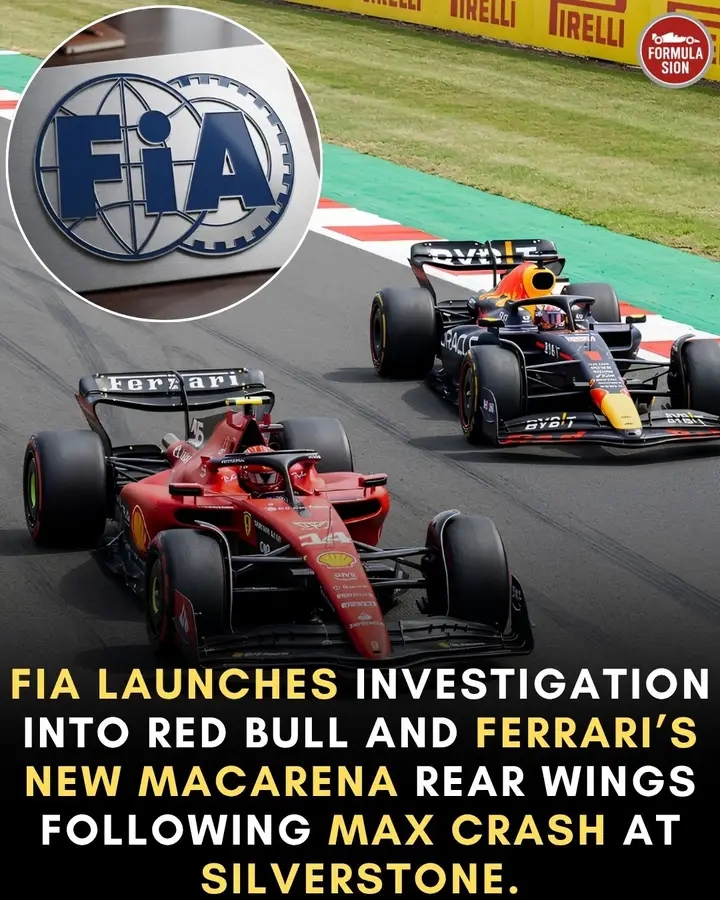
Formula 1 has been thrown into fresh technical controversy after the FIA launched an official investigation into the innovative rear wing concepts introduced by Red Bull and Ferrari during the British Grand Prix weekend. The eye-catching designs, nicknamed the “Macarena” rear wings by fans and paddock observers, are now facing detailed scrutiny following Max Verstappen’s dramatic high-speed crash at Silverstone.
The investigation has immediately become one of the biggest talking points in the paddock, raising fresh questions about the balance between engineering innovation, regulatory compliance, and driver safety. While Formula 1 has always rewarded teams willing to push technical boundaries, every new development must still satisfy the FIA’s strict safety and technical standards.
WHY THE FIA IS TAKING A CLOSER LOOK
Formula 1 teams constantly search for aerodynamic gains worth only a few hundredths of a second per lap. Rear wings play a crucial role in that pursuit, influencing straight-line speed, cornering stability, drag levels, and overall car balance.
Red Bull and Ferrari both introduced aggressive rear wing concepts designed to improve efficiency without sacrificing downforce. Early data suggested the upgrades delivered noticeable performance improvements, making them valuable weapons at one of Formula 1’s fastest circuits.
However, Verstappen’s high-speed accident has shifted attention away from lap times and toward safety. While there has been no official indication that the crash was caused by the rear wing, the FIA has chosen to examine whether the designs behave as intended under extreme aerodynamic loads experienced at high speed.
That investigation reflects Formula 1’s cautious approach whenever new technology coincides with a significant on-track incident.
SAFETY ALWAYS COMES FIRST
Formula 1 has evolved dramatically over the past two decades, with safety becoming the sport’s highest priority. Every aerodynamic component must pass rigorous structural tests before being approved for competition.
The FIA’s investigation is expected to focus on several areas, including:
- Structural strength under maximum aerodynamic loads.
- Wing flexibility during high-speed running.
- Compliance with technical regulations regarding movable aerodynamic surfaces.
- Overall stability in extreme racing conditions.
Modern Formula 1 cars generate enormous aerodynamic forces, especially through fast corners like those at Silverstone. Even the slightest unexpected movement in a rear wing can affect handling, stability, and driver confidence.
Although innovation is encouraged, the FIA has repeatedly shown that it will intervene whenever there are concerns over safety or regulatory interpretation.
RED BULL AND FERRARI PUSHING THE LIMITS
Both Red Bull and Ferrari have built reputations for producing some of Formula 1’s most advanced aerodynamic packages.
Red Bull’s technical department has consistently delivered race-winning innovations over recent seasons, while Ferrari has invested heavily in aerodynamic development as it seeks to close the performance gap to its rivals.
The latest rear wing concepts appeared to be another example of Formula 1 engineers maximizing every available opportunity within the regulations. The fine line between legal innovation and regulatory overreach has always been one of the sport’s defining characteristics.
History has shown that many groundbreaking designs eventually become either accepted innovations or banned concepts after FIA review.
WHAT THIS COULD MEAN FOR THE CHAMPIONSHIP
If the FIA concludes that the rear wings fully comply with both technical and safety regulations, Red Bull and Ferrari will likely continue using the designs throughout the season.
However, if modifications are required—or if the concepts are ultimately ruled non-compliant—it could have significant consequences for both teams.
Losing an aerodynamic upgrade midway through the championship could affect:
- Straight-line performance.
- Tire management.
- Race strategy.
- Qualifying pace.
- Overall championship momentum.
In an incredibly competitive Formula 1 season, even a small reduction in performance can change the balance of power between the leading teams.
THE SILVERSTONE FACTOR
Silverstone remains one of Formula 1’s toughest aerodynamic tests. Its combination of long straights and ultra-fast corners places enormous stress on every aerodynamic component.
That makes the British Grand Prix an ideal event for evaluating new upgrades—but it also exposes any potential weaknesses more quickly than many other circuits on the calendar.
The FIA’s investigation is therefore as much about future safety as it is about understanding how these new wing concepts behave under some of the harshest conditions Formula 1 cars encounter.
WHAT HAPPENS NEXT?
The governing body is expected to collect telemetry, inspect both teams’ components, and review engineering data before reaching any conclusions.
At this stage, no penalties or rule breaches have been announced. The investigation should be viewed as a precautionary technical review rather than evidence of wrongdoing.
Teams will continue cooperating with the FIA as engineers work to demonstrate that their designs satisfy every aspect of Formula 1’s demanding regulations.
FINAL THOUGHTS
The investigation into Red Bull’s and Ferrari’s “Macarena” rear wings highlights the constant battle between innovation and regulation that defines modern Formula 1. Every championship-winning team searches for technical breakthroughs, but those advances must never compromise safety.
For fans, the story adds another fascinating layer to an already dramatic British Grand Prix weekend. Whether the rear wing designs are ultimately cleared or require changes, the FIA’s findings could influence not only future car development but also the trajectory of this season’s championship battle.
As Formula 1 continues to evolve, technical innovation will always remain one of its greatest attractions—but the sport’s commitment to protecting its drivers will continue to take precedence over every performance gain.