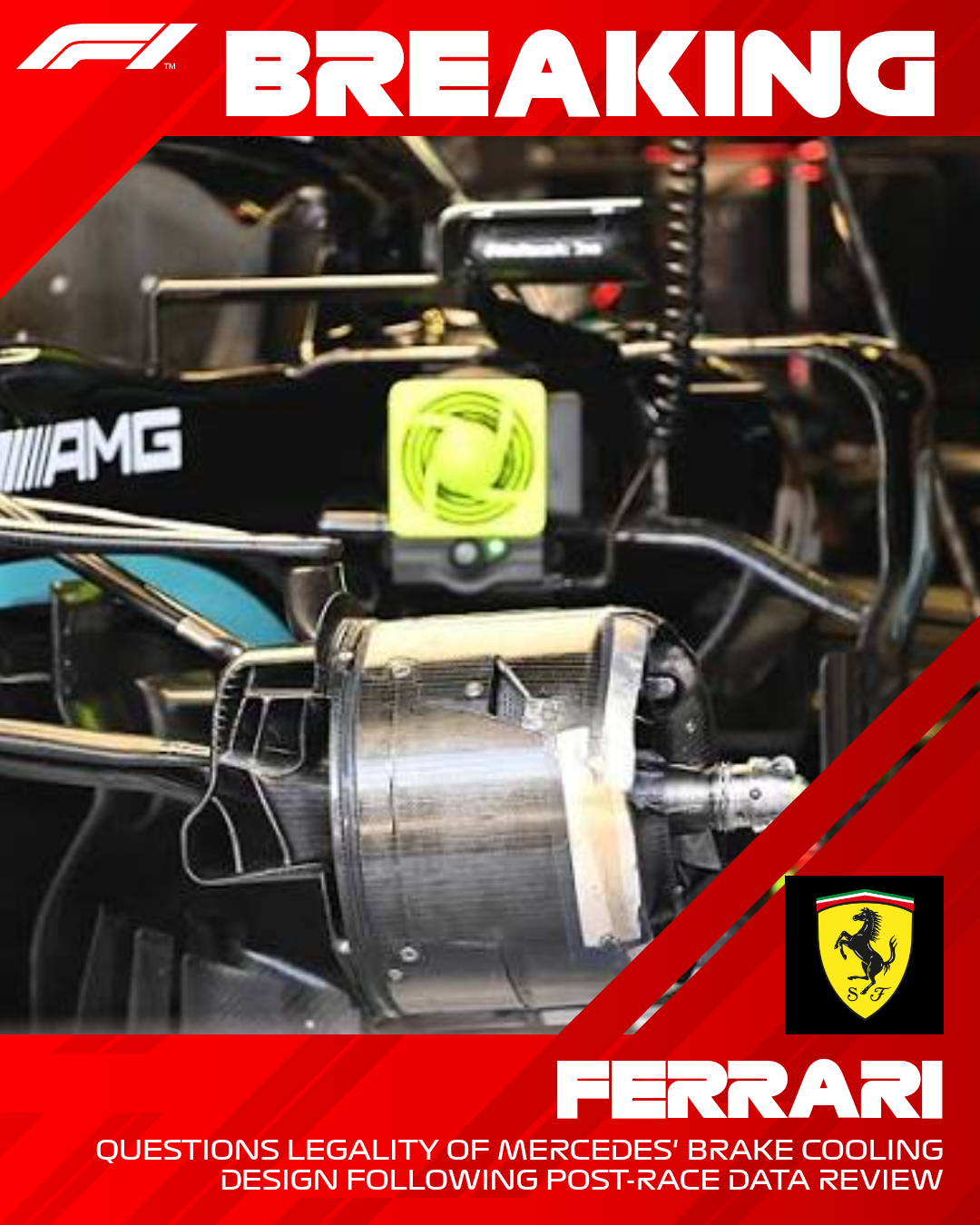
Formula 1 could be heading toward another high-profile technical dispute after reports emerged that Ferrari has questioned the legality of Mercedes’ brake cooling design following an extensive review of post-race data. The alleged concerns have reportedly been raised with the FIA, placing Mercedes under fresh scrutiny as rival teams continue to search for any competitive advantages hidden within the complex technical regulations.
It is important to note that, at the time of writing, neither Ferrari, Mercedes, nor the FIA has officially confirmed that Mercedes has breached any regulations. The reports indicate that Ferrari has raised questions regarding the design, not that any wrongdoing has been established.
FERRARI’S REVIEW HAS SPARKED PADDOCK SPECULATION
Technical battles are often just as fierce as the racing itself in Formula 1, and teams constantly analyze telemetry, onboard footage, thermal images, and performance data after every Grand Prix. According to the reports, Ferrari engineers identified aspects of Mercedes’ brake cooling system that they believe deserve closer examination under the FIA’s technical regulations.
Brake cooling systems play a crucial role in modern Formula 1. They are designed not only to prevent overheating but also to maintain the ideal operating temperature for both the braking components and the tyres. Even a small advantage in temperature management can significantly improve tyre performance, braking consistency, and overall race pace over a full Grand Prix distance.
Because of these potential gains, brake ducts and cooling solutions remain one of the most carefully monitored areas of every Formula 1 car.
WHY BRAKE COOLING IS SUCH A SENSITIVE TECHNICAL AREA
Modern Formula 1 cars generate enormous heat under braking, particularly at circuits featuring heavy deceleration zones. Teams invest millions in designing brake cooling systems that maximize efficiency while remaining fully compliant with FIA regulations.
A highly effective cooling package can deliver several competitive benefits. It helps drivers maintain consistent braking performance, reduces wear on critical components, improves tyre temperature management, and enhances overall race strategy.
However, the FIA places strict limits on how these systems may function. Components intended solely for cooling cannot be used to generate aerodynamic gains or create additional performance advantages outside their intended purpose.
This delicate balance has led to several technical controversies throughout Formula 1 history, making brake cooling one of the sport’s most heavily scrutinized engineering areas.
TECHNICAL PROTESTS ARE PART OF FORMULA 1’S DNA
Ferrari’s reported concerns illustrate the relentless competitive environment that defines Formula 1. Every leading team continuously studies its rivals, searching for innovations that may stretch or reinterpret the regulations.
Throughout the sport’s history, numerous championship battles have included technical protests involving flexible wings, suspension systems, aerodynamic concepts, fuel flow measurements, and hybrid power unit technologies.
In many cases, teams do not necessarily believe a rival has broken the rules outright. Instead, they seek clarification from the FIA regarding whether a particular interpretation aligns with the intended spirit of the regulations.
Such reviews often lead to technical directives that clarify existing rules without requiring teams to face formal penalties.
THE FIA NOW FACES AN IMPORTANT DECISION
If Ferrari has formally requested clarification, FIA technical delegates will likely conduct a detailed examination of Mercedes’ brake cooling architecture. That process could include inspections of design documentation, physical components, telemetry, and compliance with the current Formula 1 technical regulations.
Should the FIA determine that Mercedes’ system complies fully with the regulations, the issue may end with a simple confirmation that no rule has been broken.
If officials identify an interpretation they believe falls outside the intended regulations, Mercedes could be instructed to modify its design before future races. Only in the event of a confirmed regulatory breach would more severe sporting consequences become possible.
For now, there is no official indication that any penalties are under consideration.
CHAMPIONSHIP IMPLICATIONS COULD BE SIGNIFICANT
Technical investigations often extend beyond the team directly involved. If Mercedes’ design is ultimately deemed legal, rival teams may attempt to develop similar solutions to close the performance gap.
Conversely, if the FIA issues a clarification restricting the concept, multiple teams could be forced to adjust their own development programs depending on how closely their designs resemble Mercedes’ approach.
With the championship entering its decisive phase, every technical innovation carries enormous value. Even small performance differences can determine qualifying positions, race victories, and ultimately world championship outcomes.
This explains why manufacturers monitor each other’s designs so aggressively throughout the season.
THE ENGINEERING BATTLE CONTINUES BEHIND THE SCENES
While fans focus primarily on wheel-to-wheel racing, Formula 1’s fiercest competition frequently takes place away from the television cameras.
Engineering departments spend countless hours exploring every possible interpretation of the rulebook in pursuit of tiny performance gains. At the same time, rival teams analyze every visible component, searching for innovations that may deserve closer regulatory attention.
Ferrari’s reported concerns regarding Mercedes’ brake cooling design are another reminder that Formula 1 remains an engineering arms race as much as a sporting contest.
Until the FIA completes any review and provides official guidance, the discussion remains one of technical interpretation rather than proven illegality. Nevertheless, if the matter develops further, it could become one of the defining technical stories of the 2026 Formula 1 season and potentially influence future car development across the entire grid.