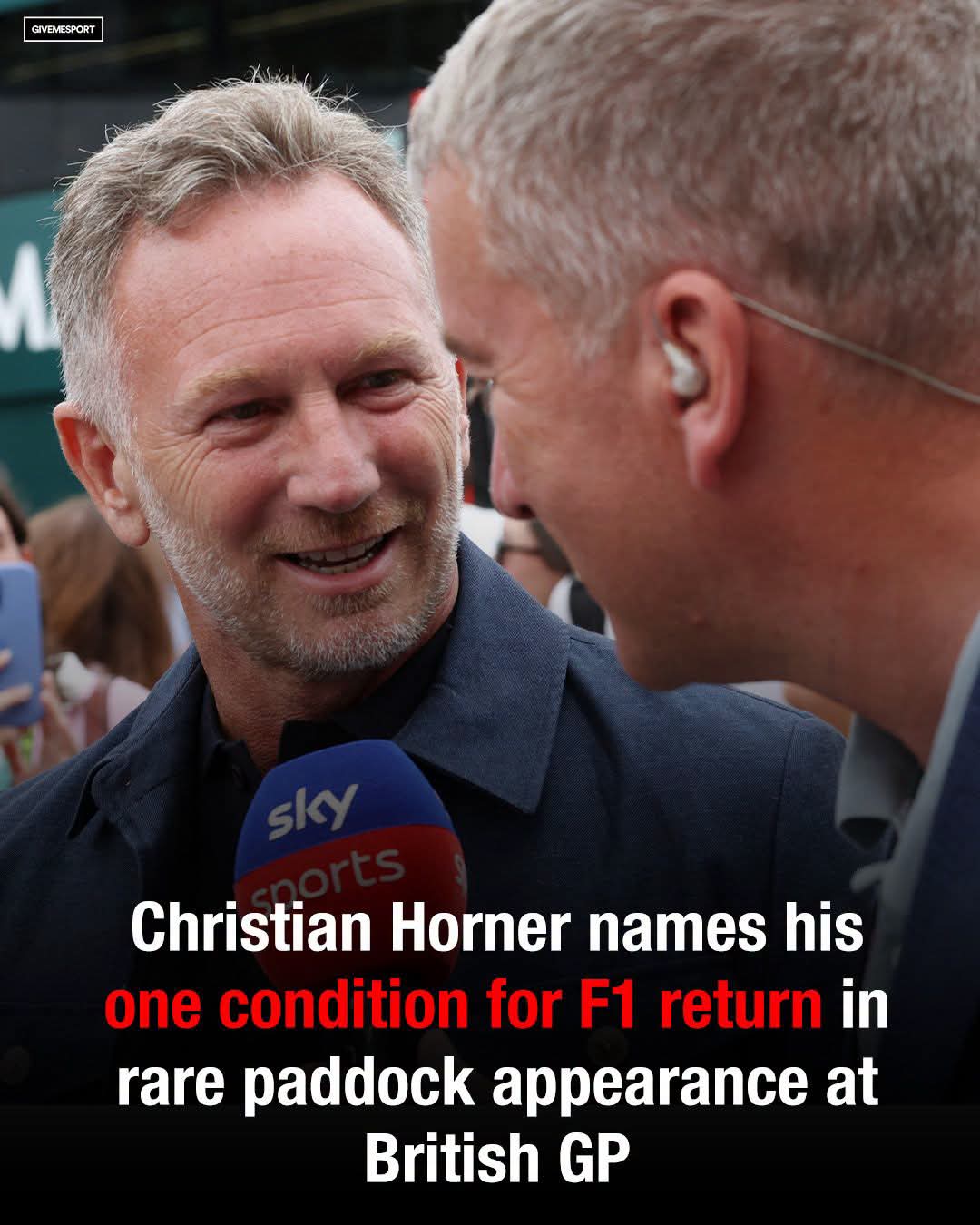
Christian Horner has finally broken his silence on a potential return to Formula 1, and his message leaves little room for interpretation. Making his first appearance in the F1 paddock since his departure from Red Bull, the former team principal admitted he remains open to coming back—but only under one very specific condition.
Horner’s comments at the British Grand Prix immediately reignited speculation about where the sport’s most successful modern team boss could land next. Whether it’s an established manufacturer, an ambitious rebuilding project, or an entirely new team entering Formula 1, Horner made it clear that simply returning isn’t enough. If he comes back, it must be with a realistic opportunity to fight for victories and championships.
HORNER RETURNS TO THE F1 PADDOCK AFTER RED BULL EXIT
Silverstone marked Horner’s first public appearance inside a Formula 1 paddock since leaving Red Bull, ending months of speculation about his future.
Although he insisted he attended the British Grand Prix as a fan, his presence immediately attracted attention from media, team executives, and paddock insiders. Having led Red Bull through one of the most dominant eras in Formula 1 history, Horner remains one of the sport’s most respected and influential figures.
His arrival alone was enough to spark fresh rumors that negotiations with potential employers may already be underway.
THE ONE REQUIREMENT FOR HIS RETURN
When asked directly about his future, Horner delivered perhaps the most revealing statement since his departure.
Rather than denying interest in returning, he admitted he would only consider joining a project capable of winning.
That single requirement speaks volumes.
For Horner, rebuilding for the sake of rebuilding appears to hold little appeal. After spending two decades competing at the front of the grid, his motivation remains centered on championships rather than simply participating.
Any organization hoping to secure his services will therefore need to demonstrate genuine competitive ambition—not just financial resources.
WHY HORNER STILL HOLDS HUGE VALUE
Few figures in modern Formula 1 possess Horner’s résumé.
During his tenure at Red Bull, the team captured multiple Drivers’ and Constructors’ Championships while overseeing the careers of several world champions. More importantly, Horner helped transform Red Bull from an ambitious newcomer into one of Formula 1’s defining powerhouses.
That experience makes him one of the few executives capable of building both competitive performance and organizational culture simultaneously.
For teams searching for long-term leadership, Horner represents far more than a race strategist—he offers proven championship-winning management.
ALPINE CONTINUES TO EMERGE AS A POSSIBILITY
Among the strongest rumors surrounding Horner involves Alpine.
Despite possessing significant infrastructure and factory resources, Alpine has struggled to consistently challenge Formula 1’s leading teams. Bringing in a leader with Horner’s experience could dramatically accelerate the team’s long-term rebuilding process.
With continued investment flowing into the organization, Alpine appears determined to position itself as a future championship contender rather than remaining a midfield competitor.
Should Horner believe that ambition is genuine, Alpine could become an increasingly attractive destination.
ASTON MARTIN ALSO HAS THE INGREDIENTS
Another frequently discussed possibility remains Aston Martin.
The British team has invested heavily in facilities, personnel, and future development, including major technical partnerships designed to elevate its competitiveness.
While Aston Martin has endured difficult periods recently, the long-term vision remains ambitious.
Horner himself acknowledged that watching the team’s current struggles is disappointing, suggesting he still sees untapped potential within the organization.
With world-class infrastructure already taking shape, Aston Martin may only require the right leadership structure to maximize its investment.
A BRAND-NEW PROJECT COULD OFFER THE BIGGEST CHALLENGE
Perhaps the most fascinating possibility involves a completely new Formula 1 team.
Reports continue linking Chinese automotive giant BYD with ambitions to launch a twelfth Formula 1 entry.
For Horner, leading an expansion team would present an opportunity unlike anything he has experienced before.
Rather than inheriting an existing organization, he would have the chance to shape every aspect of the team’s philosophy, recruitment, technical direction, and long-term identity from day one.
While the risks would be considerable, so too would the rewards.
HIS SILVERSTONE APPEARANCE MAY NOT HAVE BEEN A COINCIDENCE
Although Horner repeatedly insisted he was simply enjoying the race, his appearance alongside experienced Formula 1 public relations personnel naturally fueled speculation.
The British Grand Prix attracts nearly every major decision-maker in Formula 1, making it the perfect venue for informal conversations behind closed doors.
Even without formal meetings, simply being visible within the paddock reminds every team owner, investor, and manufacturer that Horner remains available.
In Formula 1, visibility often serves as its own negotiation strategy.
WHY FORMULA 1 COULD BENEFIT FROM HIS RETURN
Beyond individual teams, Formula 1 itself stands to benefit if Horner eventually returns.
His leadership, technical understanding, media presence, and competitive mindset have shaped many of the sport’s biggest storylines over the past two decades.
Whether fans supported Red Bull or rooted against them, Horner consistently brought personality, strategic depth, and intensity to the championship battle.
His return would immediately add another compelling storyline to an already competitive era of Formula 1.
WHAT HAPPENS NEXT?
Horner emphasized that he is in no hurry to rush back into Formula 1.
That patience could ultimately strengthen his negotiating position.
Rather than accepting the first available opportunity, he appears willing to wait until the right project aligns with both his competitive ambitions and long-term vision.
As several teams continue evaluating their futures—and with potential new manufacturers exploring Formula 1 entry—the number of possible destinations may continue growing.
One thing now appears certain: Christian Horner has not closed the door on Formula 1.
Instead, he has thrown down a challenge.
If a team wants one of the most successful leaders in modern motorsport, it must offer more than a contract. It must offer a realistic path back to the very top of Formula 1.