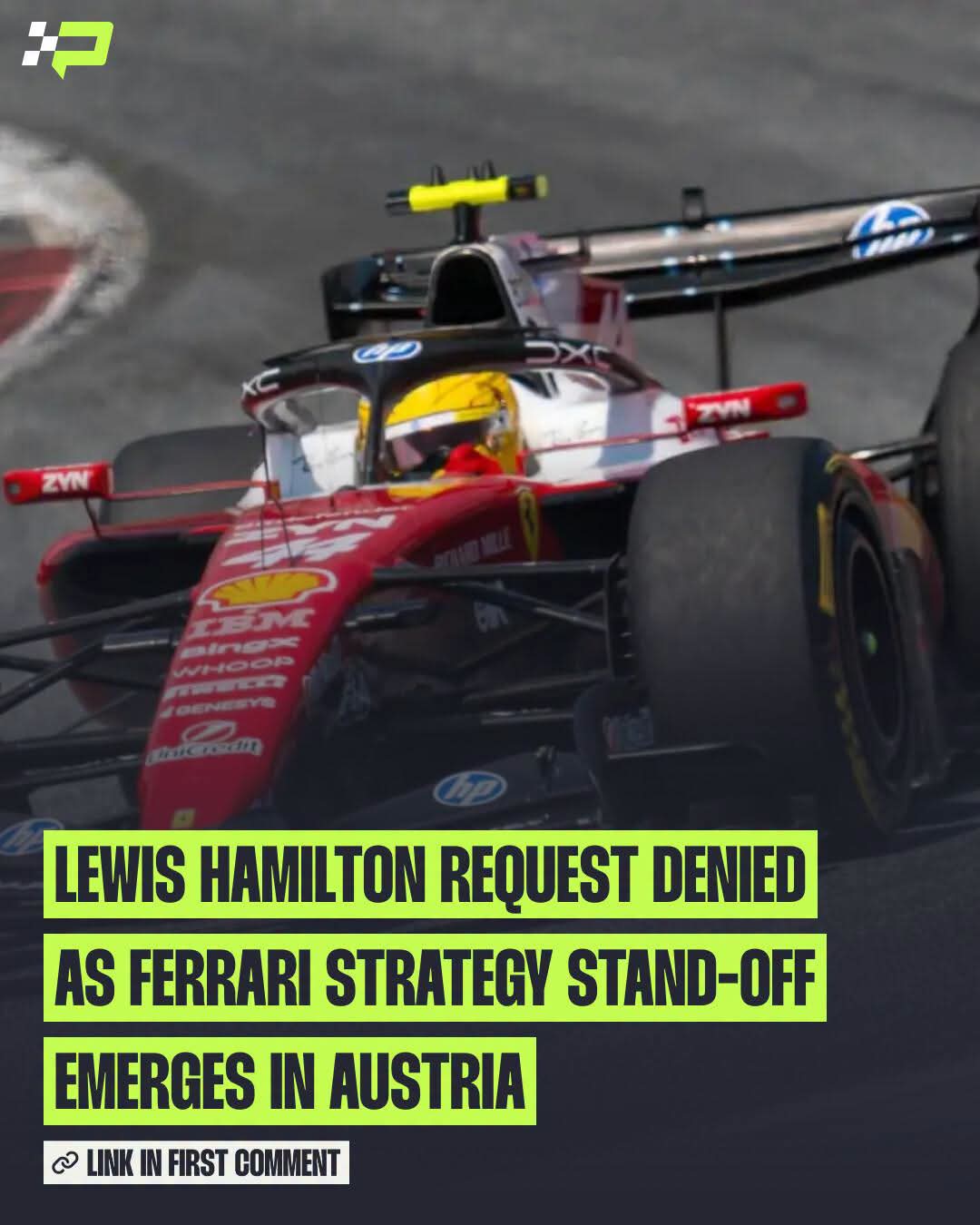
Lewis Hamilton has revealed that Ferrari ignored the race strategy he believed offered the best chance of challenging for victory at the Austrian Grand Prix, with the seven-time Formula 1 world champion insisting he had warned the team about severe tyre degradation long before the lights went out.
Despite lining up in a promising third position after qualifying, Hamilton could only finish fifth at the Red Bull Ring as Ferrari struggled with tyre wear and race pace in scorching conditions. Speaking after the race, the British driver admitted he had pushed for a completely different approach before the start, believing a three-stop strategy combined with a soft-tyre opening stint would be the fastest route to the finish.
His comments have shed fresh light on Ferrari’s race-day decision-making and raise questions about whether the Scuderia missed an opportunity to maximize Hamilton’s performance during one of the hottest races of the 2026 Formula 1 season.
HAMILTON WANTED A BOLDER APPROACH
Track temperatures at the Red Bull Ring climbed into extreme territory, creating one of the highest tyre degradation races of the year. While Ferrari’s strategists calculated that a conventional two-stop race would be the quickest option, Hamilton saw the situation differently.
According to the Ferrari driver, simulations presented during pre-race meetings suggested a three-stop strategy would actually lose around four seconds over the race distance. Hamilton disagreed with that assessment, believing the heat would punish tyres far more severely than expected.
He wanted to start on the soft compound before attacking the race with three pit stops—similar to the strategy that helped him claim victory in Spain earlier this season. However, Ferrari opted for the safer medium-tyre start instead.
Hamilton believes that decision immediately placed him at a disadvantage.
TYRE DEGRADATION DESTROYED FERRARI’S RACE
Hamilton’s concerns quickly became reality once the race began.
Although he briefly remained in contention with Mercedes driver George Russell during the opening laps, Ferrari’s rear tyres deteriorated rapidly. Russell gradually pulled away while Hamilton struggled to keep the SF-26 under control.
His first pit stop came as early as Lap 12, far earlier than many of his rivals, confirming that Ferrari’s tyre life was significantly worse than anticipated.
Ironically, Ferrari eventually abandoned its original plan anyway, switching both Hamilton and Charles Leclerc onto three-stop strategies after recognizing just how quickly the tyres were wearing out.
By then, however, much of the damage had already been done.
Hamilton later admitted that Ferrari’s car simply could not preserve any tyre compound effectively, explaining that neither the medium nor the hard tyres performed as expected throughout the afternoon.
WHY FERRARI’S STRATEGY MATTERS
Hamilton’s revelation highlights one of Ferrari’s recurring weaknesses in recent seasons—not outright speed alone, but the ability to react decisively during strategic situations.
The team entered Austria with a strong qualifying performance, locking out second and third behind George Russell. On paper, that provided an excellent platform to fight Mercedes and Red Bull.
Instead, both Ferrari drivers slipped backwards.
When a driver with Hamilton’s experience identifies a likely race trend before the event even begins, teams often give considerable weight to that feedback. His long history of managing tyres successfully has been one of the defining strengths of his Formula 1 career.
While there is no guarantee that Hamilton’s preferred strategy would have delivered victory, his prediction about excessive tyre degradation proved accurate. That naturally raises questions over whether Ferrari relied too heavily on simulations rather than adapting to the unique conditions presented by Austria’s extreme heat.
THE CHAMPIONSHIP IMPLICATIONS
Hamilton’s fifth-place finish carries greater significance than a single disappointing result.
The Austrian Grand Prix allowed Mercedes to strengthen its position at the top of the Constructors’ Championship, while George Russell climbed back to second in the Drivers’ standings after his victory.
Hamilton now sits third in the championship, trailing Mercedes rookie Andrea Kimi Antonelli by 46 points heading into the British Grand Prix at Silverstone.
With Mercedes leading the Constructors’ standings on 302 points, Ferrari remains second with 204, leaving the Italian outfit facing increasing pressure to improve both performance and operational execution if they hope to mount a sustained title challenge.
Every strategic mistake becomes increasingly costly as the championship enters its second half.
SILVERSTONE OFFERS AN IMMEDIATE CHANCE TO RESPOND
Fortunately for Hamilton, the next race arrives at one of his strongest circuits.
Silverstone has delivered a record nine Formula 1 victories for the British driver, and the home crowd will expect him to fight near the front once again.
Ferrari will undoubtedly analyze every aspect of its Austrian strategy before arriving in Britain. Beyond improving outright pace, the team must ensure communication between engineers and drivers becomes more effective, particularly when race conditions differ significantly from pre-race simulations.
Hamilton’s confidence in his own reading of tyre behaviour suggests he will continue pushing Ferrari to trust his instincts more often in similar situations.
FERRARI CANNOT AFFORD TO REPEAT THE SAME MISTAKE
Austria demonstrated that Ferrari still possesses enough speed to qualify near the front, but converting strong starting positions into podium finishes remains an ongoing challenge.
Hamilton’s post-race comments were notable not because they criticized the team harshly, but because they revealed a clear difference of opinion before the race even started.
Whether Ferrari changes its approach after Austria could become one of the defining stories of the remainder of the 2026 Formula 1 season.
With Mercedes continuing to build momentum and Red Bull remaining a constant threat, Ferrari can no longer afford strategic compromises if it hopes to keep Hamilton’s championship ambitions alive.
As Formula 1 heads to Silverstone, the spotlight will not only be on Ferrari’s car—but on whether the team is finally prepared to listen when one of the sport’s greatest drivers believes he already knows how the race will unfold.