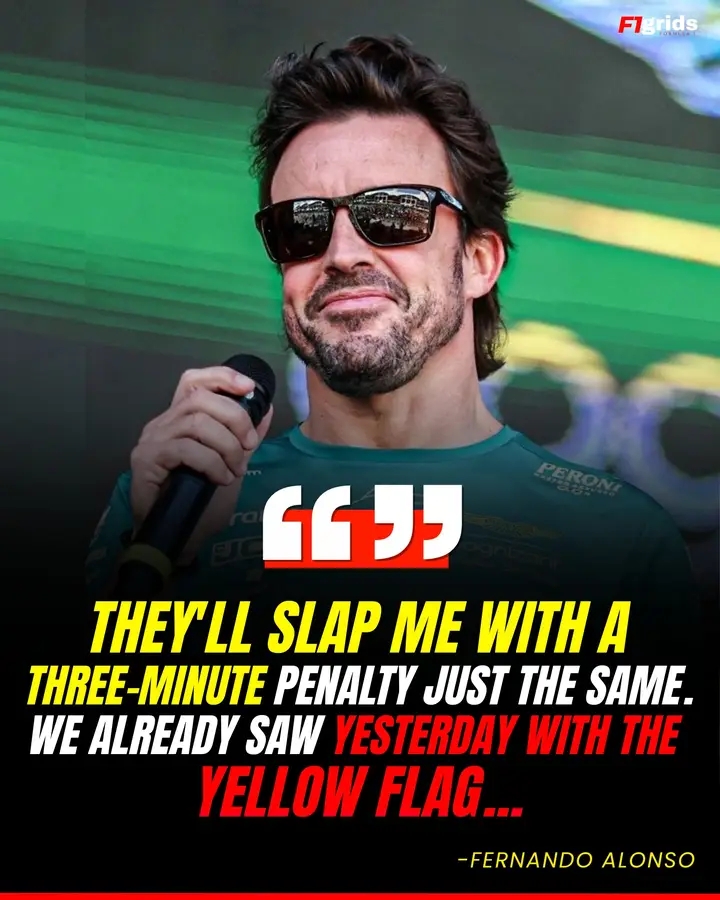
Fernando Alonso has built a reputation as one of Formula 1’s sharpest minds—and one of its quickest wits. That reputation was on full display after the Spanish veteran was summoned to the stewards for allegedly ignoring blue flags, prompting a sarcastic response that perfectly captured his mood.
While Alonso’s comment generated laughs across the paddock, the incident also highlighted a deeper issue facing Aston Martin. A team that entered the season hoping to challenge at the front now finds itself battling simply to remain competitive, leaving even a two-time world champion visibly frustrated.
WHAT HAPPENED DURING THE RACE?
Blue flags are among the most important signals in Formula 1. They instruct slower cars to allow faster, lapping competitors to pass without unnecessary delay.
During the race, Alonso was investigated after officials believed he had failed to comply with blue flag regulations. As he was informed that he would need to visit the stewards following the Grand Prix, Alonso responded with trademark sarcasm, suggesting the situation had become almost routine.
The moment quickly became a talking point because it reflected the Spaniard’s dry sense of humor while also revealing his disappointment with the circumstances surrounding Aston Martin’s race.
Fortunately for Alonso, the investigation did not become the defining story of his weekend, but it added another chapter to what has been a challenging campaign.
WHY BLUE FLAGS MATTER IN FORMULA 1
Ignoring blue flags isn’t treated lightly.
When a driver is being lapped, failing to move aside promptly can cost the leading cars valuable time and potentially affect the outcome of the race. Race control monitors these situations closely, and repeated violations can lead to penalties ranging from time additions to penalty points.
However, these incidents are not always straightforward.
Modern Formula 1 cars generate enormous turbulent air, making overtaking difficult even when both drivers cooperate. Drivers also have to balance moving out of the way with staying on the racing line safely, especially through high-speed corners.
Because of this, investigations often examine telemetry, onboard footage, and timing data before determining whether a driver genuinely ignored the instructions.
ALONSO’S SARCASM REFLECTS A MUCH BIGGER PROBLEM
Alonso has never been afraid to express his opinions, whether through radio messages or interviews.
His sarcastic reaction wasn’t simply about visiting the stewards. It reflected the frustration of competing in the midfield after spending much of the previous season fighting near the front.
For a driver who still believes he can challenge for victories under the right circumstances, repeatedly finding himself being lapped by the leading teams is undoubtedly difficult.
The contrast with Aston Martin’s impressive start to 2023 is striking. The team appeared capable of regularly challenging Red Bull, Ferrari, and Mercedes. Since then, however, rivals have made significant progress while Aston Martin has struggled to unlock consistent performance from its evolving car.
ASTON MARTIN’S DEVELOPMENT QUESTIONS CONTINUE
One of the biggest talking points surrounding Aston Martin has been its inability to maintain development momentum.
The team invested heavily in new facilities, expanded its technical staff, and attracted some of the biggest names in Formula 1 engineering. Expectations naturally increased.
Yet translating investment into lap time has proven far more complicated.
Several upgrades introduced throughout the season have delivered only modest gains, while competitors have continued to improve. That has left Alonso fighting in crowded midfield battles rather than competing for podium finishes.
The arrival of legendary designer Adrian Newey for Aston Martin’s long-term project has generated enormous optimism, but transforming the team into a championship contender will take time.
WHY ALONSO REMAINS ONE OF F1’S MOST VALUABLE DRIVERS
Despite Aston Martin’s struggles, Alonso continues to demonstrate why he is regarded as one of Formula 1’s greatest racers.
His qualifying performances regularly extract more from the car than many expect. His racecraft remains among the very best on the grid, while his technical feedback continues to play a vital role in the team’s development.
Even when results disappoint, Alonso’s experience helps Aston Martin understand where improvements are needed.
His sarcastic exchanges may grab headlines, but they also reveal a driver who remains deeply invested in maximizing every opportunity.
WHAT THIS MEANS FOR THE CHAMPIONSHIP
From a championship perspective, incidents involving blue flags rarely decide the title on their own.
However, they highlight the increasing performance gap between the front-running teams and the midfield.
For Aston Martin, every race has become an opportunity to gather data rather than chase victories. Consistent points remain valuable, but the team’s primary focus is increasingly shifting toward building a stronger package for future seasons.
Meanwhile, the leading championship contenders continue to benefit whenever backmarkers cooperate efficiently during races, minimizing disruptions in strategic battles.
COULD ASTON MARTIN TURN THINGS AROUND?
There are reasons for cautious optimism.
The team’s state-of-the-art factory, expanding technical department, and long-term investment strategy provide a solid foundation. Future regulation changes could also present opportunities for Aston Martin to close the gap.
However, Formula 1’s competitive landscape is unforgiving. Ferrari, Mercedes, McLaren, and Red Bull all continue investing aggressively, meaning Aston Martin cannot rely solely on infrastructure improvements.
Execution, innovation, and consistent car development will determine whether Alonso gets another realistic chance to fight for victories before the end of his remarkable career.
FINAL THOUGHTS
Fernando Alonso’s sarcastic response to being called before the stewards may have provided one of the lighter moments of the race weekend, but it also carried a deeper message.
Behind the humor lies the frustration of a fiercely competitive driver who knows he is capable of much more than fighting in the midfield. Aston Martin’s ambitions remain enormous, but converting those ambitions into championship-contending performance remains one of Formula 1’s biggest ongoing challenges.
If the team can finally unlock the potential of its ambitious project, Alonso’s wit may once again accompany podium celebrations instead of steward investigations. Until then, every race serves as another reminder that in Formula 1, even the smallest incidents can reflect much larger stories unfolding behind the scenes.