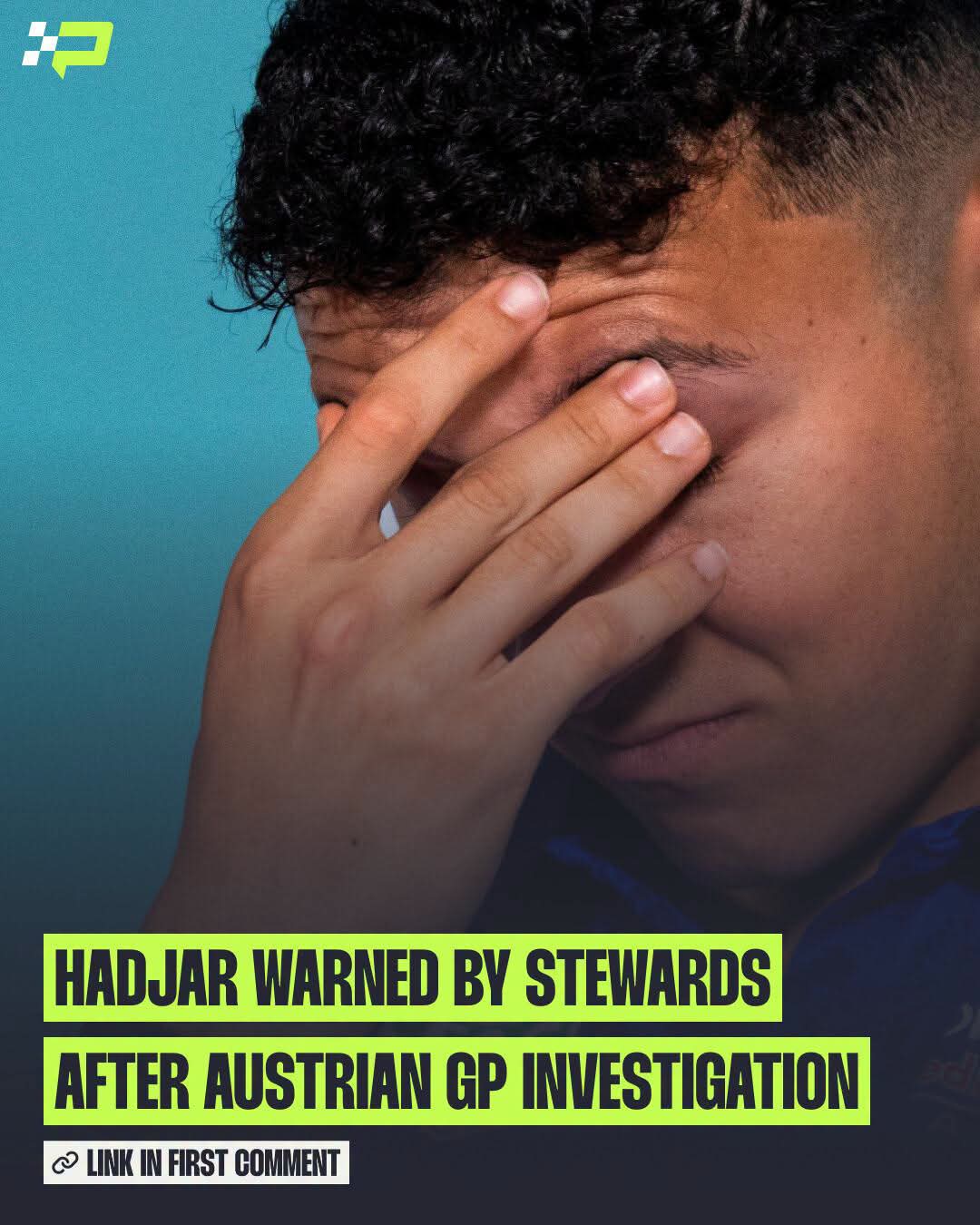
Red Bull youngster Isack Hadjar has escaped a sporting penalty after Formula 1 stewards concluded their investigation into his conduct during qualifying for the 2026 Austrian Grand Prix. Instead of receiving a grid drop or points penalty, the French driver was issued an official warning after being found guilty of driving unnecessarily slowly during the opening phase of qualifying.
While George Russell’s controversial pole position dominated the headlines following Max Verstappen’s late crash, Hadjar quietly found himself under FIA scrutiny in another reminder of how closely Formula 1 monitors every driver’s behavior during qualifying sessions.
FIA REVIEWS HADJAR’S QUALIFYING CONDUCT
Following Q1 at the Red Bull Ring, FIA stewards launched an investigation into Hadjar after data suggested he had driven unnecessarily slowly on track. Such incidents are taken seriously because slow-moving cars can create dangerous closing speeds for drivers attempting fast laps.
After reviewing telemetry, positioning data, onboard footage, timing information, and hearing explanations from both Hadjar and Red Bull representatives, the stewards determined that the Racing Bulls driver had indeed breached the sporting regulations.
However, because Hadjar completed the lap without impeding another competitor or creating a direct safety hazard, the FIA stopped short of imposing a harsher punishment. Instead, officials issued only a formal warning, allowing him to retain his eighth-place qualifying result.
The decision highlights the FIA’s willingness to differentiate between technical rule breaches and incidents that materially affect other competitors.
WHY THE FIA CHOSE A WARNING INSTEAD OF A PENALTY
Formula 1’s qualifying regulations are designed to prevent drivers from creating traffic or dangerous situations while preparing for flying laps. Driving excessively slowly can force approaching cars to take evasive action or ruin crucial qualifying attempts.
In Hadjar’s case, however, the evidence showed that no other driver was overtaken or blocked during the relevant sequence.
That distinction proved critical.
Rather than punishing the Red Bull junior with a grid penalty, the FIA effectively reminded him that similar behavior in future sessions could result in stronger sanctions.
Warnings often serve as an important first step within Formula 1’s disciplinary process, especially for young drivers still adapting to the demands of competing at the highest level.
BRAKING PROBLEMS CONTINUE TO HAMPER HADJAR
The investigation came at the end of what Hadjar described as a frustrating qualifying session for reasons that extended far beyond the FIA inquiry.
Throughout the Austrian Grand Prix weekend, the 21-year-old repeatedly complained about inconsistent braking performance, particularly into Turn 3—the circuit’s heavy braking zone at the end of the longest straight.
Known for his aggressive late-braking style, Hadjar admitted he has been unable to drive naturally because he simply cannot attack the braking zones with confidence.
Without being able to brake as late as usual, he explained that every phase of the corner becomes compromised, costing valuable lap time throughout the circuit.
For a driver whose strengths rely heavily on aggressive corner entry, such limitations significantly reduce his overall competitiveness.
RED BULL’S CHALLENGING WEEKEND EXTENDS BEYOND VERSTAPPEN
Much of the attention during qualifying focused on Max Verstappen’s dramatic crash in Q3 and George Russell’s controversial pole position.
However, Hadjar’s struggles reveal that Red Bull faced wider performance issues throughout the weekend.
The reduced downforce characteristics of the 2026 Formula 1 regulations have made cars increasingly difficult to control under heavy braking, particularly on circuits like the Red Bull Ring.
Hadjar pointed out that several teams experienced similar issues, referencing incidents involving rival drivers earlier in the weekend as evidence that the problem is not unique to Red Bull.
Even so, Mercedes and Ferrari ultimately managed to extract stronger qualifying performances when it mattered most, while Red Bull continued searching for answers.
WHAT THIS MEANS FOR HADJAR’S DEVELOPMENT
Despite receiving only a warning, the incident represents another valuable learning experience for one of Formula 1’s youngest drivers.
Rookies often face a steep learning curve when balancing tyre preparation, traffic management, fuel strategy, and strict FIA sporting regulations during qualifying.
The Austrian Grand Prix demonstrated how even relatively minor procedural mistakes can attract the attention of race officials.
Fortunately for Hadjar, the consequences remained minimal this time.
If he continues refining both his racecraft and decision-making while Red Bull resolves the braking issues affecting his RB22, the Frenchman has every opportunity to convert his undeniable speed into more consistent top-ten performances throughout the remainder of the 2026 season.
With Formula 1’s midfield becoming increasingly competitive, eliminating small mistakes like these could make the difference between scoring valuable championship points and falling behind equally talented rivals.