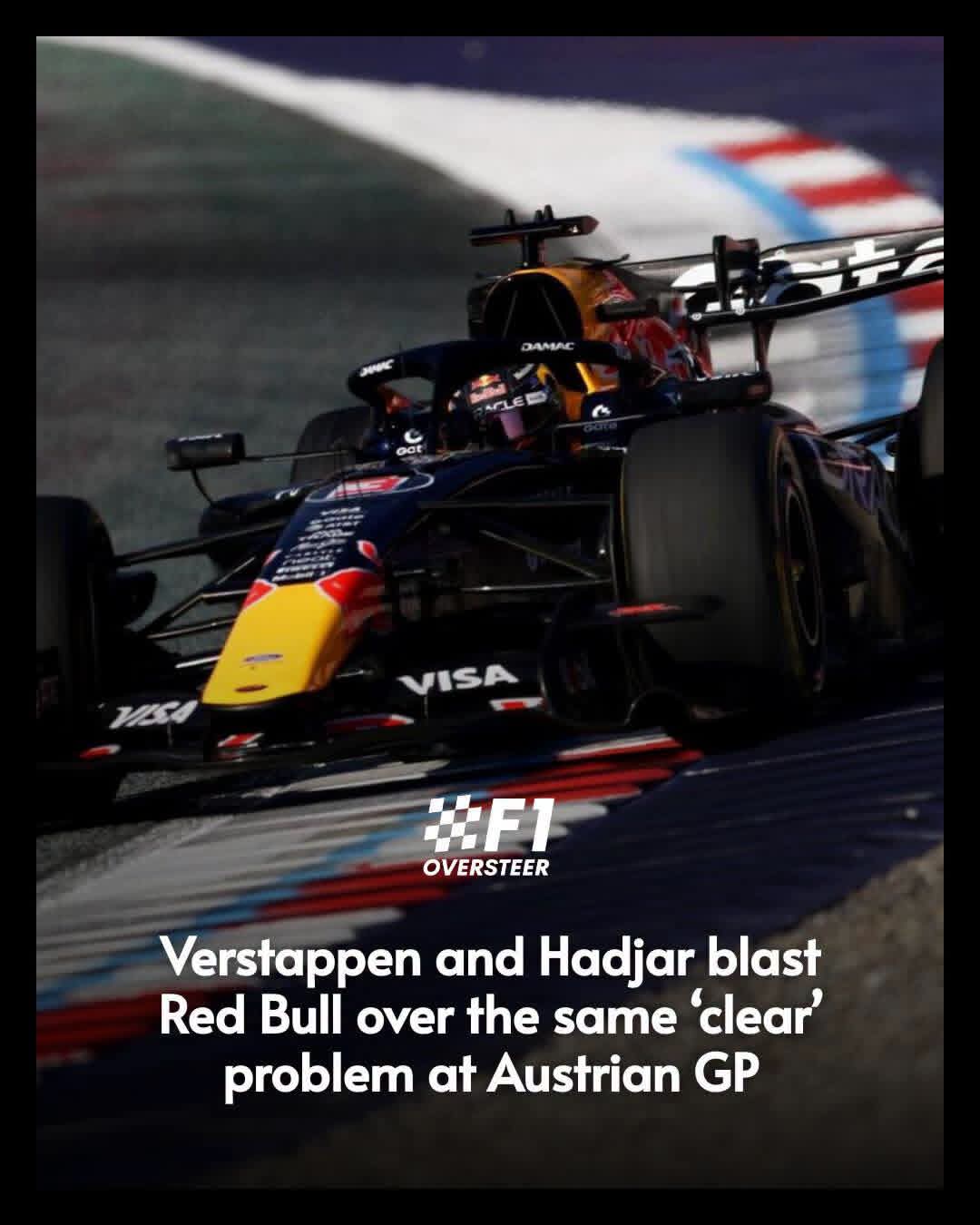
Red Bull may have entered its home race hoping to challenge Mercedes and McLaren at the front, but Friday’s practice sessions at the Austrian Grand Prix highlighted a worrying issue that could seriously limit the team’s chances. Max Verstappen and Isack Hadjar were both heard voicing almost identical frustrations over team radio, pointing to the same recurring problem with the RB22 at Turn 3 of the Red Bull Ring.
While Verstappen still managed to finish among the front-runners, the complaints suggested Red Bull has more work to do than the timing screens initially revealed. With qualifying and the race still ahead, solving this issue could be the difference between fighting for victory and simply limiting the damage.
MERCEDES CONTINUES TO SET THE PACE IN AUSTRIA
Friday belonged largely to Mercedes as championship leader Andrea Kimi Antonelli topped both practice sessions, reinforcing the Silver Arrows’ position as the benchmark team in the 2026 season.
George Russell also looked competitive in FP1 before McLaren’s Oscar Piastri and reigning world champion Lando Norris completed the top three in the second session.
The early pace from Mercedes confirmed that their dominance in both championships is no accident. Leading the Constructors’ Championship with 262 points while Antonelli tops the Drivers’ standings, Mercedes once again demonstrated why they remain the team everyone is chasing.
For Red Bull, that made every technical issue even more significant.
TURN 3 BECOMES RED BULL’S BIGGEST HEADACHE
Throughout FP2, both Verstappen and Hadjar repeatedly encountered problems entering and exiting Turn 3, one of the circuit’s slowest yet most important corners.
The issue appeared to affect the car’s drivability and power delivery, disrupting momentum onto one of the circuit’s longest acceleration zones.
Hadjar’s frustration was immediately obvious over team radio.
“You see? This is the story of Turn 3 today. Like, what was that again?” he exclaimed after another troublesome lap.
Moments later, Verstappen reported almost exactly the same problem.
“Look what happened there on the apex of Turn 3 with the engine? That’s what happens on the push lap as well. The drop in RPM, it’s clear!”
The fact that both drivers independently identified the same issue strongly suggests Red Bull is dealing with a fundamental setup or power delivery characteristic rather than an isolated driver complaint.
HADJAR’S COMMENTS REVEAL THE SCALE OF THE ISSUE
As the session progressed, Hadjar’s concerns became even more direct.
“I need the car to give me power, man! Because otherwise I’m going to get overtaken…”
That message revealed how much confidence the young driver was losing in the RB22’s ability to accelerate consistently out of slower corners.
At a circuit like the Red Bull Ring, where several long straights begin immediately after tight corners, poor power delivery can cost valuable tenths of a second every lap.
It also leaves drivers vulnerable to overtakes, especially under DRS.
RED BULL ADMITS THERE IS A PROBLEM
Unlike many teams that attempt to downplay Friday issues, Red Bull team principal Laurent Mekies openly acknowledged that the team had identified the same weakness.
Speaking after practice, Mekies admitted Red Bull had been “wrestling” with the car’s drivability around Turn 3 throughout the day.
He explained that solving the issue had become one of the team’s main overnight priorities before qualifying.
Mekies also emphasized that the current performance gap was unacceptable.
If the pace deficit remained at roughly half a second heading into Saturday, Red Bull would face an uphill battle against Mercedes and McLaren.
The team believes there is additional performance available once the drivability problem is corrected.
WHY THIS ISSUE MATTERS SO MUCH
Turn 3 is arguably the most critical overtaking setup corner at the Red Bull Ring.
Drivers brake heavily uphill before accelerating onto one of the circuit’s fastest sections. Any hesitation in engine response or instability through the apex compromises acceleration all the way down the following straight.
For Verstappen, whose driving style relies heavily on aggressive corner exits, inconsistent power delivery is particularly damaging.
Even a small delay in acceleration can translate into several tenths across an entire lap.
With Mercedes appearing extremely comfortable and McLaren also showing impressive race pace, Red Bull cannot afford to leave performance on the table.
VERSTAPPEN STILL FINDS A WAY TO STAY COMPETITIVE
Despite the problems, Verstappen still demonstrated why he remains one of Formula 1’s elite drivers.
The Dutchman finished fourth fastest in FP2, while Hadjar ended the session in seventh.
Those positions suggest that Red Bull’s outright pace is not disastrously far behind the leaders.
However, the practice sessions also indicated that Verstappen may currently be extracting more from the RB22 than the car naturally offers.
If Red Bull successfully resolves the Turn 3 issue overnight, Verstappen could become a genuine contender for pole position.
If not, Mercedes and McLaren may hold a decisive advantage heading into qualifying.
THE CHAMPIONSHIP PRESSURE CONTINUES TO BUILD
The timing of these technical concerns could hardly be worse.
Mercedes currently leads both world championships, while McLaren continues to develop one of the fastest overall packages on the grid.
Every race weekend where Red Bull loses ground increases the pressure surrounding Verstappen’s future, especially amid ongoing speculation about his long-term plans.
Although Friday practice rarely tells the complete story of a Grand Prix weekend, it exposed a weakness Red Bull cannot ignore.
At their home circuit, expectations are always exceptionally high. Solving the RB22’s drivability issues before qualifying may ultimately determine whether Verstappen can fight for victory—or spend another weekend chasing the teams currently setting the standard in Formula 1.