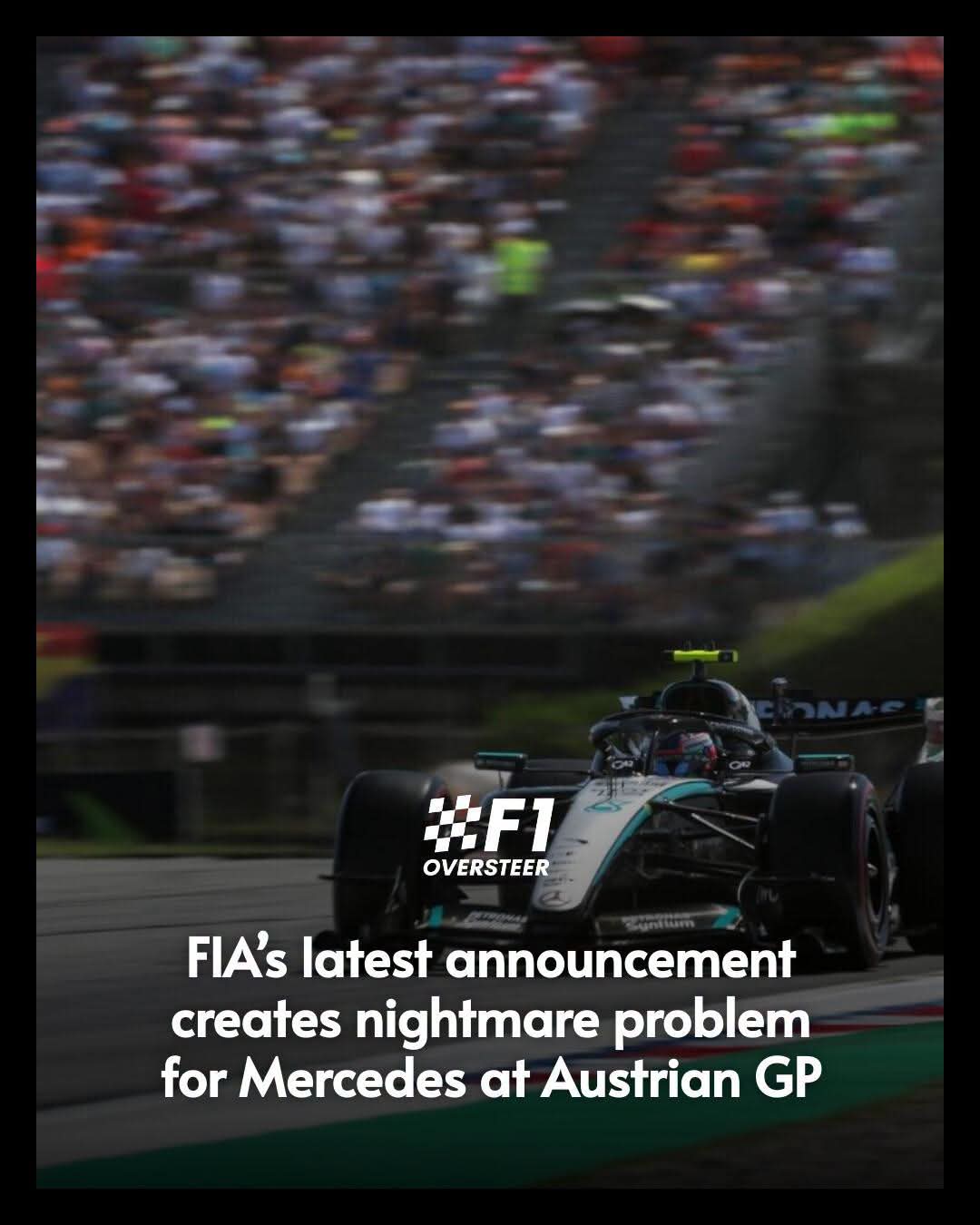
Mercedes heads into the Austrian Grand Prix as the clear benchmark of the 2026 Formula 1 season, but a fresh announcement from the FIA has introduced a new challenge that could threaten the Silver Arrows’ dominance. While the Brackley squad leads both championships thanks to an outstanding start to the campaign, extreme weather conditions expected at the Red Bull Ring could expose one of the team’s biggest weaknesses.
The FIA has officially classified the Austrian Grand Prix as a heat-hazard event, meaning teams will face exceptionally high temperatures throughout the race weekend. For Mercedes, whose power unit has already suffered reliability concerns this season, the timing could hardly be worse as rivals Ferrari and Red Bull look for opportunities to close the gap.
MERCEDES ARRIVES IN AUSTRIA UNDER PRESSURE DESPITE CHAMPIONSHIP LEAD
Mercedes has enjoyed an exceptional start to the 2026 campaign. Andrea Kimi Antonelli has emerged as the surprise championship leader, while George Russell has consistently added valuable points to help Mercedes establish a commanding advantage in the Constructors’ Championship.
The standings reflect just how dominant the Silver Arrows have been. Mercedes leads Ferrari by more than 70 points, with McLaren sitting further behind in third. However, championship momentum can change quickly in Formula 1, especially when reliability begins to undermine outright performance.
The Austrian Grand Prix was expected to favor Mercedes thanks to its long straights and high-speed layout, but the weather forecast has complicated those expectations significantly.
FIA’S HEAT-HAZARD DECLARATION CHANGES THE WEEKEND
The FIA’s decision to declare Austria a heat-hazard race is based on forecasts predicting extremely high track temperatures throughout the weekend. Such conditions place enormous stress on every aspect of an F1 car, particularly cooling systems, batteries, electronics, brakes, and power units.
Unlike cooler circuits where teams can maximize engine performance, extreme temperatures often force engineers to prioritize reliability over outright speed. That could leave Mercedes facing difficult setup compromises if they believe pushing their power unit to its limit increases the risk of another costly retirement.
These conditions will test not only driver endurance but also every team’s engineering preparation.
BATTERY PROBLEMS REMAIN MERCEDES’ BIGGEST CONCERN
Mercedes’ greatest vulnerability throughout 2026 has not been outright pace—it has been reliability.
Battery-related issues have repeatedly interrupted strong race weekends. George Russell suffered electrical problems while fighting for victory in Canada, while Antonelli experienced similar issues in Spain that ultimately forced his retirement.
The concern extends beyond the factory team. Mercedes-powered customer outfits have also experienced mechanical setbacks this season, suggesting the issue may involve broader characteristics of the current power unit package rather than isolated incidents.
High temperatures traditionally place even greater strain on hybrid systems. Batteries generate additional heat under heavy energy deployment, making cooling increasingly difficult during long race stints.
If temperatures rise as forecast, Mercedes engineers could once again find themselves walking a fine line between performance and durability.
FERRARI AND RED BULL SENSE AN OPPORTUNITY
Mercedes’ reliability concerns come at an unfortunate moment because both of its closest rivals arrive in Austria with reasons for optimism.
Ferrari continues building confidence after Lewis Hamilton secured his maiden victory for the Scuderia earlier this season, while reports suggest the Italian team has introduced further engine developments aimed at narrowing Mercedes’ advantage.
Meanwhile, Red Bull hopes fresh upgrades introduced at its home circuit will revive Max Verstappen’s disappointing campaign. The Dutchman desperately needs a strong result to climb back toward the front of the Drivers’ Championship and strengthen his long-term future with the team.
Should Mercedes encounter reliability issues while Ferrari and Red Bull complete clean races, the championship picture could tighten considerably heading into the middle phase of the season.
ENGINE MANAGEMENT COULD DECIDE THE RACE
One solution available to Mercedes would be reducing engine output to protect critical components from overheating. While that may improve reliability, it would also sacrifice valuable straight-line speed and overall performance.
This creates a fascinating strategic dilemma.
Push the engine aggressively and risk another mechanical failure—or run more conservatively and potentially hand rivals a genuine chance to fight for victory on merit.
The decision could influence qualifying, race strategy, and even tire management, as drivers may need to alter their driving styles to reduce thermal stress on the car.
WHY AUSTRIA COULD BE A CHAMPIONSHIP TURNING POINT
Championship-winning teams are often defined not only by speed but by how they overcome adversity.
Mercedes has proven it possesses the fastest overall package in 2026, but the Austrian Grand Prix may become its toughest reliability examination yet. If the Silver Arrows survive the heat without further failures, it will reinforce their position as overwhelming favorites for both world titles.
However, another retirement or significant reliability setback would hand Ferrari and Red Bull renewed belief that the championship remains very much alive.
With soaring temperatures, evolving strategies, and increasing pressure from rivals, the Austrian Grand Prix could become one of the defining weekends of the 2026 Formula 1 season—and Mercedes knows there is little margin for error.