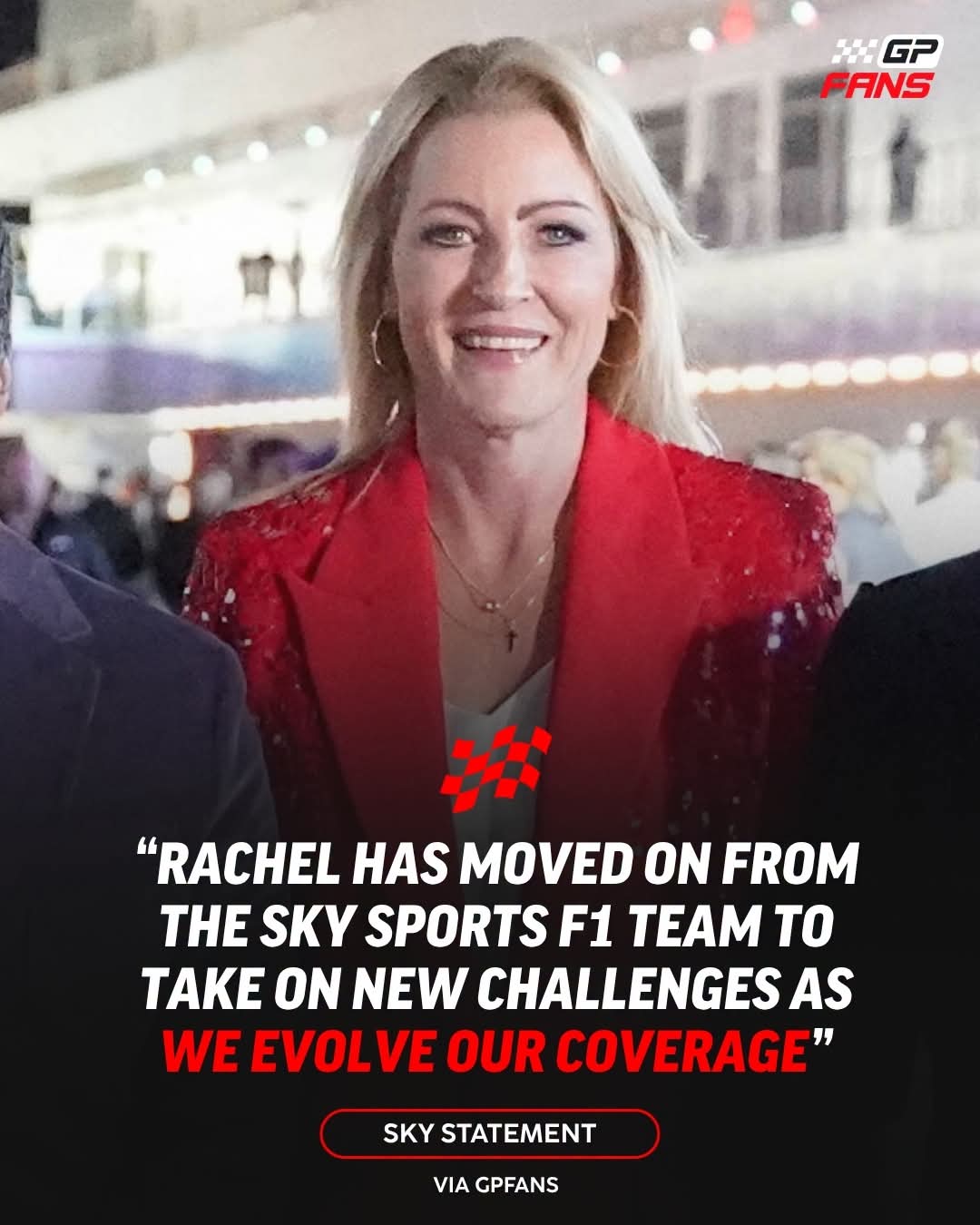
Sky Sports F1 is preparing for a significant transition after long-serving presenter and reporter Rachel Brookes officially confirmed her departure from the broadcaster ahead of the Austrian Grand Prix weekend.
The announcement has surprised many Formula 1 fans, not only because of Brookes’ longevity with the network but also because of the crucial role she played in Sky’s coverage throughout one of the sport’s most transformative eras. With Formula 1 enjoying record global popularity and entering a fiercely competitive new chapter in 2026, her exit marks the end of an important period for the broadcaster.
While Brookes has made it clear that she is not leaving Formula 1 altogether, her departure raises questions about the future shape of Sky’s coverage and how one of the sport’s most influential media teams will evolve moving forward.
THE END OF A 14-YEAR SKY F1 JOURNEY
Rachel Brookes has been part of Sky Sports’ Formula 1 operation since 2012, the year the broadcaster secured exclusive live F1 rights in the United Kingdom.
Over the past decade and a half, she became a familiar face to fans through her work in the paddock, on the grid, and in post-race media sessions. Her role frequently placed her at the center of the sport’s biggest moments, whether interviewing drivers immediately after victories, discussing controversies, or providing updates from the heart of the paddock.
Sky Sports confirmed her departure in an official statement, praising her contribution to the team and wishing her success in her future projects.
For viewers, her exit represents the loss of one of the most recognizable personalities in Formula 1 broadcasting.
WHY BROOKES BECAME AN IMPORTANT FIGURE IN F1 COVERAGE
Formula 1 reporting is a unique challenge.
Unlike traditional sports, F1 journalists often work in highly charged environments where emotions run high, especially after races, penalties, crashes, and championship-defining moments.
Brookes built a reputation for asking direct questions while maintaining professionalism in difficult situations. That balance helped her become one of Sky’s most trusted reporters and one of the most visible journalists in the paddock.
Her interviews frequently generated headlines because she was willing to address controversial topics rather than avoid them.
That approach earned respect from many viewers, even if it occasionally placed her in uncomfortable situations.
THE VERSTAPPEN INCIDENT THAT PUT HER IN THE SPOTLIGHT
One of the most discussed moments of Brookes’ career came during the 2025 season following a controversial collision involving Max Verstappen and George Russell.
After Sky Sports analysts openly questioned Verstappen’s actions, Brookes asked the Red Bull driver directly whether the contact had been intentional.
The question immediately attracted widespread attention.
While many praised her for addressing the issue head-on, others criticized her on social media. The backlash became severe enough that Brookes later revealed the extent of the abuse she received online.
The incident highlighted a growing issue across modern sport: the increasing pressure faced by journalists covering highly passionate fan bases.
Despite the criticism, Brookes maintained that she had no personal issue with Verstappen and was simply doing her job as a reporter.
That professionalism ultimately reinforced her reputation within the industry.
WHAT HER DEPARTURE MEANS FOR SKY SPORTS F1
Sky Sports has built one of the most stable Formula 1 broadcasting teams in the world.
Unlike some networks that frequently rotate presenters and commentators, Sky has largely maintained the same core group since launching its F1 coverage.
Simon Lazenby, David Croft, Martin Brundle, Ted Kravitz, Natalie Pinkham, Karun Chandhok, Anthony Davidson, Naomi Schiff, Bernie Collins, and others have formed a consistent lineup that many fans associate directly with Formula 1 itself.
Brookes’ departure therefore stands out because major personnel changes within the Sky team have become increasingly rare.
Replacing her experience, relationships within the paddock, and understanding of Formula 1’s unique dynamics will not be straightforward.
WHY FORMULA 1 MEDIA IS MORE IMPORTANT THAN EVER
Brookes’ departure also highlights a larger trend within Formula 1.
The sport’s popularity has exploded over the past decade, driven by global expansion, digital content, streaming platforms, and increased interest from younger audiences.
As a result, media coverage now plays a larger role than ever before in shaping public perception.
Drivers are no longer judged solely on race results. Their personalities, interviews, social media interactions, and media appearances significantly influence their public image.
Journalists like Brookes help bridge the gap between fans and the paddock, providing access and context that viewers cannot get from race broadcasts alone.
That responsibility has become increasingly challenging as every interview is instantly analyzed across social media.
WHO COULD FILL THE GAP?
At this stage, Sky Sports has not announced a direct replacement.
Natalie Pinkham remains one of the broadcaster’s most experienced presenters and reporters, while Craig Slater continues to provide paddock coverage and breaking news.
The network also has several talented contributors who could assume larger responsibilities moving forward.
However, replacing Brookes may not simply involve hiring another reporter.
Formula 1 broadcasting continues to evolve, and Sky may decide to restructure its coverage rather than appoint a like-for-like successor.
The rise of digital platforms, social media content, and behind-the-scenes programming means broadcasters are increasingly exploring new ways to engage audiences.
WHY SILVERSTONE WILL FEEL DIFFERENT
Although Brookes has left Sky Sports, she confirmed that she will still be involved in Formula 1 and plans to attend next week’s British Grand Prix at Silverstone.
That creates additional intrigue around her next move.
Silverstone is one of the biggest events on the Formula 1 calendar and often serves as a major platform for announcements involving teams, drivers, and media personalities.
Many fans will be watching closely to see what role she takes on next.
Given her experience and reputation within the sport, it would be surprising if she remained away from Formula 1 for long.
THE CHANGING LANDSCAPE OF F1 BROADCASTING
Formula 1 is entering a period of transformation both on and off the track.
New regulations, emerging stars like Andrea Kimi Antonelli, Lewis Hamilton’s resurgence at Ferrari, and ongoing uncertainty surrounding Max Verstappen’s future are reshaping the competitive landscape.
At the same time, broadcasters are adapting to new audience expectations and changing consumption habits.
Rachel Brookes’ departure may seem like a single personnel change, but it reflects a broader evolution taking place across Formula 1 media.
As the sport continues to grow globally, broadcasters must balance traditional reporting with modern storytelling, digital engagement, and instant audience interaction.
WHAT COMES NEXT FOR RACHEL BROOKES?
While the details remain unclear, Brookes’ statement suggests that her journey in Formula 1 is far from over.
Her extensive paddock connections, interviewing experience, and deep understanding of the sport make her a valuable asset for any media organization involved in motorsport.
Whether she joins another broadcaster, launches independent projects, or takes on a new role within Formula 1 itself, her next move will attract considerable interest.
For now, however, the Austrian Grand Prix weekend marks the first race in over a decade where Sky Sports F1 will move forward without one of its most recognizable reporters.
And for many fans, Formula 1 coverage will feel just a little different because of it.