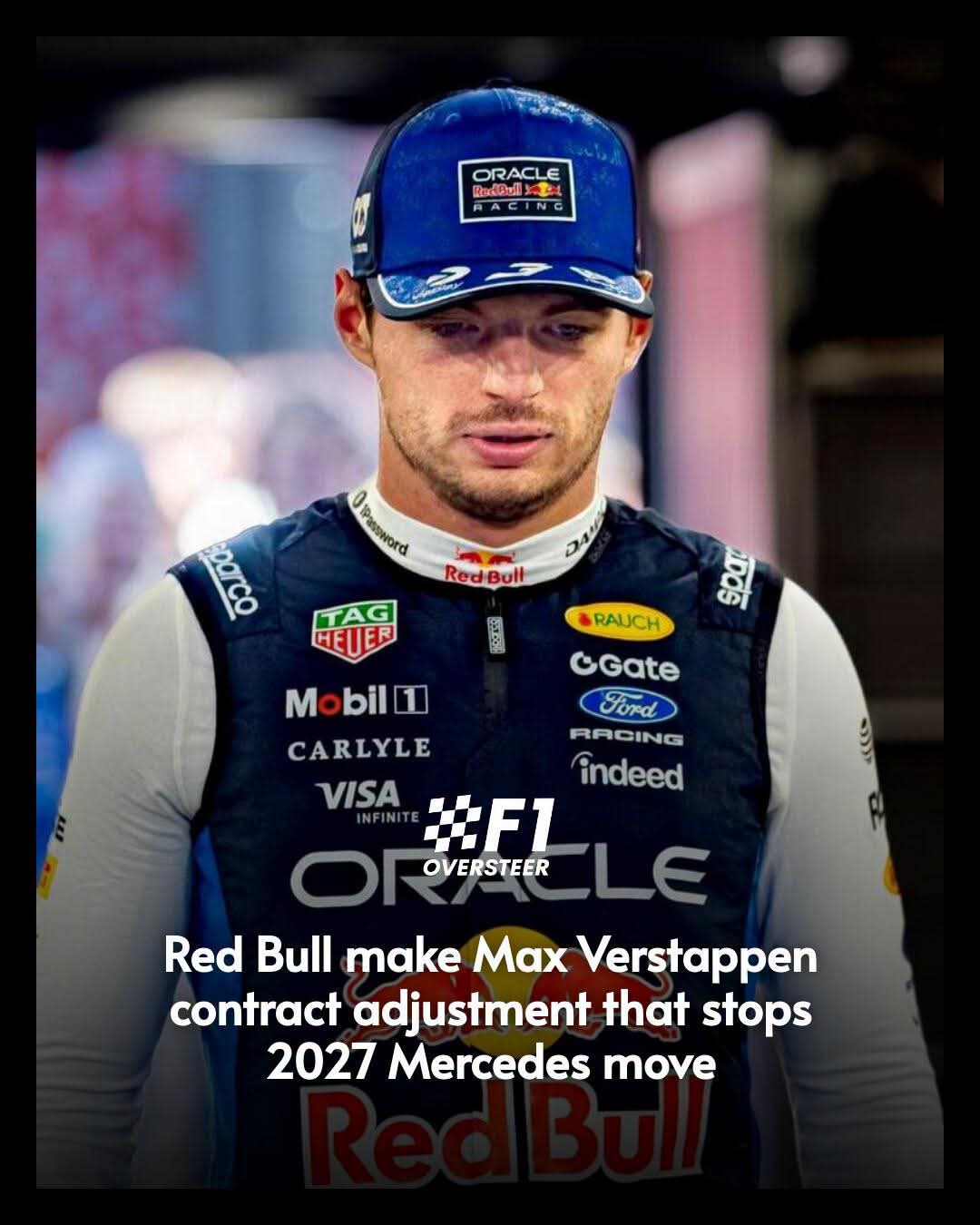
The Formula 1 driver market may have just received its biggest answer of the season. After months of speculation linking Max Verstappen with a blockbuster move to Mercedes, fresh reports suggest Red Bull has taken decisive action to keep its star driver beyond 2026.
According to reports emerging ahead of the Austrian Grand Prix, Verstappen is now expected to remain with Red Bull for 2027 after the team reportedly made significant adjustments to his contract and provided reassurances regarding the future direction of its Formula 1 project.
The development could have major consequences not only for Verstappen and Red Bull but also for Mercedes, George Russell, Kimi Antonelli, and the entire driver market.
VERSTAPPEN’S FUTURE HAS DOMINATED THE 2026 DRIVER MARKET
Few stories have generated as much attention this season as Max Verstappen’s uncertain future.
Although the Dutchman remains contractually tied to Red Bull until the end of 2028, multiple reports have suggested that performance-related exit clauses could allow him to leave before then. Those clauses became increasingly relevant as Red Bull struggled to match the pace of Mercedes and Ferrari under Formula 1’s new regulations.
At one stage, Verstappen appeared to be a realistic option for Mercedes, particularly as the Silver Arrows evaluated their long-term driver lineup.
The possibility of pairing Verstappen with either George Russell or Andrea Kimi Antonelli sparked endless debate throughout the paddock.
However, recent developments suggest that scenario is becoming increasingly unlikely.
WHY MERCEDES WAS ALWAYS INTERESTED
Any team principal would be interested in signing Max Verstappen.
The Dutchman remains one of Formula 1’s most complete drivers, combining exceptional qualifying speed, racecraft, consistency, and technical feedback. Even during Red Bull’s struggles this season, Verstappen has continued extracting results that often exceed the car’s true potential.
For Mercedes team principal Toto Wolff, the opportunity to sign a driver of Verstappen’s caliber was impossible to ignore.
The Silver Arrows have enjoyed a remarkable resurgence in 2026, leading the Constructors’ Championship with 262 points and occupying two of the top three positions in the Drivers’ Championship through Andrea Kimi Antonelli and George Russell.
Adding Verstappen to that project would have made Mercedes an even more formidable force.
But Formula 1’s biggest transfers require more than desire—they require timing.
And it appears Red Bull has moved quickly to eliminate the threat.
RED BULL’S CONTRACT ADJUSTMENT CHANGES EVERYTHING
Reports indicate Red Bull has modified aspects of Verstappen’s contractual situation while simultaneously providing additional confidence in the team’s future competitiveness.
The exact nature of those adjustments remains unclear, but several possibilities have emerged.
One theory suggests Red Bull may have addressed concerns surrounding exit clauses, while another points toward financial incentives or long-term strategic guarantees. There have also been suggestions that the team could be willing to compensate Verstappen in exchange for limiting his ability to activate certain performance-related clauses.
Whatever the mechanism, the objective is obvious.
Red Bull wants to remove uncertainty and ensure Verstappen remains the centerpiece of its future.
Considering the enormous value he brings both on and off the track, the team’s aggressive approach is hardly surprising.
AUSTRIAN GRAND PRIX UPGRADES COULD PLAY A CRUCIAL ROLE
The timing of this development is particularly interesting.
Red Bull arrives at its home race in Austria with what many believe is a critical upgrade package. The team has reportedly focused on reducing weight and improving overall performance, hoping to close the gap to Mercedes and Ferrari.
For Verstappen, these upgrades could serve as an important indication of Red Bull’s ability to recover.
The Dutchman has repeatedly stated that performance is his priority. If the Austrian package delivers the improvements Red Bull expects, it could strengthen his belief that the team remains capable of returning to championship-winning form.
A competitive showing at the Red Bull Ring would therefore represent more than just a strong race result—it could reinforce the argument for staying.
WHAT THIS MEANS FOR GEORGE RUSSELL
One of the biggest winners from Verstappen’s apparent decision may be George Russell.
The British driver has spent much of the season facing questions about his long-term future at Mercedes. Despite remaining one of the grid’s most talented drivers, speculation surrounding Verstappen naturally placed Russell’s position under scrutiny.
Now, reports suggest Mercedes has moved forward with plans to secure Russell’s future.
That stability could allow Russell to focus entirely on his championship battle rather than contract negotiations.
While his performances have occasionally come under criticism this season, he remains third in the Drivers’ Championship and continues to play a crucial role in Mercedes’ Constructors’ campaign.
With Verstappen seemingly unavailable, Mercedes no longer faces the difficult decision of choosing between proven talent and generational greatness.
ANTONELLI’S RISE MAKES MERCEDES LESS DESPERATE
Another factor reducing Mercedes’ urgency is the extraordinary rise of Andrea Kimi Antonelli.
The young Italian leads the Drivers’ Championship with 156 points and has emerged as one of the sport’s biggest stars. His rapid development has exceeded expectations and given Mercedes a potential championship leader for years to come.
Had Antonelli struggled, Mercedes might have pushed harder for Verstappen.
Instead, the team finds itself in the enviable position of already possessing one of Formula 1’s brightest talents.
That makes the prospect of missing out on Verstappen significantly easier to accept.
THE DRIVER MARKET DOMINO EFFECT
Verstappen’s expected commitment to Red Bull could now trigger stability across much of the grid.
Oscar Piastri had been loosely linked to Red Bull in certain scenarios. George Russell’s future remained uncertain. Several midfield drivers were waiting for clarity before negotiating their own contracts.
Now, many of those questions may be resolved.
The top teams appear increasingly likely to maintain their current lineups, shifting attention toward battles in the midfield and among junior programs.
For young drivers such as Arvid Lindblad and Nikola Tsolov, those developments could have a direct impact on future opportunities.
Formula 1’s driver market often resembles a chain reaction, and Verstappen’s decision may have just stopped the biggest domino from falling.
CAN RED BULL RETURN TO THE FRONT?
The bigger question remains whether Red Bull can provide Verstappen with another championship-winning car.
The team has experienced a challenging transition into Formula 1’s latest regulatory era, while Mercedes has adapted exceptionally well. Ferrari’s recent surge, highlighted by Lewis Hamilton’s victory in Barcelona, has added another powerful rival.
However, writing off Red Bull would be dangerous.
This is still the organization that dominated Formula 1 for years and continues to possess elite technical resources, operational excellence, and one of the sport’s greatest drivers.
If the Austrian upgrades succeed and future developments continue to arrive, Red Bull could quickly re-enter the championship conversation.
WHY THIS COULD BE A DEFINING MOMENT
Max Verstappen’s apparent decision to stay may ultimately prove to be one of the defining moments of the 2026 season.
For Mercedes, it reinforces confidence in Russell and Antonelli. For Red Bull, it preserves the foundation of its long-term project. For Formula 1 as a whole, it prevents a blockbuster transfer that would have reshaped the competitive landscape.
Most importantly, it signals that Verstappen still believes Red Bull can return to the top.
Whether that belief is rewarded will become one of the most fascinating storylines to watch over the remainder of the season and beyond.
If Red Bull’s upgrades deliver and the team starts closing the gap, Verstappen’s commitment could look like a masterstroke.
If not, questions about what might have happened at Mercedes will only grow louder.