Ferrari’s resurgence in Formula 1 is no longer a distant possibility—it is becoming a genuine threat to the established order.
Following an impressive performance leap after the team’s latest upgrade package, paddock conversations have shifted dramatically. What once appeared to be another season dominated by the usual contenders is now evolving into a much more unpredictable championship battle, with Ferrari emerging as one of the most dangerous forces on the grid.
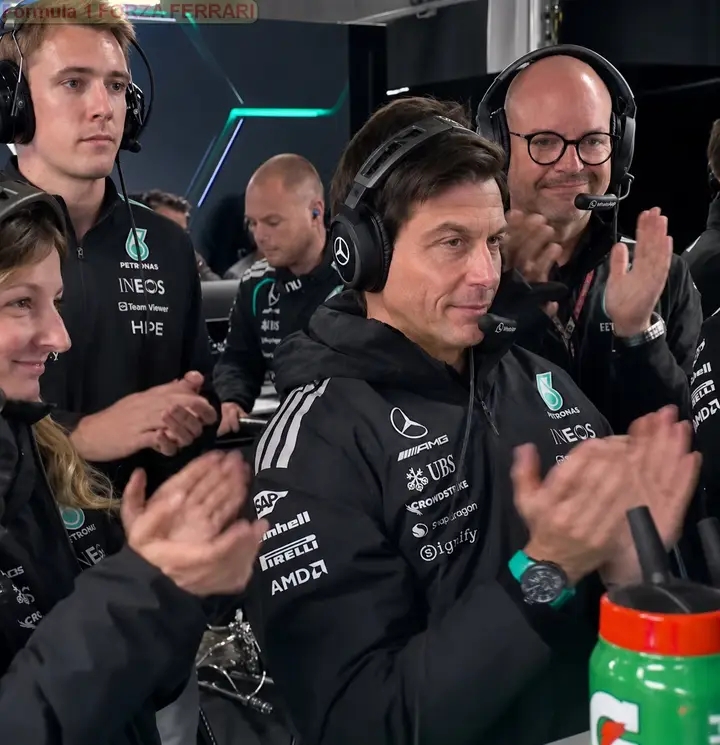
The growing concern inside rival teams has become impossible to ignore. Among those paying close attention is Mercedes team principal Toto Wolff, who understands better than most how quickly Formula 1’s competitive landscape can change when a team unlocks significant performance gains.
FERRARI’S BARCELONA TRANSFORMATION CHANGES EVERYTHING
The Spanish Grand Prix weekend provided perhaps the clearest indication yet that Ferrari’s development direction is paying off.
While incremental gains are common throughout a Formula 1 season, Ferrari’s latest package appeared to deliver something much more substantial. Engineers introduced a series of updates designed to improve aerodynamic efficiency, balance, and overall performance consistency, and the results immediately caught the attention of competitors.
What makes the development particularly significant is that Ferrari did not simply find a few tenths of a second. The team appears to have fundamentally improved the behavior of the SF-26 across a variety of conditions, allowing drivers to extract more performance throughout a race weekend.
In modern Formula 1, where the margins between victory and defeat are often measured in hundredths of a second, a major upgrade package can completely reshape a championship campaign.
WHY MERCEDES IS CONCERNED
Mercedes has spent years setting the benchmark in Formula 1, but the current financial regulations have changed the game.
Under the sport’s budget cap rules, teams must carefully choose where and how they spend their development resources. Massive mid-season redesigns are far more difficult than they were during Formula 1’s previous era of unrestricted spending.
This is where Ferrari’s progress becomes particularly troubling for rivals.
If a team successfully introduces a major upgrade package while remaining within the financial restrictions, competitors cannot simply throw unlimited resources at the problem and catch up immediately. Every development decision carries consequences.
For Wolff, the concern is not merely Ferrari’s current speed. It is the possibility that Ferrari has discovered a development pathway that could continue delivering gains throughout the remainder of the season.
That scenario would place enormous pressure on Mercedes and other contenders to respond with limited resources available.
THE SF-26 MAY HAVE FOUND ITS SWEET SPOT
One of the most encouraging signs for Ferrari is that the improvements appear to extend beyond outright pace.
Championship-winning cars are not always the fastest over a single lap. More often, they are the most complete packages—machines capable of performing consistently across different circuits, temperatures, tire compounds, and race conditions.
Recent performances suggest Ferrari may finally be approaching that level of balance.
The SF-26 appears more stable through high-speed corners, more predictable during race stints, and more efficient in tire management than earlier versions of the car. Those qualities become increasingly valuable as the championship progresses and teams face a wider variety of circuit characteristics.
If Ferrari has genuinely solved some of the underlying weaknesses that limited previous campaigns, rivals have every reason to be concerned.
THE UPCOMING POWER BOOST COULD BE A GAME CHANGER
Perhaps the most intriguing aspect of Ferrari’s trajectory is that the team’s current gains may not represent the final step in its development journey.
Reports within the paddock continue to suggest that additional performance improvements are expected, including upgrades focused on extracting more power and efficiency from the overall package.
Should those gains materialize, Ferrari could become even more competitive on tracks where straight-line speed and acceleration play a crucial role.
The combination of a stronger chassis, improved aerodynamics, and enhanced power delivery is precisely the formula that creates championship-caliber machinery.
For rivals, the fear is obvious: Ferrari may still have untapped potential waiting to be unlocked.
THE IMPACT ON THE CHAMPIONSHIP FIGHT
A stronger Ferrari is good news not only for the Scuderia but also for Formula 1 as a whole.
Fans have repeatedly called for closer competition at the front of the field, and Ferrari’s progress could help deliver exactly that.
A genuine multi-team title battle increases pressure on drivers, strategists, and engineers alike. Every qualifying session becomes more important. Every pit stop matters. Every strategic decision carries greater consequences.
If Ferrari can maintain its development momentum, the championship fight could become one of the most competitive in recent years.
That scenario would force rivals to operate at their absolute maximum level while giving Ferrari an opportunity to challenge for the sport’s biggest prizes.
CAN FERRARI FINALLY TURN POTENTIAL INTO A WORLD TITLE?
The biggest question remains whether Ferrari can sustain its current trajectory over an entire season.
The team has shown flashes of brilliance in previous campaigns, only for reliability issues, strategic errors, or development stagnation to derail its title ambitions.
This time feels different.
The latest upgrades suggest Ferrari’s technical department has a clearer understanding of the current regulations and a stronger foundation for future development. More importantly, the team appears capable of improving the car without compromising its overall balance.
That combination is often the hallmark of championship contenders.
THE REST OF THE GRID HAS BEEN WARNED
Whether or not Toto Wolff’s concerns ultimately prove justified, one fact is becoming increasingly clear: Ferrari is no longer viewed as an outsider.
The Scuderia has forced the Formula 1 paddock to take notice. What began as a promising development program is rapidly evolving into a serious challenge to the sport’s established powerhouses.
If Ferrari continues extracting performance from the SF-26 while introducing further upgrades in the coming races, the championship picture could change dramatically.
For Mercedes, Red Bull, and every other rival, the warning signs are already flashing.
And for Ferrari fans around the world, there is growing belief that the dream of returning to the top of Formula 1 may finally be within reach.