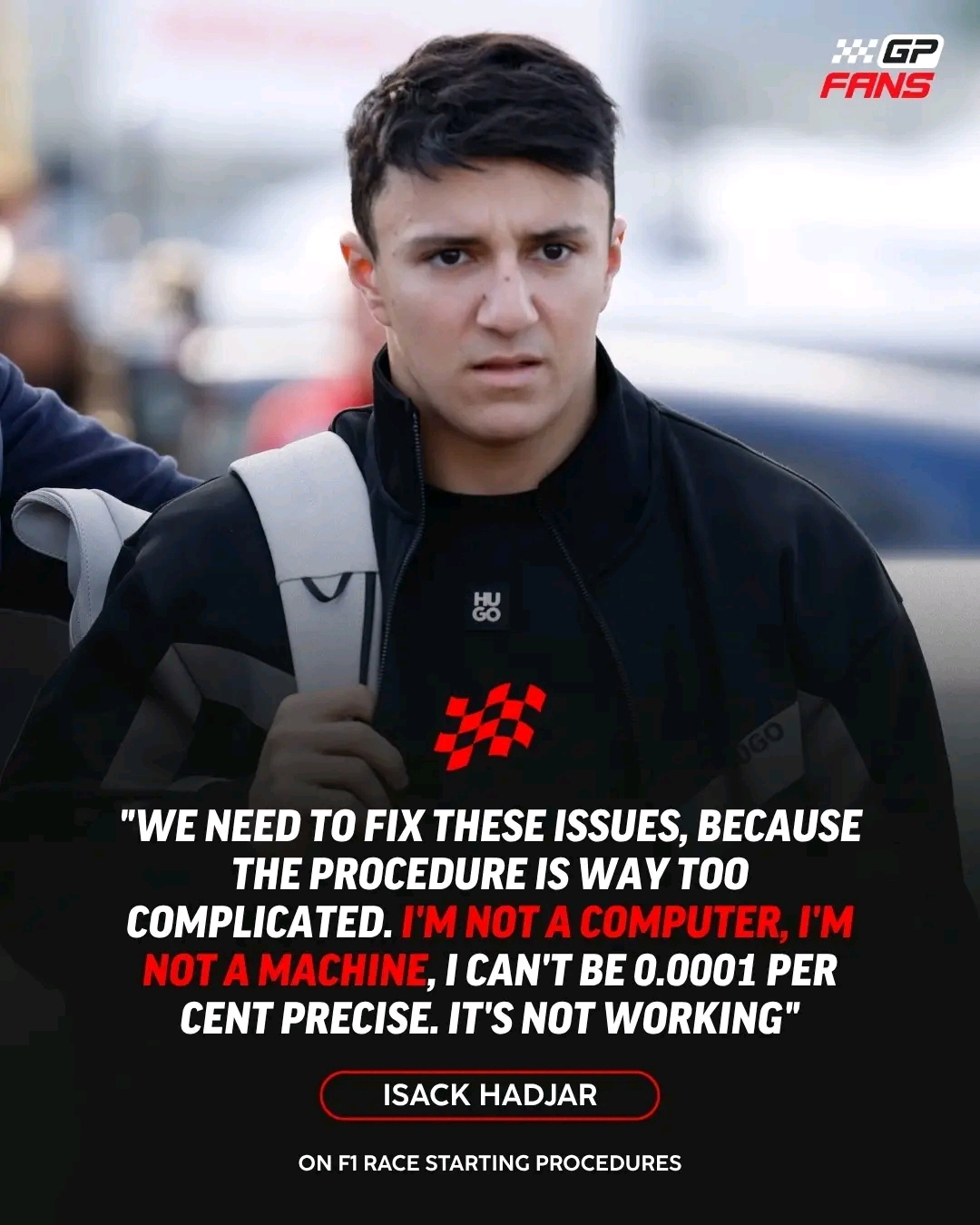
Formula 1 is a sport where fractions of a second can determine victory or defeat. But when a driver publicly admits that his team’s procedures are “too complicated” and “not working,” it raises a much bigger question than a poor race start.
Following the Spanish Grand Prix in Barcelona, Red Bull driver Isack Hadjar openly criticized the team’s starting procedure after another frustrating getaway from the grid. The Frenchman claimed the process requires an unrealistic level of precision and suggested Red Bull needs to simplify its approach before more opportunities are lost.
The comments have sparked debate throughout the paddock. Is Hadjar exposing a genuine weakness inside Red Bull, or is the team simply searching for excuses after another disappointing race weekend?
WHAT HAPPENED IN BARCELONA?
Hadjar entered the Spanish Grand Prix weekend showing encouraging pace. He qualified sixth and appeared well-positioned to challenge for another strong points finish.
However, everything changed when the lights went out.
Instead of launching cleanly, Hadjar suffered a poor start and immediately lost multiple positions. By the end of the opening lap, a race that looked promising had turned into a recovery mission. Despite fighting back impressively to finish sixth, the damage had already been done.
After the race, Hadjar did not hide his frustration. He revealed that he had struggled with practice starts throughout the weekend and argued that Red Bull’s current procedure demands an impossible level of perfection from the driver.
WHY STARTS HAVE BECOME A MAJOR ISSUE FOR RED BULL
The concern extends beyond a single race.
Throughout the 2026 season, Red Bull drivers have repeatedly experienced inconsistent launches. Sometimes the car leaves the grid perfectly. Other times, valuable positions disappear before Turn 1.
The problem has affected not only Hadjar but also Max Verstappen at various points during the campaign. Several rivals appear to have improved their launch systems, while Red Bull continues searching for consistency.
In modern Formula 1, race starts are more important than ever. With overtaking becoming increasingly difficult on certain circuits, losing positions in the opening seconds can completely compromise a race strategy.
That makes Hadjar’s criticism particularly significant.
If a driver lacks confidence in the starting process, the issue becomes both technical and psychological.
DOES HADJAR HAVE A VALID ARGUMENT?
Based on the available evidence, yes.
Drivers are expected to execute complex procedures, but those procedures must remain repeatable under intense pressure.
When a driver reports repeated problems across multiple practice starts and then experiences the worst launch of the entire weekend during the actual race, it suggests there may be a systemic issue rather than simple driver error.
Formula 1 drivers operate under extreme stress. They must manage clutch bite points, tire temperatures, steering wheel settings, race strategy information, and reactions to the start lights simultaneously.
Adding an overly narrow operating window can make even elite drivers vulnerable to mistakes.
Hadjar’s statement that he is “not a computer” resonates because Formula 1 remains a human sport despite its technological sophistication.
WHY RED BULL SHOULD TAKE THE COMPLAINT SERIOUSLY
Championships are rarely lost because of one dramatic failure.
More often, they are lost through small inefficiencies repeated over an entire season.
A poor start might cost one position in Australia, two positions in Monaco, and several points in Barcelona. Over a 24-race season, those losses accumulate quickly.
For a team accustomed to fighting for victories and championships, even minor weaknesses demand immediate attention.
Hadjar’s comments may actually provide Red Bull with valuable feedback rather than unwanted criticism.
The most successful teams in Formula 1 often improve because drivers are willing to identify weaknesses publicly and privately.
THE BIGGER PICTURE FOR HADJAR
One of the most encouraging aspects of Barcelona was Hadjar’s recovery drive.
Despite dropping down the order, he fought his way back into the points and demonstrated strong race pace. That performance highlighted a growing maturity that has become increasingly evident throughout his Red Bull career.
Earlier in the season, setbacks might have completely derailed his race.
Instead, he responded calmly and maximized the result available to him.
For a young driver still establishing himself among Formula 1’s elite, that resilience could prove more important than the disappointing start itself.
WHAT THIS MEANS FOR RED BULL’S 2026 SEASON
The timing of this issue is not ideal.
Mercedes has emerged as a serious force, Ferrari appears increasingly competitive, and McLaren continues to challenge near the front. The margin for error is shrinking every weekend.
If Red Bull cannot consistently convert strong qualifying performances into strong opening laps, they risk losing crucial points in both championships.
The Austrian Grand Prix, Red Bull’s home race, now becomes an important test.
A clean launch and competitive performance would quickly quiet the criticism.
Another poor getaway, however, would reinforce Hadjar’s argument and increase pressure on the team’s engineers to find a solution.
PREDICTION: RED BULL WILL RESPOND QUICKLY
Red Bull has built its reputation on solving problems faster than its rivals.
Historically, when a weakness becomes obvious, the team rarely ignores it for long.
Expect engineers to review clutch mapping, launch settings, and driver procedures before the next race weekend. Whether the solution is technical, procedural, or a combination of both, it is difficult to imagine Red Bull allowing the issue to persist throughout the season.
The bigger question is whether the fix arrives soon enough to prevent further damage.
Because in a championship fight, losing positions at the start is one thing.
Losing confidence in the system itself is far more dangerous.
FINAL VERDICT
Hadjar’s criticism does not sound like sour grapes.
It sounds like a driver highlighting a recurring weakness that has already cost him valuable track position and potentially valuable championship points.
While Red Bull may not appreciate the public nature of the comments, the evidence suggests there is a genuine issue that requires attention.
The Barcelona Grand Prix may ultimately be remembered not for Hadjar’s poor start, but for the moment a young Red Bull driver forced the team to confront a problem that could become much bigger if left unresolved.