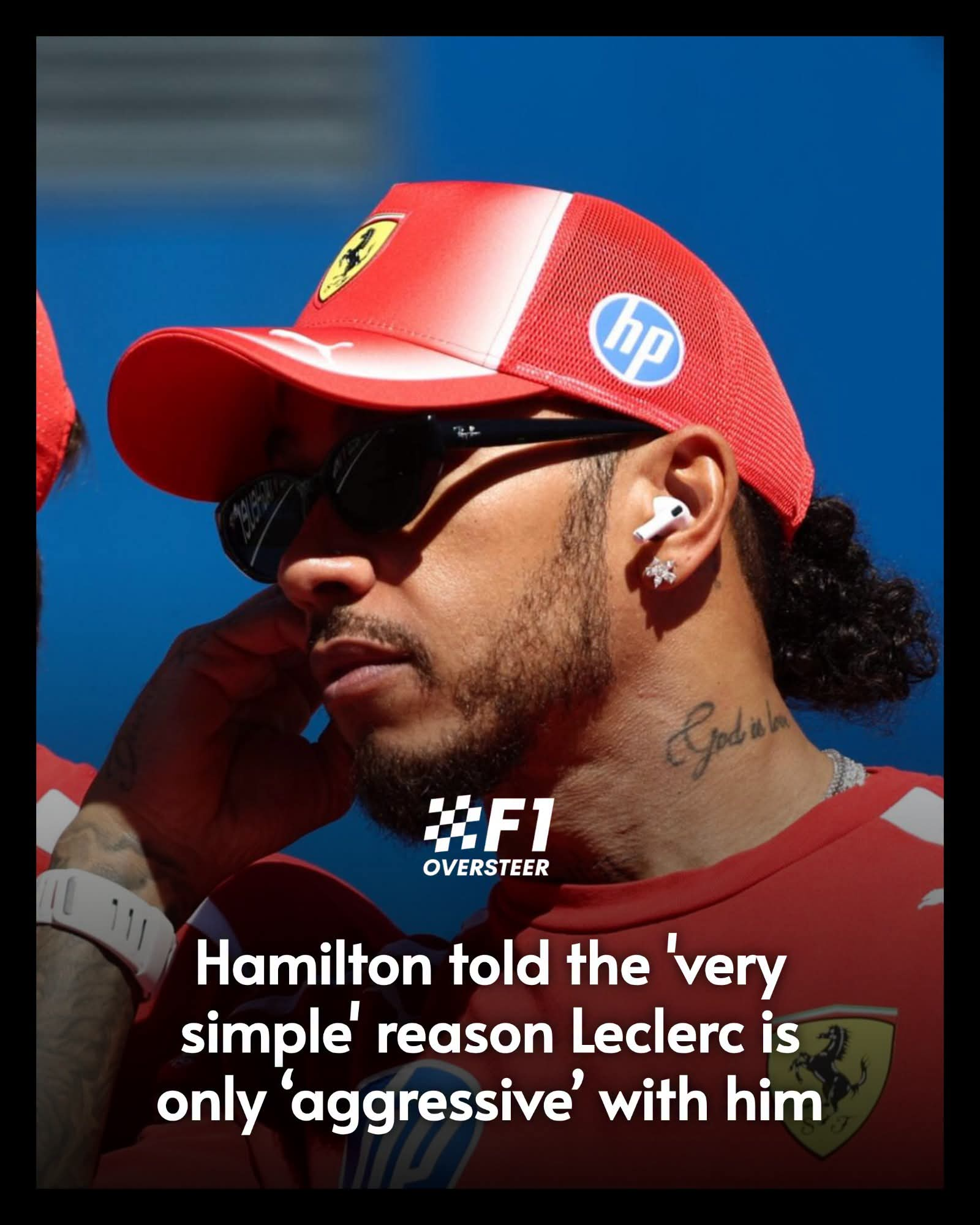
Ferrari’s internal tensions have attracted another major intervention after former Formula 1 driver Juan Pablo Montoya questioned why Charles Leclerc appears to race Lewis Hamilton so aggressively compared with other competitors on the grid.
The Colombian believes the repeated clashes between the Ferrari team-mates could be connected to a battle for authority within the team, particularly as both drivers attempt to establish themselves as Ferrari’s leading figure for the future.
His comments come after another dramatic confrontation at the Las Vegas Grand Prix, where Leclerc and Hamilton made contact while fighting on track. With tensions already rising following previous incidents, Montoya believes Ferrari must introduce meaningful consequences if it wants to prevent the situation from becoming even worse.
More importantly, he has questioned whether team principal Frederic Vasseur has sufficient control over the situation.
MONTOYA QUESTIONS LECLERC’S AGGRESSIVE APPROACH AGAINST HAMILTON
Montoya’s biggest concern is not simply that Leclerc has been involved in multiple incidents. Instead, he wants to understand why the Monegasque appears particularly aggressive when competing against his own team-mate.
Speaking on the MontoyAS podcast, the former Williams and McLaren driver questioned why similar behaviour was not being directed towards drivers such as Max Verstappen, George Russell, Kimi Antonelli or the McLaren competitors.
“For me, the big problem is why he does that to Lewis and not to anyone else?” Montoya asked.
He then offered his interpretation of the situation, suggesting that Leclerc understands Ferrari could be entering a stronger period and wants to establish his authority before the team’s next major opportunity to fight for championships.
This is Montoya’s personal theory, not an established explanation for Leclerc’s driving decisions. Nevertheless, it highlights the growing perception that the rivalry between Ferrari’s drivers is becoming about more than individual race results.
Both men have championship ambitions, and neither wants to become the unquestioned second driver.
LAS VEGAS COLLISION ADDS TO FERRARI’S GROWING PROBLEMS
The latest disagreement between Hamilton and Leclerc took place during the Las Vegas Grand Prix.
On Lap 38, Leclerc made contact with Hamilton’s left-rear tyre, sending the seven-time world champion into a spin and costing him valuable positions.
Hamilton eventually recovered to finish seventh, while Leclerc received a 10-second penalty and finished 10th.
The incident attracted considerable attention because it followed previous confrontations between the pair since the summer break, including their disagreement in Mexico.
Repeated contact between team-mates is particularly damaging because both drivers are competing for the same organisation. Every lost position can affect Ferrari’s championship ambitions, while every public disagreement creates additional pressure on the team management.
Ferrari cannot afford to treat these incidents as isolated racing moments indefinitely. The team needs a clear understanding between its drivers about how they are expected to compete.
MONToya BELIEVES VASSEUR MUST TAKE STRONGER ACTION
Montoya believes Ferrari’s leadership must intervene before the situation becomes impossible to manage.
He suggested that one of two major changes may eventually become necessary: separating the drivers or making a significant change in the team’s leadership.
His criticism was particularly direct when discussing Vasseur’s authority.
“If Fred can’t control them, the people at Ferrari are going to say: ‘So Fred isn’t the right person,'” Montoya argued.
The former driver also insisted that Ferrari should establish written consequences for repeated incidents.
He rejected the idea of deliberately damaging one driver’s machinery, such as supplying a slower engine, because that would also hurt the team’s overall performance.
Instead, his argument centres on clear sporting rules and meaningful disciplinary measures.
That approach could involve internal penalties, stricter racing instructions or a formal agreement about how the drivers are expected to behave when fighting each other.
However, Ferrari would need to apply any rules consistently. Punishing one driver while appearing to protect the other could create an even bigger internal conflict.
SHOULD FERRARI CHOOSE A NUMBER ONE DRIVER?
The debate over Ferrari’s driver hierarchy has become increasingly difficult to ignore.
Hamilton arrived with seven world championships and enormous experience, while Leclerc has been part of Ferrari since 2019 and sees the team as the central project of his career.
Both have legitimate reasons to compete for victories, and neither is likely to welcome a permanent supporting role.
Leclerc has also recently denied having a contractual clause that guarantees him number one status at Ferrari. That clarification makes it even more important to distinguish between contractual privileges and race-specific decisions made by the team.
Ferrari could introduce a temporary hierarchy when championship circumstances demand it, but choosing a permanent number one driver carries risks.
Favouring Hamilton could undermine Leclerc’s long-term commitment, while favouring Leclerc could create frustration for a seven-time champion who joined Ferrari expecting to compete at the front.
There is also a third option: allow both drivers to race freely under stricter rules designed to prevent unnecessary contact and protect the team’s results.
That approach would preserve competition, but it would require both drivers to accept responsibility when their battles threaten Ferrari’s interests.
FERRARI’S BIGGEST PROBLEM MAY STILL BE THE CAR
While the driver rivalry dominates the headlines, Ferrari must not lose sight of its larger competitive objective.
A team cannot win championships through driver management alone. It needs a consistently competitive car, reliable race operations, strong strategy and effective development throughout the season.
Even if Ferrari successfully resolves the tension between Hamilton and Leclerc, it must still provide machinery capable of challenging its strongest rivals.
This is why the current situation is complicated. Ferrari must manage two high-profile drivers while also addressing the competitive demands of the championship.
If the team introduces unnecessary restrictions before it has a genuine title fight to manage, it could create resentment without improving its results.
However, allowing repeated collisions to continue would also be irresponsible.
The challenge for Vasseur is finding a balance that protects Ferrari without destroying the competitive freedom that makes both drivers valuable.
HAMILTON AND LECLERC RIVALRY COULD FORCE A MAJOR FERRARI DECISION
Montoya’s intervention has added another layer to an increasingly uncomfortable situation at Maranello.
His suggestion that Leclerc’s aggression could be connected to a struggle for authority remains an opinion, but the repeated incidents have made Ferrari’s driver-management strategy a legitimate talking point.
The team must now demonstrate that it can maintain discipline without creating the impression that one driver receives special treatment.
Hamilton and Leclerc are both capable of producing outstanding performances, but their partnership will only benefit Ferrari if they can compete without repeatedly damaging each other’s races.
For Vasseur, the priority should be establishing clear expectations and ensuring that both drivers understand the consequences of crossing the line.
The next races could reveal whether Ferrari has found a solution behind the scenes or whether the disagreement is heading towards another major confrontation.
One thing is becoming increasingly clear: Ferrari cannot afford to let its two biggest driving assets become its biggest competitive problem.