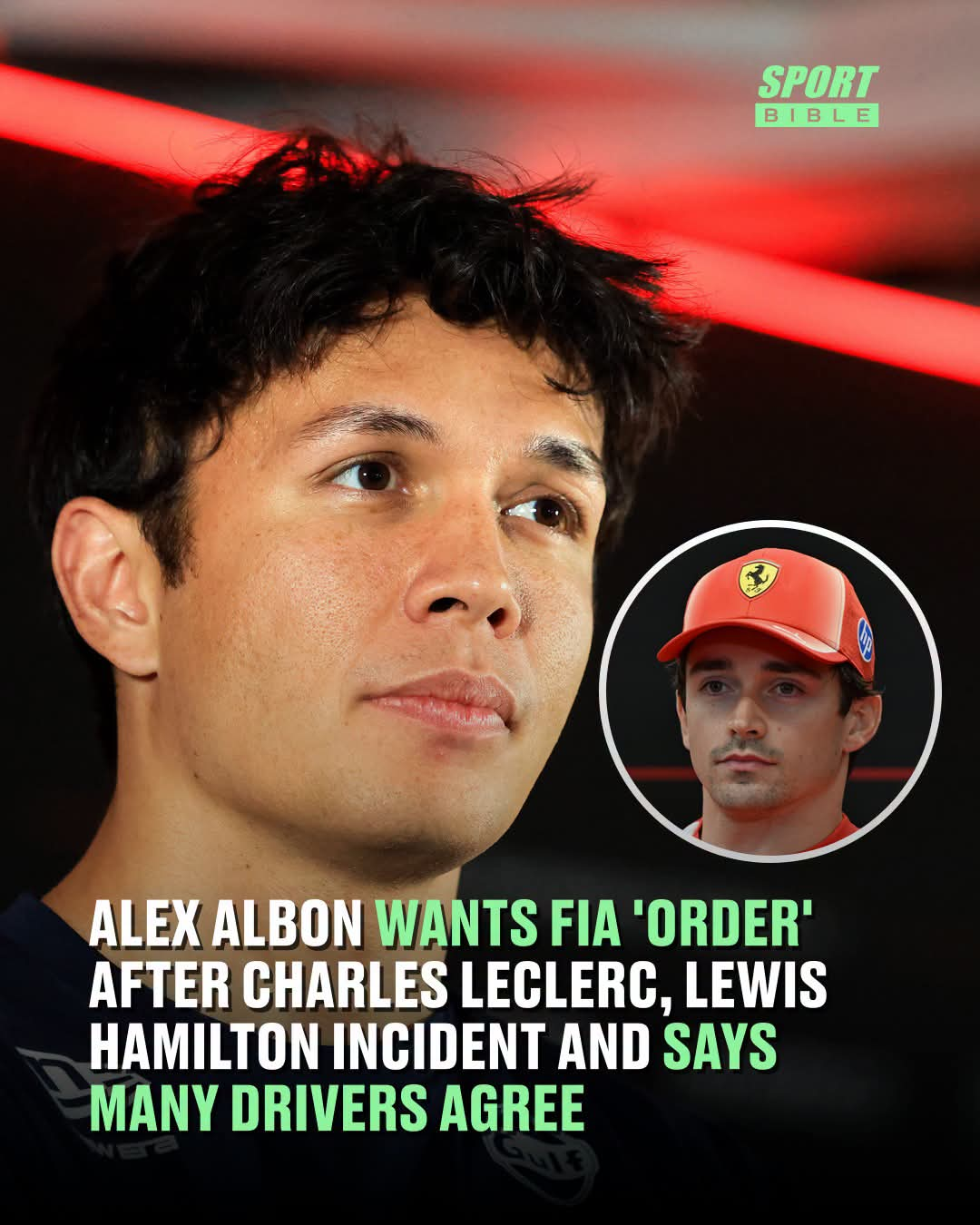
Formula 1’s penalty system is facing renewed scrutiny after Alex Albon called on the FIA to introduce a tougher approach to incidents involving drivers who gain an advantage by leaving the track. The Williams driver believes certain offences should result in an immediate instruction to surrender a position rather than relying on time penalties that may not adequately reflect what happened.
His comments followed the controversial incidents involving Ferrari team-mates Charles Leclerc and Lewis Hamilton at the Mexican and Las Vegas Grands Prix. More importantly, Albon suggested that his position is shared by many drivers on the current grid, raising the possibility of a wider push for changes to how race stewards enforce the rules.
With the FIA already facing questions about consistency in its decisions, the discussion could become an important part of preparations for the 2027 season.
ALBON CALLS FOR FIA TO INTRODUCE POSITION-BASED PENALTIES
Speaking after Thursday’s annual drivers’ meeting in Qatar, Albon argued that some incidents require a more direct punishment.
He pointed towards several recent decisions, including George Russell’s penalty in Austin, Oscar Piastri’s incident involving Arvid Lindblad in Mexico and Leclerc’s five-second punishment for leaving the track while overtaking Hamilton.
Albon suggested that drivers should sometimes be instructed to give up the position they gained illegally.
His argument is straightforward: when a driver leaves the circuit and secures an advantage, a time penalty does not always restore the position lost by the other competitor.
A five-second penalty, for example, may have little practical impact if the driver has already built a substantial gap. By the time the punishment is applied, the original advantage could remain largely intact.
A position-based instruction would address that situation more directly, although the FIA would need clear guidelines to determine when it should be used.
LECLERC AND HAMILTON INCIDENTS REIGNITE THE DEBATE
The latest disagreement has been fuelled by the increasingly complicated relationship between Ferrari’s two drivers.
During the Mexico City Grand Prix, Leclerc received a five-second penalty after leaving the circuit while overtaking Hamilton at Turn 4 and gaining a lasting advantage. The stewards applied mitigating circumstances rather than the standard 10-second punishment.
That decision has now become an example in the wider debate about whether the FIA’s penalties are sufficiently severe.
The controversy continued in Las Vegas, where Leclerc and Hamilton collided on Lap 38. Leclerc made contact with the left-rear tyre of Hamilton’s Ferrari, sending the seven-time world champion into a spin.
Hamilton recovered to finish seventh, while Leclerc received a 10-second penalty and ended the race in 10th.
Although the Las Vegas collision and the Mexico track-limit incident involved different circumstances, both have contributed to increased scrutiny of Ferrari’s internal racing arrangements and the FIA’s approach to driver conduct.
For the governing body, the challenge is ensuring that similar offences receive consistent treatment without ignoring the specific details of each incident.
CARLOS SAINZ BACKS THE NEED FOR A DIFFERENT APPROACH
Albon was not alone in questioning the severity of certain FIA decisions.
His Williams team-mate Carlos Sainz also agreed that Leclerc’s five-second penalty in Mexico was not sufficiently severe.
Sainz, who previously raced alongside Leclerc at Ferrari, believes the FIA must revisit its regulations and find a more effective way of applying punishments.
His comments are significant because the issue extends beyond one team or one driver. If competitors across different teams share concerns about how penalties are being issued, the governing body may face pressure to review its approach.
According to the report, The Race described drivers as being more aligned than ever during this year’s annual meeting.
That does not mean every competitor supports exactly the same solution. However, the apparent agreement suggests that consistency and proportionality in stewarding decisions remain major concerns within the paddock.
WHY A POSITION-SWAP PENALTY COULD CREATE NEW PROBLEMS
While Albon’s proposal appears straightforward, introducing position-based penalties would not be as simple as ordering every driver to surrender one place.
Formula 1 races often involve several cars battling within a short distance of one another. An illegal advantage can also affect more than one competitor, making it difficult to determine precisely which position should be returned.
Consider a hypothetical situation in which a driver leaves the track to pass one rival, only for another competitor to overtake that rival moments later.
If the FIA subsequently orders the original driver to surrender a position, should that driver give up one place or two?
The answer could depend on the sequence of events, the positions involved and whether the original advantage remained in place.
There would also need to be a clear distinction between deliberate corner-cutting, being forced off the circuit and incidents where a driver gains an advantage unintentionally.
Without carefully defined rules, position-based penalties could create another source of controversy rather than eliminate existing disagreements.
The FIA would therefore need to establish transparent criteria explaining when a driver must surrender a position and when a conventional time penalty remains appropriate.
FIA FACES PRESSURE TO IMPROVE STEWARDING CONSISTENCY
The wider significance of the Qatar meeting is that drivers appear increasingly interested in having a stronger voice in discussions about sporting regulations.
Stewards must make decisions under considerable pressure, often with limited time to examine incidents involving several cars. Different circumstances can also make apparently similar situations difficult to judge identically.
However, consistency remains essential to maintaining confidence in Formula 1’s rulebook.
Drivers need to understand what is expected of them, teams need predictable enforcement, and fans want to see that competitors are being treated fairly.
The FIA could consider a more structured penalty framework for 2027, potentially combining position restoration with time penalties depending on the circumstances.
That would allow the governing body to address the advantage gained rather than relying exclusively on a punishment applied after the incident.
For now, Albon’s comments represent a proposal rather than an announced FIA rule change. No new position-based penalty system has been confirmed.
Nevertheless, with several prominent drivers reportedly sharing concerns about recent decisions, the discussion is unlikely to disappear quickly.
The Qatar meeting may have opened the door to a broader conversation about how Formula 1 should punish on-track offences — and the FIA could face growing pressure to turn those discussions into meaningful changes.