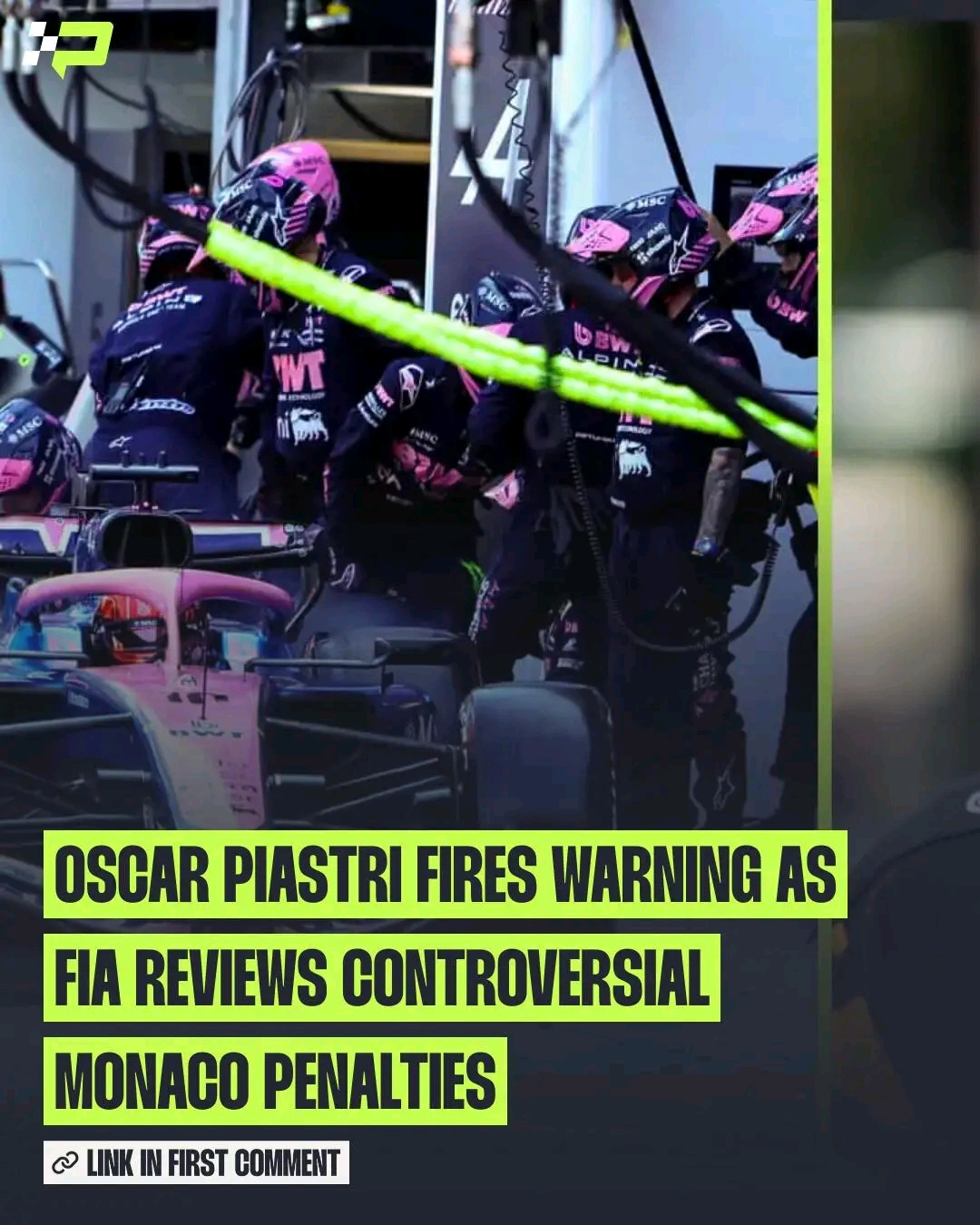
The fallout from the Monaco Grand Prix continues to dominate Formula 1 discussions, but championship contender Oscar Piastri believes there is little chance the FIA will alter the final race classification despite ongoing controversy surrounding penalties that significantly impacted multiple drivers.
Monaco once again delivered drama, strategy, and heated debate. However, instead of focusing solely on the on-track action, much of the post-race conversation has centered on steward decisions, penalties, and whether the governing body should reconsider certain rulings through its Right of Review process.
While some teams and fans continue to question aspects of the race outcome, Piastri has made it clear that he does not expect Formula 1’s governing body to revisit the final result.
His comments highlight a larger issue facing modern Formula 1: balancing fairness, consistency, and finality in stewarding decisions.
WHY THE MONACO GRAND PRIX CONTROVERSY REFUSES TO GO AWAY
Monaco is unlike any other race on the Formula 1 calendar.
Its narrow streets, limited overtaking opportunities, and emphasis on track position mean that even minor penalties can have enormous consequences.
Unlike circuits where drivers can recover lost positions through pace advantages, Monaco often magnifies the impact of every steward decision. A time penalty or race incident investigation can completely alter the outcome for several competitors.
Following this year’s event, multiple penalties became major talking points among teams, drivers, and analysts. Questions emerged about consistency, interpretation of regulations, and whether certain incidents deserved different outcomes.
As a result, some observers suggested that further reviews could potentially change parts of the race classification.
Piastri, however, appears unconvinced that such a scenario is realistic.
UNDERSTANDING THE FIA’S RIGHT OF REVIEW PROCESS
One of the most misunderstood procedures in Formula 1 is the FIA’s Right of Review system.
The process allows teams to request that race incidents be reconsidered if significant new evidence becomes available after the event.
However, the threshold for success is extremely high.
Teams cannot simply disagree with a decision and ask for another judgment. They must present relevant, significant, and previously unavailable evidence that could materially affect the original ruling.
Over the years, many review requests have been submitted, but only a small number have led to substantial changes.
That reality likely explains Piastri’s confidence that Monaco’s final result will remain unchanged.
The Australian understands that overturning race outcomes is intentionally difficult because Formula 1 relies heavily on the certainty of official results.
WHY CHANGING A RACE RESULT COULD CREATE BIGGER PROBLEMS
At first glance, correcting a potentially controversial decision sounds reasonable.
However, there are important consequences when race results are modified long after the checkered flag.
Formula 1 teams immediately begin planning around official classifications. Championship points, strategic development decisions, sponsor commitments, and media obligations are all based on those results.
If race outcomes could easily be changed days or weeks later, uncertainty would become a constant issue throughout the season.
Drivers would also struggle to trust the competitive process if every controversial incident remained open for prolonged debate.
This is one reason why motorsport governing bodies generally prioritize finality once a race weekend concludes.
Unless compelling new evidence emerges, officials tend to stand by their original decisions.
WHAT THIS MEANS FOR THE CHAMPIONSHIP BATTLE
Piastri’s comments come at an important stage of the season.
The championship fight remains extremely competitive, with every point carrying significant weight as teams battle for both Drivers’ and Constructors’ Championship positions.
A revised Monaco result could potentially affect not only individual drivers but also team standings worth millions of dollars in prize money.
That makes the stakes particularly high.
For title contenders like Piastri, consistency in officiating is crucial. Drivers may not always agree with every steward decision, but they generally prefer clear and stable rules rather than ongoing uncertainty.
As the season progresses, maintaining confidence in race officiating becomes increasingly important for the credibility of the championship.
THE GROWING CHALLENGE OF FIA DECISION-MAKING
The Monaco debate also reflects a broader trend in Formula 1.
Modern races generate enormous amounts of data, onboard footage, radio communications, and telemetry information. Every incident can be analyzed from countless angles by teams, media outlets, and fans.
This level of scrutiny places unprecedented pressure on FIA officials.
Even well-reasoned decisions can become controversial when viewed through the lens of social media, team loyalties, and championship implications.
The governing body faces the difficult task of making rapid judgments during race weekends while knowing those decisions will be examined for weeks afterward.
As Formula 1’s popularity continues to grow worldwide, that challenge is only becoming more complex.
PIASTRI’S RESPONSE SHOWS A CHAMPIONSHIP MENTALITY
One of the most interesting aspects of Piastri’s comments is the mindset they reveal.
Rather than becoming consumed by post-race controversies, the McLaren driver appears focused on the bigger picture.
Championship-winning drivers typically understand that dwelling on decisions beyond their control rarely provides a competitive advantage.
Instead, they concentrate on maximizing future opportunities.
Piastri’s approach suggests he is maintaining that long-term perspective, recognizing that championship campaigns are ultimately decided across an entire season rather than a single disputed incident.
That mentality has been one of the defining strengths behind his emergence as a genuine title contender.
COULD THE FIA STILL FACE PRESSURE TO ACT?
While Piastri expects no changes, public debate surrounding the Monaco penalties is unlikely to disappear quickly.
Fans, former drivers, and team representatives will continue analyzing the incidents and discussing whether the correct decisions were made.
The FIA may still review internal procedures or clarify regulations to avoid similar controversies in future races.
However, clarification and reform are very different from rewriting official results.
At this stage, the likelihood of a significant change appears remote unless genuinely new evidence emerges that satisfies the strict requirements of the Right of Review process.
PREDICTION: THE MONACO RESULT WILL STAND, BUT THE DEBATE WILL INFLUENCE FUTURE RACES
The most probable outcome is that Monaco’s official classification remains unchanged.
Piastri’s assessment aligns with Formula 1’s long-standing preference for preserving race results unless exceptional circumstances exist.
However, that does not mean the controversy will be forgotten.
Instead, discussions arising from Monaco could influence future stewarding guidelines, race director procedures, and FIA communication strategies.
Formula 1 often evolves through controversy, and Monaco may become another example of a disputed race weekend shaping how future incidents are handled.
For now, though, teams appear focused on the races ahead rather than expecting any dramatic revision to one of the season’s most controversial Grands Prix.
As Oscar Piastri sees it, the race has been run, the points have been awarded, and Formula 1’s attention should now shift toward the next chapter of an increasingly intense championship battle.