One practice scrap. One fiery radio laugh. One post-race press conference that turned personal. And one single word from a former world champion that somehow said everything.
The 2026 Las Vegas Grand Prix delivered the latest chapter in the long-running Max Verstappen–George Russell feud, and this time the Dutchman left almost nothing unsaid. After winning a chaotic street race under the neon lights, Verstappen declared Russell “so far below my level” that the Briton’s earlier criticism barely registered. He called Russell’s season a joke, celebrated the Mercedes driver’s late crash as perfect karma, and made it clear he sees no need to engage with someone he considers a non-rival.
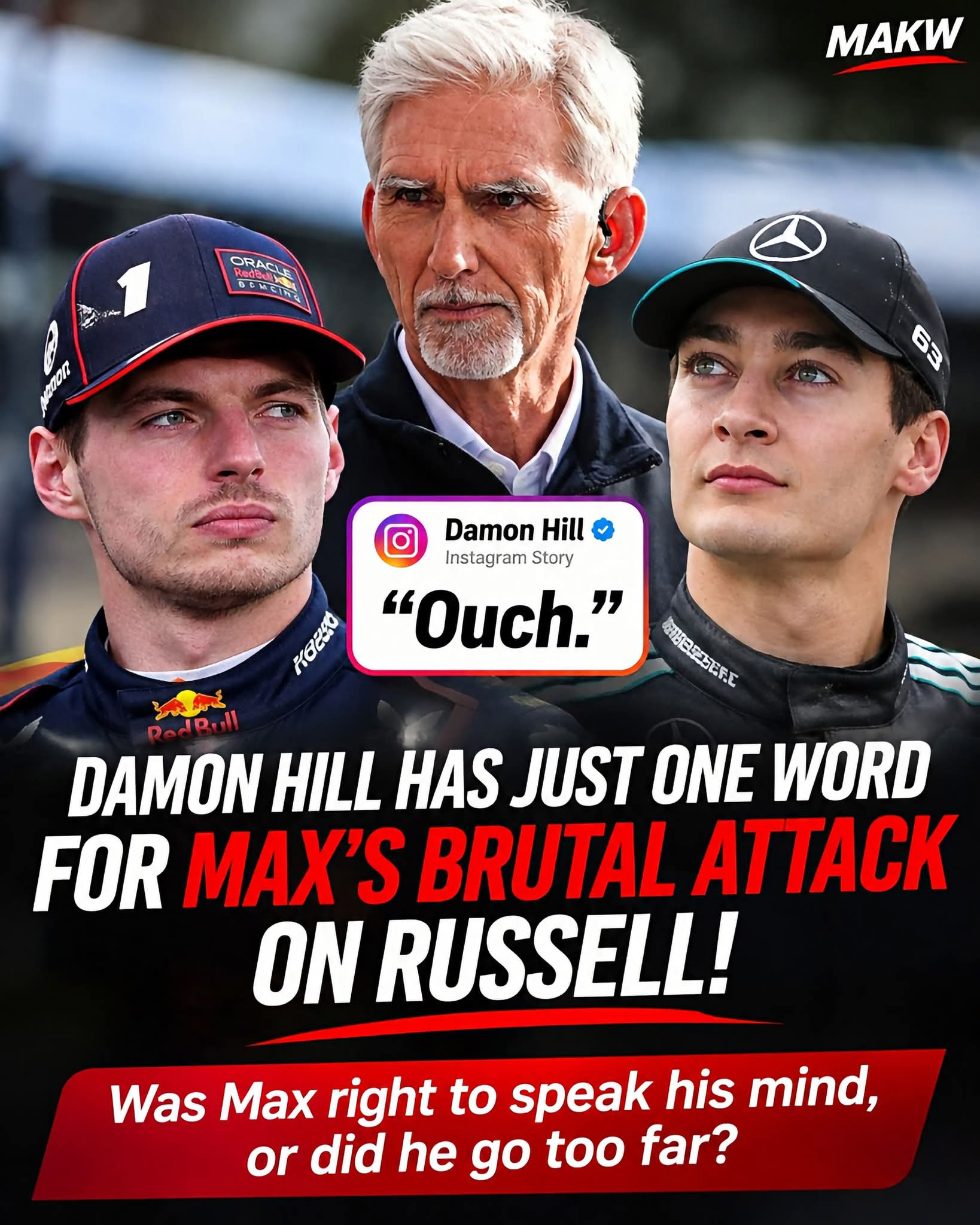
Damon Hill, the 1996 world champion, saw the comments, shared them, and simply wrote: “ouch.”
That single word captured the collective reaction of many in the paddock and among fans. Was Verstappen justified in speaking so bluntly, or did he cross a line that even a four-time champion should respect?
WHAT ACTUALLY HAPPENED IN LAS VEGAS
The weekend’s tension started in FP3. Verstappen overtook Russell as the Mercedes driver prepared for a flying lap along the Strip. Russell fought back into the braking zone for Turn 14. The cars made contact. Stewards investigated and handed Verstappen a formal warning for an unpredictable change of direction under braking.
Russell did not stay quiet. He accused Verstappen of regularly compromising other drivers’ laps and then carrying himself as if he were above the rest of the field. “Somebody has got to stand up to that guy,” Russell said. The comments were pointed, public, and deliberately aimed at the defending champion.
The pair started on the front row after Kimi Antonelli’s grid penalty. They spent much of the race exchanging the lead in a high-energy, battery-managed battle typical of the current generation of cars. Verstappen controlled the chaos and took the win. Russell, fighting with his own teammate late on, locked up, hit the barriers, and limped home ninth. Verstappen’s radio reaction was immediate and mocking. In the media afterwards he went further, framing Russell’s entire season as a failure relative to Antonelli’s title-winning campaign and dismissing the earlier criticism as irrelevant because of the performance gap.
WHY THIS FEUD KEEPS REIGNITING
This is not a new rivalry. It has simmered since the 2023 Azerbaijan Sprint, flared badly in Qatar 2024 over an impeding incident and subsequent war of words, and produced more contact and penalties in Spain 2025. Each time the pattern is similar: on-track frustration, sharp public comments, and a refusal by either driver to fully de-escalate.
Verstappen’s style has always been confrontational when he feels disrespected. Russell’s approach is more measured in tone but equally willing to call out what he sees as bullying or gamesmanship. The result is a genuine personal edge that most modern Formula 1 rivalries lack. In an era of carefully managed media appearances and team-approved soundbites, the Verstappen–Russell dynamic feels closer to older-school driver conflict.
Hill’s one-word reaction is telling. As a former champion who has criticized Verstappen before and supported Russell at times, his “ouch” suggests even veterans recognize the comment landed with unusual force. It was not just competitive banter. It was a public ranking of relative status.
THE IMPACT ON BOTH DRIVERS AND THEIR TEAMS
For Verstappen the comments reinforce his image as the uncompromising alpha of the current grid. Red Bull has generally given him space to speak freely, and the results continue to back him up. The risk is that repeated personal digs start to look like unnecessary provocation rather than justified pushback, especially if the performance gap narrows.
Russell faces a different challenge. Entering the season as a championship contender and then being clearly outperformed by a younger teammate creates narrative pressure. Publicly challenging Verstappen keeps him relevant and shows fight, but it also invites exactly the kind of response he received. Mercedes must manage the optics carefully. Supporting their driver is important, yet the team cannot afford the distraction to dominate headlines while they chase long-term competitiveness under the new regulations.
The broader paddock watches closely. Younger drivers see how far they can push Verstappen. Rivals note that Russell is willing to confront him publicly. Media and fans get the story they crave: real friction between two elite talents who clearly do not like each other much.
DOES VERSTAPPEN HAVE A POINT, OR DID HE GO TOO FAR?
Performance is the ultimate currency in Formula 1. Verstappen has multiple titles and a dominant win record in recent seasons. Russell has not matched that level consistently, particularly in 2026 against his own teammate. From a pure results perspective, the “below my level” claim is hard to argue against right now.
Yet timing and tone matter. Russell’s original criticism targeted a specific practice incident and a pattern of behavior he believes disadvantages other drivers. Verstappen’s reply shifted the conversation to overall career standing and seasonal failure. Celebrating a rival’s crash on the radio and then doubling down in the press conference removes any remaining ambiguity. This was personal.
Some will argue elite sport demands this edge. Others will say multiple world champions should model a higher standard once the helmets come off. Both views have merit. What is clear is that the comment will not be forgotten quickly.
WHAT COMES NEXT FOR THE RIVALRY
With two races remaining in the 2026 season the immediate pressure is limited, but the psychological residue carries into the winter and beyond. Contract negotiations, team dynamics, and the next generation of cars will all be viewed through this lens. If Mercedes closes the gap or Russell finds consistent form, the next on-track battle will carry extra weight. If the gap remains, Verstappen’s ranking may simply harden into accepted paddock hierarchy.
Hill’s “ouch” may prove the most lasting image. It was neither full endorsement nor full condemnation. It was recognition that the comment cut deep, that the rivalry remains live, and that Formula 1 still produces moments of raw, unfiltered intensity that no scripted content can match.
The question the original social post asked remains open: Was Max right to speak his mind, or did he go too far? The answer depends on whether you value pure competitive hierarchy or a certain level of mutual professional respect. Both drivers have drawn their lines. The next time their cars meet in close combat, those lines will be tested again.