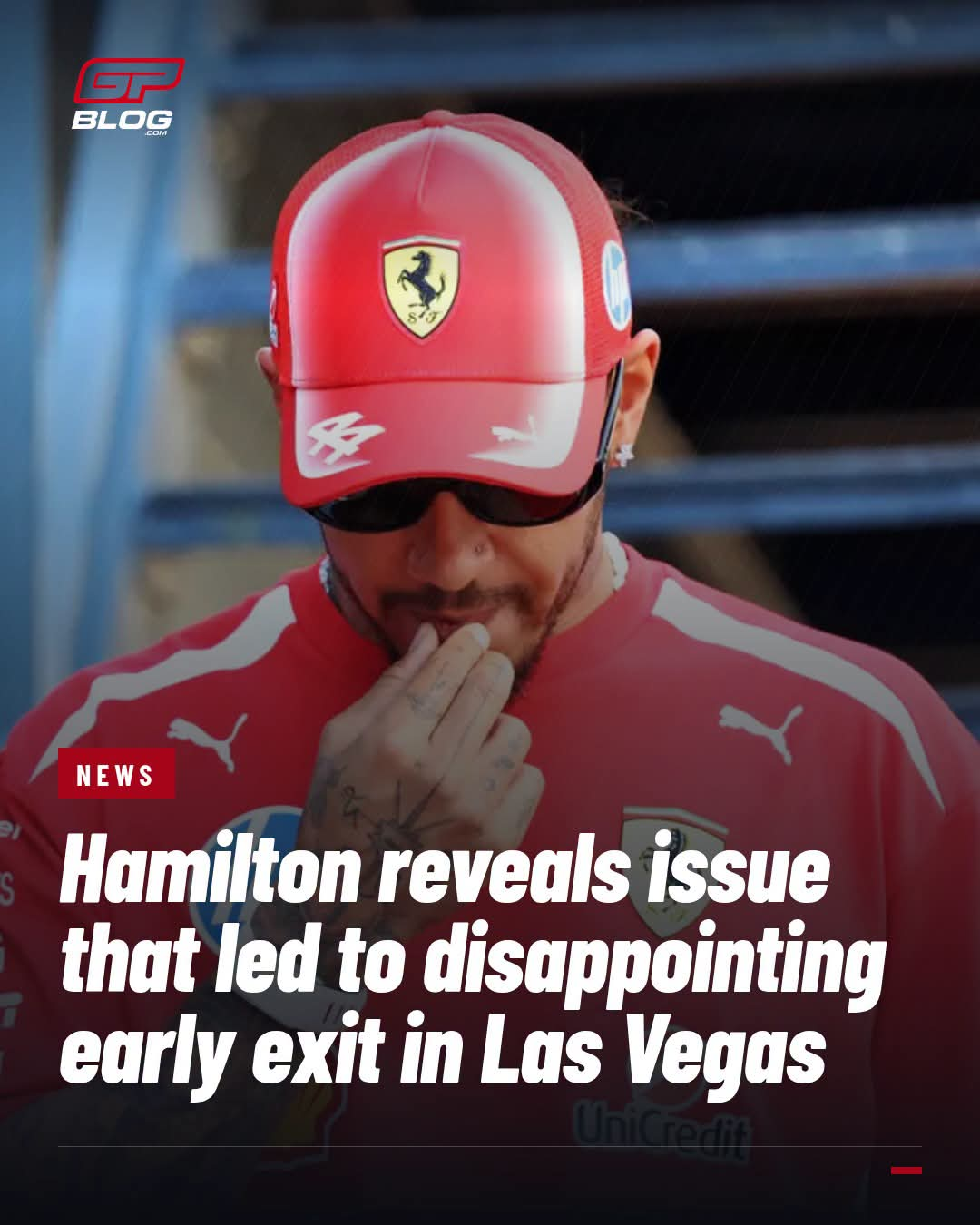
Lewis Hamilton has revealed the technical problem that contributed to his disappointing qualifying performance at the Las Vegas Grand Prix, admitting that Ferrari suffered a significant loss of aerodynamic performance after damage to the car’s floor.
The seven-time world champion qualified 12th after failing to progress beyond Q2, missing the final session by just 0.167 seconds. However, his latest explanation suggests that the Ferrari driver was fighting more than just a lack of pace.
Hamilton revealed that his SF-26 lost a section of its floor during the opening stages of Q1, immediately changing the car’s balance and reducing its downforce.
The damage reportedly cost Ferrari three to four tenths of a second in aerodynamic performance, leaving Hamilton struggling with sliding and a lack of grip for the remainder of qualifying.
But that was not the only problem. Ferrari also appeared to suffer a major straight-line speed disadvantage, with Charles Leclerc revealing an alarming loss of approximately one second on the straights.
HAMILTON REVEALS THE MOMENT HIS FERRARI LOST PERFORMANCE
Hamilton explained that the problem began almost immediately after qualifying started.
According to the British driver, a section of the floor was lost during either the first or second lap of Q1. The damage significantly affected the balance of the car and made it increasingly difficult to find the grip required to produce competitive lap times.
Speaking after the session, Hamilton explained:
“We lost a piece of the floor on the, like, first or second lap of Q1, and that car balance shifted.”
He added that the damage resulted in a loss of approximately three to four tenths of downforce.
That is a considerable disadvantage in Formula 1, where qualifying positions are frequently separated by tiny margins.
Hamilton admitted that the car became increasingly difficult to control because of the additional sliding. Despite those complications, he felt his final qualifying lap was the best he could manage with the damaged machinery.
His explanation provides important context behind Ferrari’s disappointing result and raises questions about how much more competitive the car could have been without the damage.
FERRARI’S STRAIGHT-LINE SPEED PROBLEM LEAVES LECLERC STUNNED
While Hamilton was dealing with floor damage, Leclerc was also struggling to understand Ferrari’s lack of performance.
The Monegasque driver finished 11th, one position ahead of Hamilton, as both Ferrari cars failed to reach Q3.
However, his comments after qualifying exposed another major weakness.
Leclerc revealed that Ferrari had lost approximately one second on the straights compared with its competitors.
He described the situation as extremely frustrating, particularly because straight-line speed is so important around the Las Vegas circuit.
The track features long acceleration zones where power-unit performance and energy deployment can make a significant difference.
Leclerc also criticised Ferrari’s execution throughout qualifying, pointing to mistakes involving traffic management and tyre preparation.
He explained that the situation had created considerable frustration, making it difficult to concentrate fully on his own performance.
His comments suggest that Ferrari’s problems extended beyond the engine and aerodynamic damage suffered by Hamilton.
WHY LOSING THREE TO FOUR TENTHS OF DOWNFORCE MATTERS
Hamilton’s revelation about the damaged floor is particularly significant because of the role the underfloor plays in modern Formula 1 machinery.
The floor is one of the most important aerodynamic components on a contemporary F1 car. It helps generate downforce by controlling airflow beneath the vehicle, allowing drivers to maintain grip and carry more speed through corners.
When part of that structure is damaged, airflow can become less efficient, reducing the aerodynamic performance available to the driver.
The result can be a car that slides more easily, struggles through corners and becomes increasingly difficult to balance.
For Hamilton, the problem was especially damaging because he was already struggling to extract performance from the Ferrari.
Losing three to four tenths through reduced downforce could easily make the difference between progressing into Q3 and being eliminated in the previous session.
Although the exact lap-time loss caused by the damage has not been established, Hamilton’s explanation makes it clear that he was not competing with the car in its intended condition.
FERRARI ALSO STRUGGLED TO GET THE TYRES WORKING
Another issue highlighted by Hamilton was Ferrari’s difficulty getting the tyres into the correct operating window.
The seven-time champion admitted that the tyres had been particularly difficult to manage throughout the 2026 season.
This is an important problem because tyre temperature and grip can determine how competitive a car becomes during a qualifying lap.
Drivers need sufficient grip to attack corners confidently, but getting the tyres to perform consistently can be challenging, especially on circuits with unusual surface conditions.
Las Vegas presents an additional complication because of its street-circuit layout and demanding combination of long straights and slow corners.
Hamilton suggested that Ferrari had struggled to generate the grip required, making an already difficult session even more challenging.
When tyre performance, aerodynamic damage and power-unit limitations combine, recovering lost time becomes extremely difficult.
HAMILTON MAKES NO PROMISES AHEAD OF THE LAS VEGAS RACE
With qualifying already behind him, Hamilton was cautious when discussing his expectations for the Grand Prix.
Rather than promising a major recovery, the Ferrari driver admitted that he simply wanted to see whether he could move forward.
His position reflects the uncertainty surrounding Ferrari’s race prospects.
Starting 11th after penalties and grid adjustments, Hamilton will need a strong launch, effective tyre management and a carefully executed strategy to make progress.
Leclerc also faces a difficult afternoon, with Ferrari needing to understand whether its straight-line speed disadvantage will leave both drivers vulnerable during the race.
The long straights could create overtaking opportunities, but they could also expose Ferrari’s weaknesses against cars with stronger power-unit performance.
FERRARI’S 2027 PROJECT NOW FACES EVEN GREATER PRESSURE
The Las Vegas qualifying disaster has added another layer of pressure on Ferrari as the team looks towards 2027.
Hamilton and Leclerc remain among the most recognisable drivers on the grid, but their ability to fight for victories depends heavily on the machinery Ferrari provides.
The latest problems highlight several areas requiring attention: aerodynamic reliability, power-unit performance, tyre preparation and operational execution.
Ferrari cannot afford to treat each disappointing result as an isolated incident. The team needs to identify the underlying weaknesses and ensure that the next car represents a meaningful improvement.
For Hamilton, the immediate objective is to salvage whatever is possible from the Las Vegas Grand Prix.
His final qualifying lap may have been the best he could produce under the circumstances, but Ferrari’s problems have left him with another difficult challenge.
The biggest question now is whether the team can address its weaknesses before the remaining races or whether Hamilton and Leclerc will have to endure another season-ending stretch of frustration.