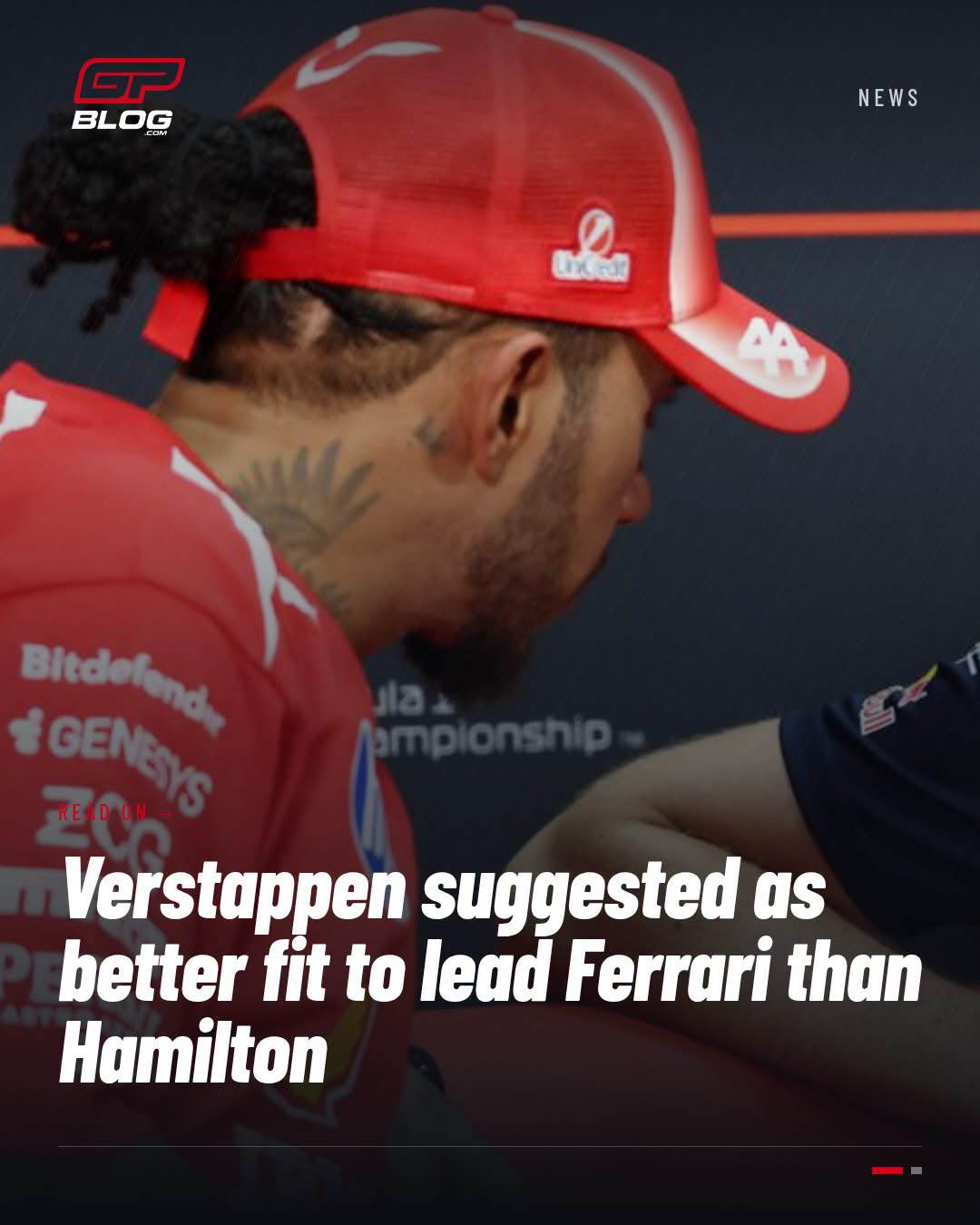
Ferrari’s search for a return to Formula 1 championship glory has taken another interesting turn after former Haas team principal Guenther Steiner questioned whether Lewis Hamilton is the right driver to lead the Scuderia back to the top. With the team’s internal tensions attracting increasing attention, Steiner has suggested that a different current F1 star could possess the determination and leadership qualities Ferrari desperately needs.
The comments have reignited the debate surrounding Ferrari’s driver lineup, particularly after Hamilton and Charles Leclerc were involved in a tense exchange following their opening-lap collision at the Mexico City Grand Prix. Although the pair subsequently held discussions in Brazil, the situation has raised fresh questions about how effectively Ferrari is managing two highly competitive drivers.
However, the bigger issue may extend beyond the relationship between its drivers. Ferrari have not won a constructors’ championship since 2008, and the pressure to end that drought continues to grow.
STEINER QUESTIONS HAMILTON’S ABILITY TO LEAD FERRARI
Hamilton arrived at Ferrari with enormous expectations, given his record-breaking achievements and experience winning championships with Mercedes. His difficult first season in 2025 raised doubts, but his performances in 2026 have been considerably stronger.
Nevertheless, Steiner believes that being one of Formula 1’s greatest drivers does not automatically make someone the right person to lead Ferrari through a complete transformation.
He questioned whether Hamilton could have the same influence that Michael Schumacher had during Ferrari’s successful era, pointing out that even Fernando Alonso struggled to deliver a championship despite his exceptional ability.
The distinction is important. Ferrari do not simply need a driver capable of winning individual races. They need someone who can contribute to a winning culture, maintain pressure on the organisation and help establish the standards required to compete consistently for championships.
Hamilton’s experience could be valuable in that process, but Steiner’s comments suggest that Ferrari must determine whether his leadership can translate into long-term success.
VERSTAPPEN IDENTIFIED AS A POTENTIAL SOLUTION
When Max Verstappen was mentioned as a possible alternative, Steiner immediately highlighted the Red Bull driver’s relentless mentality.
The former Haas boss believes Verstappen’s determination could make him an attractive candidate for a team attempting to rebuild its championship-winning identity.
Verstappen has repeatedly demonstrated an uncompromising approach to racing. His willingness to challenge his own team, demand improvements and push relentlessly for performance has become one of his defining characteristics.
That mentality could theoretically appeal to Ferrari, particularly given the team’s reputation for intense scrutiny and enormous expectations.
However, there is a major difference between being an exceptional driver and successfully transforming an organisation. Verstappen could bring speed, experience and an uncompromising competitive attitude, but Ferrari would still need to provide the engineering structure, strategy and operational consistency required to win.
A superstar driver cannot independently solve every weakness within a Formula 1 team.
WHY FERRARI’S SCHUMACHER ERA IS DIFFICULT TO RECREATE
The comparison with Schumacher is central to the argument surrounding Ferrari’s leadership problem.
When Schumacher joined Ferrari in 1996, he did not immediately turn the team into champions. His first world championship with the Scuderia arrived in 2000, following several seasons of rebuilding and the arrival of crucial technical figures, including Ross Brawn and Rory Byrne.
That history offers an important lesson for Ferrari’s current situation.
Schumacher’s influence was enormous, but his success was also built on the strength of the people around him. Ferrari needed talented engineers, effective management, reliable machinery and a long-term commitment to developing the organisation.
This is why simply replacing Hamilton with Verstappen would not guarantee a championship.
Ferrari must recreate the kind of environment that allows exceptional drivers and technical personnel to work together without being undermined by inconsistent decisions or internal disagreements.
HAMILTON AND LECLERC’S RELATIONSHIP ADDS PRESSURE
Ferrari’s immediate concern remains the relationship between Hamilton and Leclerc.
Their Mexico City incident created another difficult moment for the team, with Hamilton expressing frustration over what happened during the opening lap. The subsequent discussions in Brazil demonstrated that the disagreement required attention beyond the usual post-race conversations.
Leclerc has spent several seasons establishing himself as Ferrari’s leading driver, while Hamilton arrived with a reputation and championship record that naturally brought enormous expectations.
Managing those competing ambitions is not straightforward.
Ferrari must ensure that both drivers receive fair treatment while preventing disagreements from becoming a distraction from the championship battle. If the team cannot establish clear expectations, even the strongest driver pairing could become a source of instability.
The situation also explains why calls for Ferrari to appoint a clear number one driver continue to attract attention.
RALF SCHUMACHER ALSO QUESTIONS HAMILTON
Steiner is not the only former F1 figure raising doubts about Hamilton’s position.
Ralf Schumacher recently argued that Hamilton has not been consistently fast enough compared with Leclerc to justify being treated as Ferrari’s leading driver.
His criticism focused on the performance difference between the two teammates, suggesting that Hamilton would face fewer questions if he were clearly outperforming the Monegasque driver.
Schumacher also questioned how Hamilton compares with George Russell and how Russell compares with current world champion Kimi Antonelli.
Those comparisons have added another layer to the debate surrounding Hamilton’s current level.
However, the 2026 standings present a more complicated picture. Hamilton currently occupies fourth place with 261 points, just one point ahead of Leclerc, who has 251 points according to the supplied standings. Both drivers are behind Antonelli, Verstappen and Russell.
That narrow gap makes it difficult to argue that either Ferrari driver has established unquestionable superiority.
VERSTAPPEN’S RED BULL CONTRACT MAKES THE IDEA UNLIKELY
Despite Steiner’s suggestion, a move to Ferrari appears highly unrealistic in the immediate future.
Verstappen has a Red Bull contract running until 2030, giving the team a significant advantage in retaining its most important driver.
The Dutchman has also spent years building relationships within the Red Bull organisation. His familiarity with the engineers, working environment and development structure makes a departure a major decision rather than a simple transfer.
There would also be questions about whether Ferrari could offer him the competitive environment he expects.
Verstappen has repeatedly shown that he wants a car capable of challenging for victories and championships. Joining Ferrari would mean accepting the uncertainty of another rebuilding project, something that may not appeal to a driver already established at a major team.
Unless Red Bull’s competitive situation changes dramatically, Ferrari should not build its future plans around the assumption that Verstappen will become available.
FERRARI’S REAL PROBLEM MAY NOT BE ITS DRIVER LINEUP
The strongest argument emerging from the debate is that Ferrari’s difficulties cannot be solved simply by changing drivers.
Several reactions to Steiner’s comments focused on the organisation itself, with supporters arguing that strategy, reliability, development decisions and straight-line performance remain more important than the identity of the person behind the wheel.
That argument deserves serious consideration.
A driver can provide valuable feedback, motivate engineers and push the team towards higher standards. However, the responsibility for producing a competitive car ultimately belongs to the organisation.
Even Schumacher needed several seasons and the right technical personnel before Ferrari returned to championship glory.
Hamilton has experience from a successful Mercedes era, while Verstappen has developed a reputation for demanding the highest standards at Red Bull. Both could offer valuable qualities, but neither can guarantee success without the right machinery and management.
Ferrari must therefore decide whether it needs a different driver or a more effective structure around the drivers it already has.
THE VERDICT: VERSTAPPEN MAY BRING THE FIRE, BUT FERRARI MUST FIX ITSELF
Steiner’s comments have created an interesting hypothetical situation, but they also expose a deeper question about Ferrari’s future.
Verstappen possesses the competitive mentality and technical experience that could make him an attractive leader. His relentless approach might appeal to a team desperate to rediscover its championship-winning identity.
Hamilton, meanwhile, should not be dismissed simply because Ferrari have struggled to deliver consistent results. His experience of winning championships and working within a successful technical organisation could still prove valuable if the team properly utilises his knowledge.
Ultimately, Ferrari’s biggest challenge is not finding another superstar. It is building a team capable of giving its superstar the tools to succeed.
If Ferrari cannot improve its decision-making, car development and internal management, even a driver as determined as Verstappen could eventually encounter the same frustrations currently surrounding Hamilton.
The real test is whether Ferrari can change its own approach before making another major decision about its drivers.