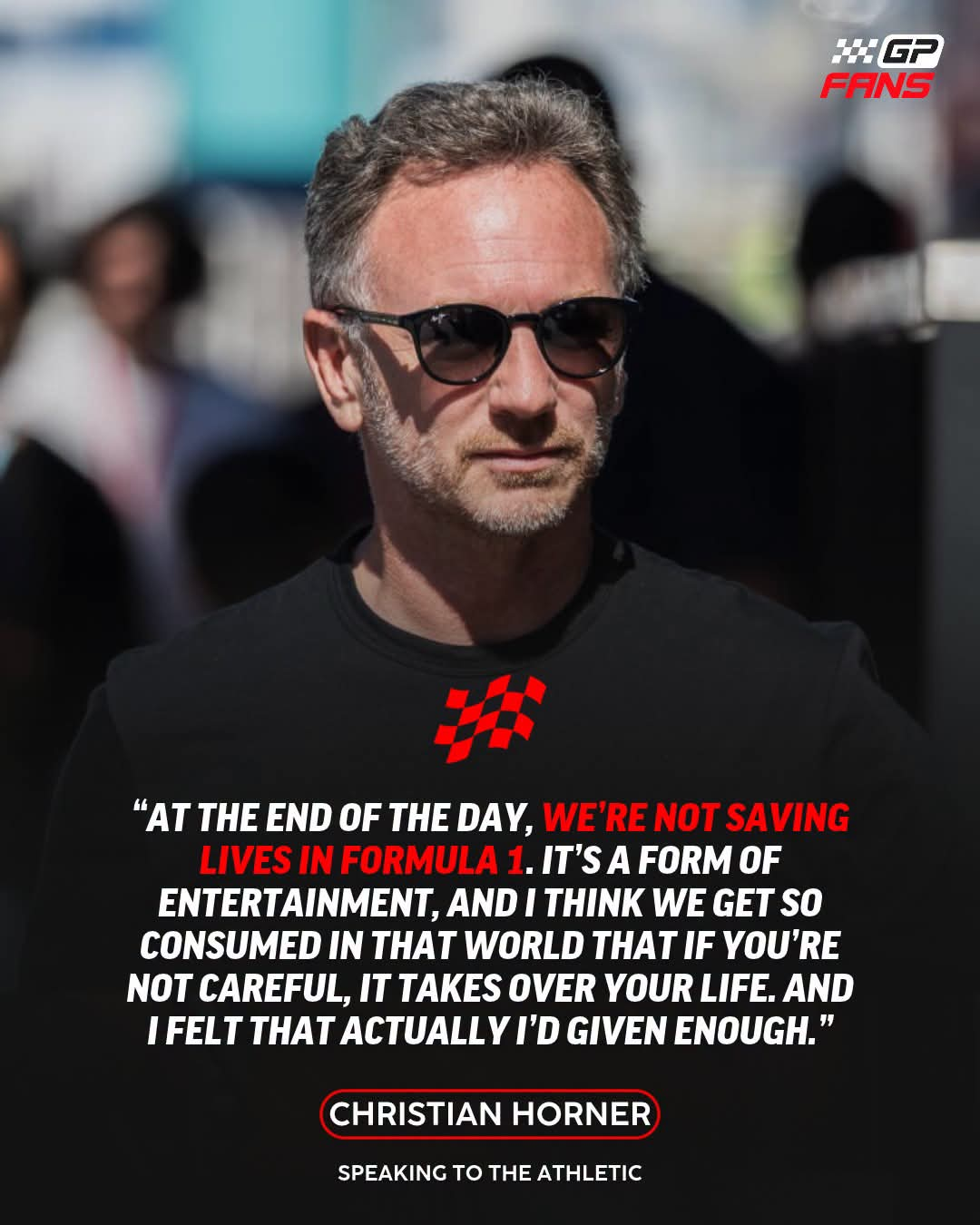
Christian Horner appears to be discovering a different side of life after spending more than two decades at the heart of Formula 1, with his extended absence from the paddock giving him an opportunity to reconsider what truly matters beyond the demands of elite motorsport.
For someone who spent years operating in one of the most demanding environments in professional sport, stepping away from the Formula 1 spotlight has seemingly brought an unexpected benefit: perspective.
The former Red Bull Racing team principal has opened up about how life has changed since his departure, suggesting that the relentless demands of managing a championship-winning organisation had gradually made it difficult to appreciate the world outside racing.
And while his competitive instincts remain firmly intact, Horner now appears increasingly comfortable with the idea that professional success should not come at the expense of everything else in life.
LIFE AWAY FROM FORMULA 1 HAS CHANGED HORNER’S PERSPECTIVE
Horner’s departure from Red Bull marked the end of one of the most successful and influential leadership periods in modern Formula 1.
During his 20-year association with the team, he transformed Red Bull from a relatively inexperienced newcomer into a dominant championship-winning organisation.
Under his leadership, the team secured multiple Constructors’ Championships and helped deliver world titles for Sebastian Vettel and Max Verstappen.
However, the pressure associated with maintaining that level of success came with considerable personal sacrifices.
Horner has explained that his time away from Formula 1 has allowed him to recognise just how consuming the sport can become, particularly for individuals occupying senior leadership positions.
In an interview with The Independent, he revealed that he had attended 405 consecutive Grands Prix, describing his current break as the first time in approximately 35 years that he had stepped away from the relentless travelling schedule.
That change has allowed him to experience everyday family moments that previously would have been difficult to accommodate.
Walking his son to school, attending school sporting events and being present for important family occasions have become increasingly meaningful.
These experiences might appear ordinary to most people, but for someone whose professional life revolved around international travel and race weekends, they represent a significant change.
THE HIDDEN PRICE OF SUCCESS IN FORMULA 1
Horner’s reflections highlight an important reality about Formula 1 that often gets overlooked.
While fans primarily associate the championship with spectacular racing, glamorous destinations and extraordinary financial rewards, the people responsible for running its teams operate under enormous pressure.
A Formula 1 team principal is expected to manage thousands of competing priorities, including driver relationships, technical development, sponsorship obligations, commercial negotiations and internal politics.
The responsibility does not disappear when the chequered flag falls.
Every disappointing result generates questions, every strategic mistake attracts criticism and every internal disagreement can become a major talking point.
For Horner, this environment was part of everyday life for years.
His admission that Formula 1 can consume an individual’s existence offers an interesting perspective on the sacrifices required to remain competitive at the highest level.
It also raises a broader question about the sustainability of leadership in elite motorsport.
Winning championships is obviously the ultimate objective, but maintaining that success while protecting personal relationships and mental well-being presents an entirely different challenge.
Horner’s experience suggests that even individuals who reach the highest levels of professional achievement can eventually recognise the importance of stepping back.
RED BULL’S SUCCESS CAME WITH AN INTENSE INTERNAL BATTLE
Horner’s final years at Red Bull were considerably more complicated than the championship celebrations that defined much of his earlier tenure.
Despite the team’s extraordinary achievements, internal disagreements, organisational tensions and intense public scrutiny became increasingly prominent.
Red Bull’s dominance in 2023, when the team won 21 of 22 races, demonstrated the extraordinary strength of the organisation.
Max Verstappen claimed 19 victories that season, establishing one of the most dominant individual campaigns in Formula 1 history.
Yet Horner has previously acknowledged that he was unhappy with the internal politicking and disagreements surrounding the organisation during that period.
His departure in 2025 therefore represented more than simply the end of a successful professional relationship.
It closed a complicated chapter involving sporting achievements, organisational power struggles and difficult personal circumstances.
His subsequent reflections suggest that distance has helped him appreciate aspects of his career that were difficult to recognise while he was directly involved in the daily battles.
Importantly, appreciating his achievements does not necessarily mean he has forgotten the difficulties surrounding his exit.
Instead, he appears to be approaching that chapter with a broader understanding of what he gained and what he sacrificed.
IS CHRISTIAN HORNER REALLY FINISHED WITH FORMULA 1?
Perhaps the most interesting question surrounding Horner’s current situation concerns whether he will eventually return to the sport.
Despite enjoying his time away, there is little indication that his passion for competition has disappeared.
He continues to follow Formula 1 and has made it clear that he would consider another opportunity if the right project emerged.
However, his expectations appear considerably more specific than simply finding another team principal position.
Horner has indicated that any return would need to involve an organisation with genuine championship ambitions and people who share his desire to succeed.
He has also suggested that he would want sufficient influence to make meaningful changes rather than simply occupy a prestigious position.
That distinction is important.
Horner spent two decades building Red Bull into a championship-winning operation. Returning to a struggling organisation without the necessary authority or resources would offer little attraction.
He has also been linked with potential opportunities involving Ferrari, Alpine and Aston Martin, although speculation should not be mistaken for confirmed negotiations.
His comments suggest that he is in no particular hurry to make a decision.
That could ultimately work in his favour.
Rather than rushing into another demanding role, Horner has the opportunity to assess the competitive landscape and identify an organisation where his experience could make a genuine difference.
WHY HORNER’S ABSENCE COULD CHANGE HIS NEXT MOVE
There is an interesting possibility that Horner’s time away could make him an even more effective leader if he eventually returns.
For years, his identity was closely connected to Red Bull’s success and the intense rivalries that developed throughout his time in Formula 1.
His battles with Mercedes team principal Toto Wolff became a defining feature of the championship’s modern era.
However, spending time outside that environment may have given him a different understanding of the sport’s political and organisational challenges.
He can now evaluate potential opportunities without the immediate pressure of defending an existing team or protecting his position.
That could encourage a more selective approach to his next career move.
It may also change the type of role he considers.
Instead of returning simply to manage a team, Horner could potentially pursue an ownership position, a senior executive role or a project where he has greater influence over long-term strategy.
For ambitious organisations, his experience in developing championship-winning structures remains an attractive proposition.
Nevertheless, his next decision will need to balance professional ambition with the lifestyle he has begun to appreciate.
WHAT THIS MEANS FOR RED BULL RACING
Horner’s comments also provide an interesting perspective on Red Bull’s evolution following his departure.
The organisation is entering a different chapter, with new leadership responsibilities and the enormous challenge of maintaining its competitive position.
His influence on the team’s history remains undeniable.
He played a central role in establishing Red Bull as a serious Formula 1 contender, recruiting important personnel and overseeing the development of an organisation capable of challenging the sport’s traditional giants.
One of his most significant achievements was helping establish Red Bull Powertrains, which laid the foundations for the team’s independent engine programme.
That project represented a major strategic gamble, particularly because developing an in-house power unit required substantial investment, technical expertise and long-term commitment.
Horner has expressed considerable pride in that achievement, especially given the doubts that surrounded the project during its early stages.
His legacy, therefore, extends beyond race victories and championship trophies.
It includes the development of an organisation that has become increasingly ambitious about controlling its own competitive future.
Red Bull’s ability to sustain that progress without him will remain an important measure of the strength of the structure he helped establish.
THE BIGGER LESSON: SUCCESS IS NOT EVERYTHING
Perhaps the most revealing aspect of Horner’s latest reflections is that he appears to have discovered something that many successful professionals struggle to recognise.
There is a difference between loving your career and allowing it to become your entire identity.
Formula 1 is an exceptionally demanding sport, and the people who reach its highest positions often sacrifice enormous amounts of personal time to remain competitive.
Horner’s experience demonstrates that stepping away does not necessarily mean losing ambition.
Sometimes, distance provides the opportunity to rediscover that ambition without allowing it to dominate every aspect of life.
His changing priorities also offer a reminder that sporting legacies should not be measured exclusively through statistics.
Horner can look back on 124 Grand Prix victories, 287 podium finishes and 14 world championships achieved during his Red Bull leadership era with considerable pride.
But being present for family occasions and enjoying experiences outside motorsport now appear to carry a different kind of value.
That does not diminish his competitive achievements. If anything, it provides a more complete picture of the person behind the public image.
WHAT HAPPENS NEXT FOR CHRISTIAN HORNER?
A return to Formula 1 remains a realistic possibility, but it is becoming increasingly clear that Horner will not accept just any opportunity.
His experience, reputation and understanding of championship-winning operations make him an interesting figure for teams looking to strengthen their leadership structures.
However, the right project will need to offer more than financial rewards or media attention.
It will need ambition, influence, organisational stability and a realistic opportunity to compete for championships.
There is also the possibility that Horner could remain outside Formula 1 for considerably longer than many observers expect.
After spending so much of his life travelling between Grands Prix, enjoying a more balanced lifestyle may prove difficult to abandon.
For now, the former Red Bull boss appears content to observe the sport from a different perspective while considering what comes next.
And perhaps that is the biggest change of all.
The man who once seemed inseparable from Formula 1 is discovering that there is a world beyond the paddock.
FINAL VERDICT
Christian Horner’s time away from Formula 1 appears to have given him something that years of championship battles could not: the opportunity to step back and reassess his priorities.
His competitive instincts have not disappeared, and a return to the paddock cannot be ruled out. However, he now seems more interested in finding the right opportunity than simply returning for the sake of being involved.
For Formula 1, that makes his future particularly intriguing.
Horner has already established his place among the sport’s most successful team principals. Whether he decides to pursue another championship challenge or embrace life outside the paddock, his next chapter could be very different from the one that made him famous.SEO DESCRIPTION: Christian Horner reflects on life away from Formula 1 after leaving Red Bull Racing. Discover how his extended break has changed his priorities and what it means for a potential F1 comeback.
SEO KEYWORDS: Christian Horner, Christian Horner latest news, Christian Horner F1 return, Red Bull Racing, Formula 1 news, Christian Horner Red Bull exit, F1 team principal, Max Verstappen.
Sources: