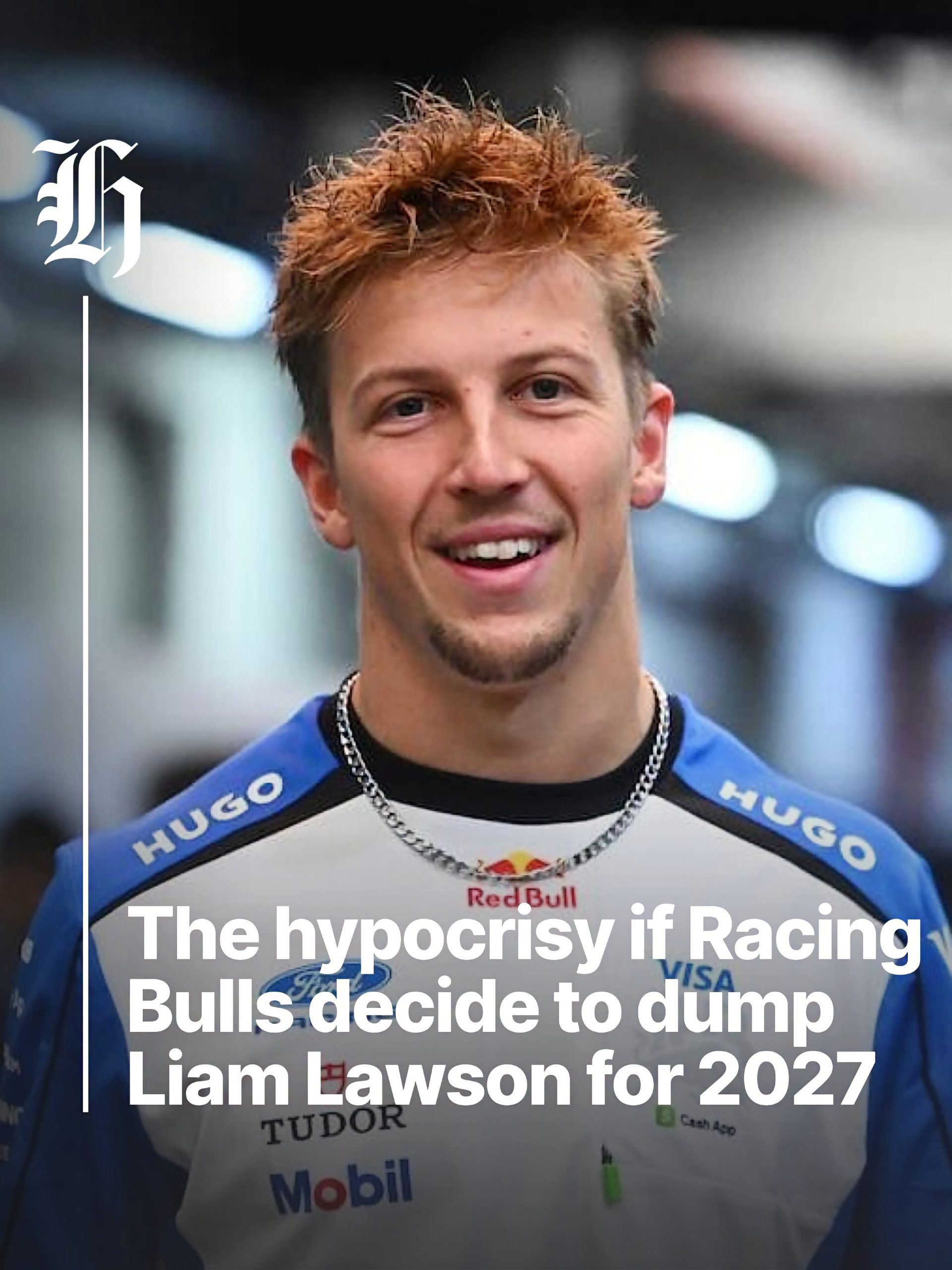
Liam Lawson’s future in Formula 1 has become one of the biggest talking points ahead of the 2027 season, with growing questions over whether Racing Bulls will reward the New Zealander’s performances with another contract.
After everything Lawson has endured since his difficult promotion to Red Bull Racing in 2025, dropping him from the grid now could trigger serious criticism of the organisation. His recent performances have strengthened his case for remaining in Formula 1, making the possibility of another driver change increasingly difficult to justify.
The debate intensified following the Brazilian Grand Prix, where Lawson delivered an impressive weekend at Interlagos. He qualified third, briefly ran as high as second during the race and eventually finished seventh after a late penalty involving Charles Leclerc promoted him in the final classification.
More importantly, the result added to an impressive season in which Lawson has scored points in 15 of his 20 Grands Prix, according to the New Zealand Herald’s report.
For a driver whose Red Bull career was cut short after just two race weekends in 2025, those numbers represent a significant response to the doubts surrounding his ability to compete at the highest level.
LAWSON HAS GIVEN RACING BULLS PLENTY OF REASONS TO KEEP HIM
The biggest argument in Lawson’s favour is consistency.
Formula 1 teams do not simply need drivers capable of producing one spectacular qualifying lap. They need competitors who can regularly extract the maximum from their machinery, score points and provide useful technical feedback.
Lawson has increasingly demonstrated those qualities throughout the 2026 campaign.
His Brazilian Grand Prix performance was another example. Securing third on the grid in difficult conditions required confidence, precision and the ability to recognise opportunities when other drivers struggled.
Although his car eventually lacked the pace to maintain a podium position, Lawson remained competitive and brought home valuable points.
Finishing seventh also strengthened his position in the midfield battle and demonstrated that he can deliver results when Racing Bulls gives him a competitive opportunity.
The question now is whether the team values that experience enough to continue with him for another season.
THE HYPOCRISY ARGUMENT AGAINST DROPPING LAWSON
The central argument raised by New Zealand Herald journalist Alex Powell is that removing Lawson after his 2026 performances could expose an uncomfortable contradiction in Red Bull’s driver-management approach.
Lawson was promoted to Red Bull Racing in 2025 because the organisation believed he had the ability to compete at the highest level.
However, after only two race weekends alongside Max Verstappen, he was moved back to Racing Bulls.
That decision attracted considerable attention because Formula 1 is an exceptionally demanding environment, and two races provide a very limited opportunity for a driver to establish himself.
Since returning to the junior team, Lawson has had to rebuild his confidence while competing under continued scrutiny.
If Racing Bulls now decides that he is no longer required despite his improved performances, critics could reasonably question what more he was expected to achieve.
There is an important distinction between replacing a driver because of poor performance and replacing one because the organisation wants to create space for another prospect.
If Lawson is dropped despite delivering consistent points and strong qualifying results, the decision could be interpreted as another example of Red Bull prioritising its development pipeline over rewarding performance.
NIKOLA TSOLOV COULD MAKE THE DECISION MORE DIFFICULT
One of the major complications surrounding Lawson’s future is the emergence of Nikola Tsolov.
The Bulgarian driver is part of Red Bull’s junior programme and is competing for an opportunity to reach Formula 1 in 2027.
His development makes him an attractive option for Racing Bulls, particularly because introducing young talent has always been an important part of Red Bull’s philosophy.
However, promoting a promising junior driver is not automatically the same as making the best decision for the team.
Tsolov may have considerable potential, but Formula 1 requires more than impressive performances in junior categories.
The transition involves adapting to greater physical demands, complex technical regulations, tyre management, race strategy and the pressure of competing against experienced drivers.
Lawson already understands those challenges.
Racing Bulls therefore faces a difficult choice: retain a driver who has demonstrated his ability to score points at Grand Prix level or take a risk on a younger prospect whose long-term potential remains to be established in Formula 1.
LAURENT MEKIES HAS ALREADY CONFIRMED A CHANGE IN RED BULL’S APPROACH
The situation has become even more interesting following comments from Red Bull team principal Laurent Mekies.
After the Brazilian Grand Prix, Mekies explained that decisions concerning the Racing Bulls driver lineup belong to Racing Bulls itself.
He made clear that although the organisation operates a shared junior programme, decisions about how drivers progress through the system are primarily the responsibility of the junior team.
This is a significant development because Red Bull’s driver decisions were historically associated with the influence of Christian Horner and Helmut Marko.
Under the previous structure, the senior management had enormous influence over promotions, demotions and driver replacements.
The new approach appears to give Racing Bulls greater responsibility for evaluating its drivers, with team principal Alan Permane and his management team expected to make recommendations before final approval.
That could work in Lawson’s favour.
The people working directly with him have a clearer understanding of his development, consistency and contribution to the team than executives who primarily assess the final results.
ALAN PERMANE’S POSITION COULD BE THE KEY TO LAWSON’S FUTURE
Another important factor is the reported support Lawson has received from Alan Permane.
The Racing Bulls team principal is believed to favour keeping the New Zealander for another season.
That support could prove decisive because Permane’s influence within the organisation has reportedly increased following his contract extension.
If he believes Lawson is the right driver to partner Arvid Lindblad in 2027, the team may have a strong reason to resist replacing him simply to accommodate another academy prospect.
Continuity could also benefit Racing Bulls.
The team needs drivers who understand its engineering processes, communicate effectively with their race engineers and consistently deliver points.
Changing the lineup too frequently can disrupt development and force teams to spend valuable time integrating new drivers.
Lawson’s experience could therefore be worth more than the excitement surrounding another young promotion.
RED BULL MUST AVOID REPEATING ITS SECOND-DRIVER MISTAKES
Lawson’s situation also brings attention to Red Bull’s wider history of struggling to find consistency in its second seat.
Several talented drivers have experienced difficulties after joining the senior team alongside Verstappen.
The demands of that position are enormous, particularly because Verstappen has developed an exceptional understanding of Red Bull machinery and consistently operates at an extremely high level.
However, repeatedly changing drivers can create a cycle in which newcomers are given limited time to adapt before their positions come under threat.
Red Bull has already acknowledged the need to examine its approach through a comprehensive review of its second-driver struggles.
Lawson’s experience and Yuki Tsunoda’s difficulties have made the issue particularly difficult to ignore.
If the organisation wants to demonstrate that the review has produced meaningful change, retaining a driver who has responded positively to adversity could send an important message.
It would show that performance and development matter more than simply creating opportunities for the next academy graduate.
WHAT A 2027 EXIT WOULD MEAN FOR LAWSON
If Racing Bulls ultimately decides against retaining Lawson, the consequences could extend beyond losing his current seat.
Formula 1 has a limited number of available positions, and drivers who leave the championship can find it difficult to secure another opportunity.
Lawson has already experienced the uncertainty of losing a senior Red Bull seat, so another unexpected departure could be particularly damaging.
Nevertheless, his 2026 performances should attract attention from other teams if he becomes available.
His experience, age and ability to score points make him a potentially valuable option for organisations looking for a driver who can contribute immediately.
A departure would not necessarily end his Formula 1 ambitions, but it could force him to consider opportunities outside the Red Bull programme.
For Racing Bulls, losing him could also mean giving up a driver who has already demonstrated that he can compete effectively in the midfield.
RACING BULLS HAVE A BIG DECISION TO MAKE
Lawson’s Brazilian Grand Prix performance has strengthened the argument that he deserves another opportunity.
Third place in qualifying, a brief fight near the front and a seventh-place finish added another positive chapter to his recovery after the disappointment of 2025.
However, the final decision will involve more than one race result. Racing Bulls must consider his entire season, his development, his relationship with the team and the long-term potential of its available alternatives.
Tsolov may represent an exciting future investment, but Lawson offers something equally important: proven Formula 1 experience and evidence that he can deliver results.
Dropping him after a season in which he has scored points in 15 of 20 Grands Prix would invite difficult questions about Red Bull’s commitment to rewarding performance.
For now, Lawson’s 2027 future remains unresolved. But one thing is clear: after everything he has done to rebuild his career, Racing Bulls will need a convincing explanation if it decides that his performances are still not enough.