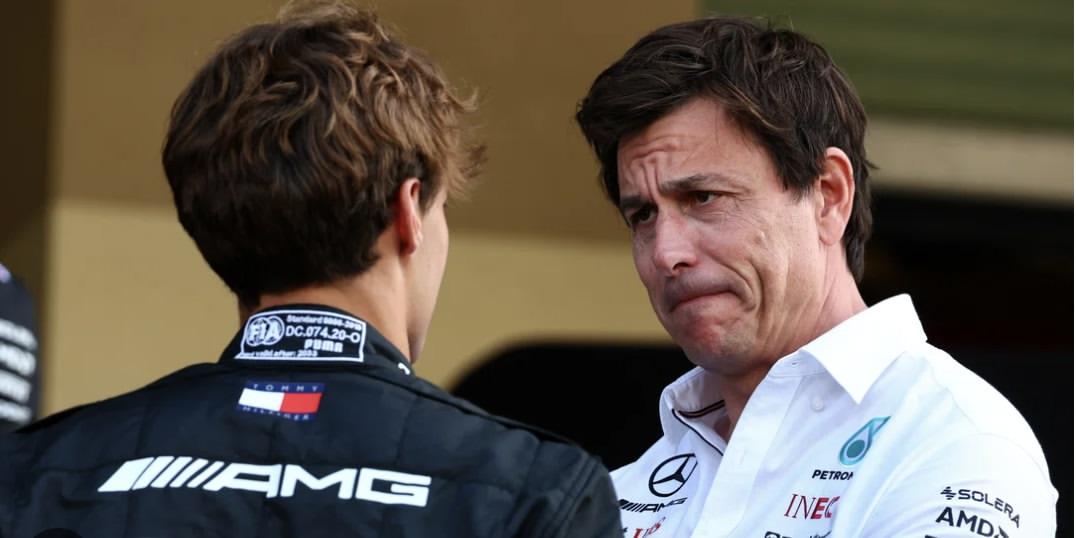
Mercedes team principal Toto Wolff has delivered a clear and supportive message following one of the most emotionally charged moments of the 2026 Formula 1 season. After Kimi Antonelli sealed the Drivers’ Championship with a third-place finish at the Mexico City Grand Prix, becoming the youngest world champion in F1 history at just 20 years and 68 days old, teammate George Russell was left devastated. Wolff described the British driver as “distraught” and called the outcome a “catastrophic moment” for a racing driver.
Russell started the Mexican race from the front row with genuine hope of forcing the title fight to continue. Instead, an energy delivery issue on the opening straight dropped him back into the pack. Contact with Isack Hadjar brought a time penalty, and he finished a distant sixth. He still found the composure to congratulate Antonelli in person before leaving the circuit without completing mandatory media duties. Mercedes received a €5,000 fine as a result. Wolff stood firmly behind his driver, stating that staying would have actually surprised him and that the team had let Russell down on a day when the car had the pace to win.
This was not simply one bad race. It was the painful full stop on a season that began with Russell as the clear pre-season favorite and ended with him comprehensively outscored by a teammate eight years his junior.
HOW ANTONELLI TURNED THE TABLES ON RUSSELL AND THE ENTIRE GRID
The 2026 season was supposed to be Russell’s breakthrough year. After years of solid performances alongside Lewis Hamilton and a strong showing in the previous campaign, Mercedes arrived with a competitive car under the new regulations. Russell won the season opener in Australia. Then Antonelli took over.
The Italian, in only his second full season of Formula 1, won nine races to Russell’s three. He claimed multiple podiums, controlled the championship from early on, and finished the job in Mexico with four rounds still remaining. Russell slipped to fourth in the standings behind Max Verstappen and Lewis Hamilton. The gap was decisive. What looked like a title-ready Mercedes package became the platform for a generational talent to announce himself as the new face of the sport.
Antonelli’s achievement carries extra weight. He is the first Italian champion since Alberto Ascari in 1953 and the first graduate of Mercedes’ junior program to claim the drivers’ crown. For a team that spent years developing talent while relying on established stars, this result validates a long-term strategy that once faced skepticism.
WHY WOLFF’S SUPPORT FOR RUSSELL MATTERS RIGHT NOW
Wolff’s comments after the race were careful and human. He has known Russell since the British driver was a teenager in the Mercedes junior ranks. He has watched him develop through Formula 2, the difficult Williams years, and the high-pressure environment of a top team. Calling the moment catastrophic was not hyperbole. For a driver who has spent the better part of a decade preparing for this exact opportunity, watching a younger teammate take the title in the same car cuts deep.
The question many fans and observers are asking is whether Wolff and Mercedes are showing enough ongoing support. Publicly standing by Russell after Mexico was the right call. Allowing him space to process the disappointment without forcing media appearances showed empathy. Yet the broader picture is more complicated. Throughout the season there have been moments when the gap in performance raised legitimate questions about adaptation to the new car, consistency under pressure, and the psychological impact of being outdriven so clearly by a teammate.
Russell himself has spoken with honesty. In a statement after the race he congratulated Antonelli, admitted the season had more bad days than good, and promised to give everything for the remainder of 2026 and into 2027. That response was classy and professional. It also left open the harder question of what comes next.
THE 2027 DECISION: FIGHT OR FLIGHT FOR GEORGE RUSSELL
This is the pivotal moment in Russell’s career. At 28 he remains in his prime. Drivers of his caliber have won titles later. Lewis Hamilton collected the majority of his championships in his thirties. Experience, maturity, and the ability to extract every tenth from a car still matter. Yet Formula 1 is ruthless. When a younger driver in the same machinery delivers at a higher level across an entire season, the narrative shifts quickly.
Russell has two clear paths. He can dig in at Mercedes, demand the development work needed to close the gap, and treat 2027 as the year he proves the 2026 result was an anomaly rather than a permanent hierarchy. Or he can begin exploring options elsewhere if he senses the team’s long-term future is already built around Antonelli. Leaving a top team is never simple, but staying in a number-two role when championship contention was the original goal can be equally damaging.
Mercedes faces its own balancing act. Keeping both drivers motivated while prioritizing the car and the constructors’ championship is a classic F1 management challenge. Wolff has managed intense teammate dynamics before. The Hamilton-Rosberg years taught him the cost of unresolved tension. Public support for Russell is necessary. Equal opportunity in the garage and on the track will be the real test.
THE WIDER IMPACT ON MERCEDES, THE CHAMPIONSHIP, AND THE SPORT
Antonelli’s title changes the landscape. Mercedes has a young champion who can potentially define the next decade. The team’s junior program suddenly looks like the gold standard. Other manufacturers will study how Mercedes identified and accelerated Antonelli’s development. For the drivers’ market, the result raises the bar. Experience alone is no longer enough when raw talent and rapid adaptation can rewrite a season.
For Russell the personal stakes are high. A strong response in the final races of 2026 and a competitive start to 2027 would restore confidence. Continued struggles would fuel speculation about his future. The sport benefits either way. Rivalries between teammates produce some of the most compelling stories in Formula 1, and this one is only beginning.
Wolff’s message after Mexico was supportive and measured. The stronger statement will come in the decisions made over the winter and the early races of next season. Russell has the talent and the platform. Whether he can channel the disappointment of 2026 into a genuine title challenge in 2027 will define the next chapter of his career and the next chapter for Mercedes.
The Mexico City result closed one story. The response from both driver and team will write the next one.