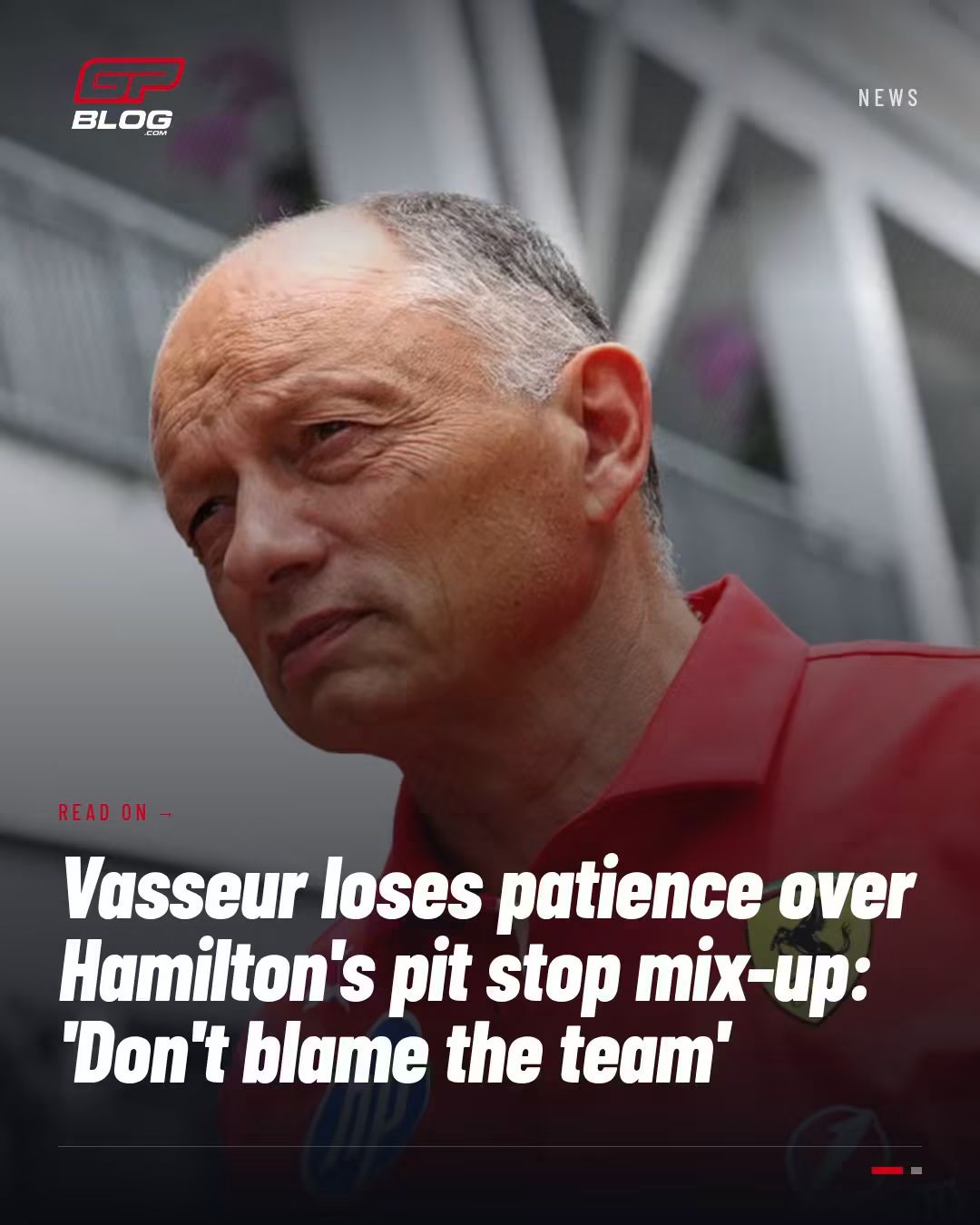
Ferrari team principal Fred Vasseur left little room for doubt after the Singapore Grand Prix. The call from the pit wall was crystal clear. The tyres were cooked. Lewis Hamilton stayed out anyway. And the Scuderia paid the price with a double podium that slipped through its fingers.
What should have been a strong 2-3 finish behind Max Verstappen’s dominant Red Bull turned into a frustrating sixth for Hamilton. Charles Leclerc salvaged second. The seven-time champion, running on soft tyres that had already covered more than 40 laps by the end, was swallowed up by Kimi Antonelli and the McLarens of Lando Norris and Oscar Piastri in the closing stages. Hamilton owned the mistake over team radio. Vasseur made sure the wider world knew exactly where the responsibility lay.
THE DECISIVE MOMENT UNDER THE VIRTUAL SAFETY CAR
The race at Marina Bay unfolded with Ferrari splitting strategies from the start in an attempt to pressure Verstappen. Leclerc began on softs. Hamilton took the mediums, looking for a longer first stint and a potential one-stop that could unlock track position on a circuit where overtaking is notoriously difficult.
The mediums never delivered. Softs proved markedly stronger across the field. Hamilton was forced into the pits as early as lap 18 for a set of softs, committing himself to a marathon final stint. Leclerc stayed out longer before switching to mediums. When Lance Stroll’s Aston Martin stopped and triggered a Virtual Safety Car around lap 39, Ferrari saw its chance.
Both cars were running second and third on the road. The pit wall called them both in. Leclerc took the free stop, bolted on fresh softs, and went on to finish second. Hamilton did not. Whether he missed the pit entry or simply preferred to hold track position, the outcome was the same: he stayed out on ageing rubber that had already done significant work.
Those softs had nothing left. Hamilton’s pace collapsed. The cars behind closed in and passed him with relative ease. He crossed the line sixth, a result that did not reflect the underlying pace of the Ferrari.
VASSEUR’S CLEAR MESSAGE TO THE MEDIA
Post-race, Vasseur faced repeated questions about strategy. His patience wore thin. He insisted the instructions had been unambiguous.
“We asked him to pit. Don’t blame the team, guys,” Vasseur said. “Clearly on the radio he said, ‘I apologise, I let you down. That it was my call’. We were P2, P3 on track. We called two cars. ‘Guys, you pit behind the VSC.’ One of my guys said, ‘no, I prefer to stay on track’. He said, ‘I missed the pit entry’. Don’t blame the team.”
He repeated the point with rising firmness: the message was crystal clear. The team had kept options open depending on a potential VSC. When it arrived, both drivers were told to box. One followed the call. The other did not. Vasseur noted that Ferrari had not been certain the existing softs would last to the flag, which is precisely why the stop was requested.
Hamilton, who visited the medical centre after the race and was excused from media duties after feeling unwell, later took full ownership. On the cool-down lap he told the team: “Sorry boys. I let you down today with that strategy. My call, and I lost us valuable points. I’ll try and make up for it in the next one.”
In subsequent comments released by the team, he described it as a painful lesson and confirmed the team had called him in but he missed the entry before deciding to stay out and defend position.
WHY THIS MOMENT MATTERS BEYOND ONE RACE RESULT
In Formula 1, strategy calls under a Virtual Safety Car or Safety Car are among the highest-leverage decisions of a race. A free or cheap stop can reshuffle the order, preserve tyre life, and convert a solid result into a podium or better. Missing that window, especially when running second and third, costs not only positions but championship points that become increasingly valuable as the season enters its final stretch.
For Ferrari, the missed double podium was a tangible blow. Leclerc’s second place limited the damage, yet the team left significant points on the table. In a season where the constructors’ battle remains tight and every point counts toward long-term momentum and resources, those lost positions matter.
For Hamilton, the episode carries different weight. At 41 and in his second year with the Scuderia, he continues to adapt to Ferrari’s processes, data flow, and decision-making culture. Drivers of his experience are rightly given significant input. They feel the car, the tyres, and the track in real time. Teams are frequently criticised for ignoring driver feedback. Yet the global picture available to the pit wall—tyre models, rival strategies, remaining race distance, and the precise timing of a VSC—often outweighs the view from the cockpit.
This was a classic tension between driver autonomy and collective strategy. Hamilton’s call to stay out prioritised track position on a difficult-to-overtake circuit. The data and the eventual degradation proved the pit wall’s caution correct. The softs simply would not last the distance at competitive pace.
The incident also highlights how tyre performance can still surprise even the most sophisticated teams. With limited dry running after a wet sprint, the field started the grand prix somewhat blind on the relative strengths of the medium and soft compounds. Softs dominated. That reality forced early stops and long final stints for those who had started on the yellow-marked rubber. Singapore’s heat and abrasive surface only amplified the challenge.
THE BROADER IMPLICATIONS FOR FERRARI AND THE CHAMPIONSHIP
Hamilton’s championship lead over Verstappen was trimmed by the result. While Verstappen remains the benchmark on pure pace in many conditions, Ferrari’s underlying speed in Singapore suggested the gap is not insurmountable. A clean execution under the VSC would have delivered a 2-3 finish and kept more pressure on Red Bull. Instead, the McLarens and Mercedes capitalised.
Team dynamics inside Ferrari will be watched closely. Vasseur’s public defence of the pit wall was firm but not aggressive toward his driver. He framed it as a shared learning opportunity rather than a crisis. Hamilton’s immediate apology on the radio and subsequent acceptance of responsibility should help prevent any lasting friction. Still, repeated strategy disagreements can erode trust if not addressed through clear processes and debriefs.
Looking ahead to the United States Grand Prix in Austin, both sides will need to recalibrate. The Circuit of the Americas rewards strong tyre management and decisive strategy. Ferrari cannot afford another high-value opportunity to evaporate because of a communication or decision gap. Hamilton, for his part, will want to demonstrate that the Singapore call was an isolated misjudgment rather than a pattern.
A PAINFUL BUT USEFUL LESSON
Formula 1 is unforgiving of small margins. A missed pit entry, a moment of hesitation, or a preference for track position over fresh rubber can swing multiple positions and valuable points. Vasseur’s message was simple and direct: the call was clear, the tyres were finished, and the driver made the final decision.
Hamilton has already accepted the cost. The team has drawn a line under the blame game. What remains is the work of turning the lesson into sharper execution in the races still to come. In a championship that continues to tighten, those recovered points and restored alignment between car and pit wall could prove decisive.