Lando Norris had every reason to be frustrated after the Azerbaijan Grand Prix. His race ended in the barriers through no fault of his own, while McLaren also lost valuable points after Oscar Piastri’s difficult afternoon.
But while Norris demanded a much harsher punishment for Franco Colapinto, Max Verstappen offered a very different perspective.
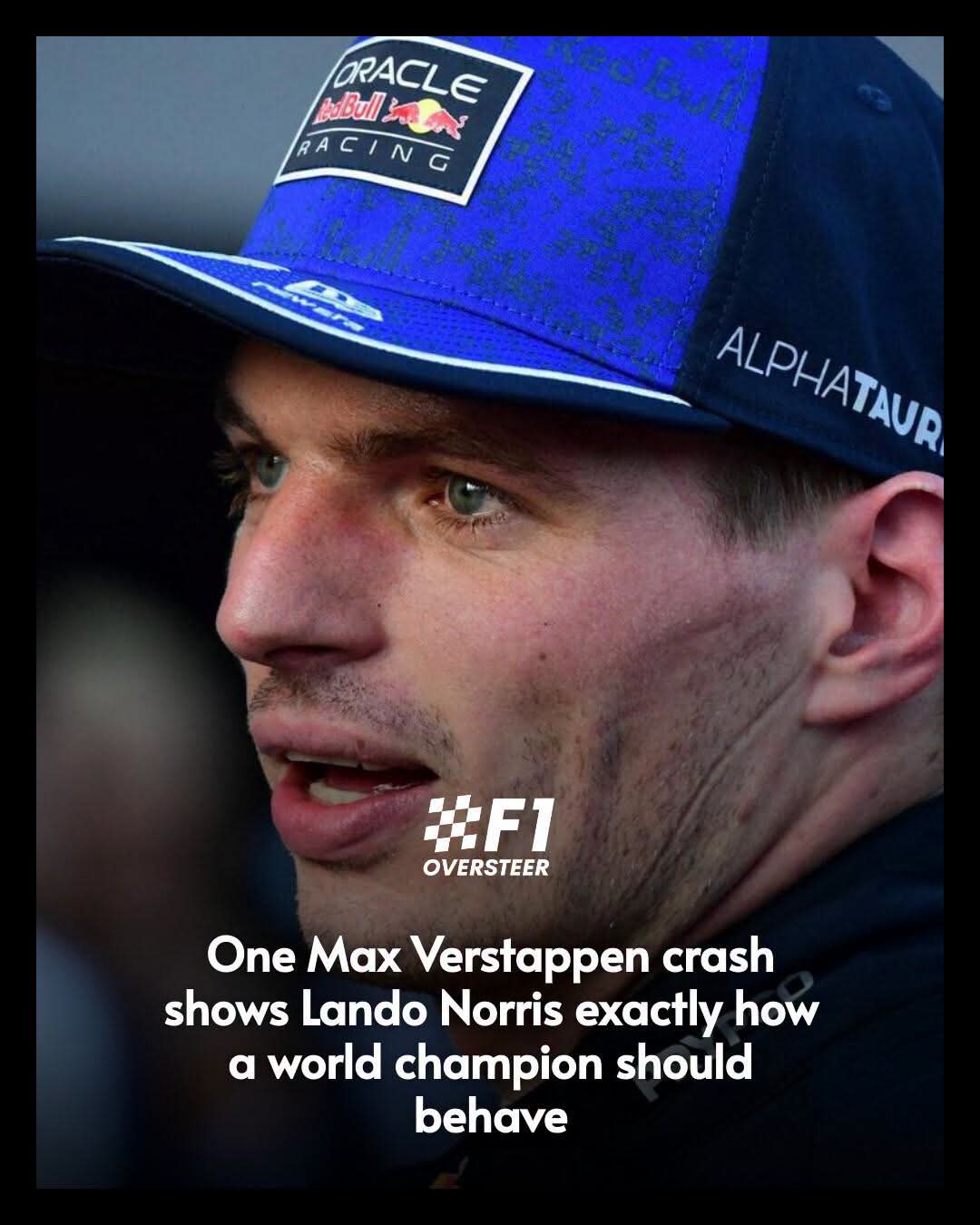
The Red Bull driver, who finished second in Baku, rejected the idea that Colapinto deserved a race ban after the Alpine driver’s mistake triggered a multi-car crash at the Safety Car restart. Verstappen’s response was striking partly because he had experienced something remarkably similar himself.
His reaction raises an important question for Norris: is championship maturity about never losing your temper, or about knowing when frustration should stop and perspective should begin?
NORRIS’ BAKU RACE ENDED IN AN INSTANT
The incident happened during the restart on Lap 36.
Colapinto approached Turn 1 with cold tyres and brakes after the Safety Car period and locked up, losing control of his Alpine. He hit his team-mate Pierre Gasly, whose car was then pushed into Norris.
All three drivers were eliminated.
For Norris, the consequences were particularly painful. He had been fighting at the front of the championship and suddenly found himself standing on the sidelines while other title contenders continued.
Norris subsequently argued that the FIA should take a tougher approach to incidents of this kind, even suggesting that a one-race ban should be considered.
His frustration was understandable. Colapinto himself accepted responsibility and apologised, describing the incident as a major mistake. Alpine also acknowledged the seriousness of what had happened.
But the question was whether the mistake justified the punishment Norris wanted.
That is where Verstappen disagreed.
VERSTAPPEN REFUSES TO TURN A MISTAKE INTO A HUNT FOR REVENGE
After finishing second behind George Russell, Verstappen was asked about Norris’ comments.
His response was considerably more measured.
Verstappen’s argument was essentially that an unintentional mistake should be judged in context. If the driver understands what happened and accepts responsibility, a race ban can be disproportionate.
That view was not unique to Verstappen.
Russell also argued that Safety Car restarts create unusual conditions because drivers are trying to manage cold tyres and brakes while preparing for an immediate acceleration and braking zone. He described the Baku incident as a relatively small error with extremely large consequences.
Isack Hadjar made a similar point, highlighting how difficult it can be to generate tyre temperature while following the Safety Car on Baku’s low-grip street circuit.
So Verstappen was not simply defending Colapinto.
He was drawing a distinction between a mistake and deliberate dangerous driving.
That distinction matters enormously in Formula 1.
VERSTAPPEN HAS BEEN IN NORRIS’ POSITION BEFORE
The strongest part of this comparison comes from the 2025 Austrian Grand Prix.
Verstappen’s race at the Red Bull Ring ended on the opening lap after rookie Kimi Antonelli locked up and hit his Red Bull.
The collision destroyed Verstappen’s race.
Antonelli immediately accepted responsibility and apologised. The FIA still penalised him with a three-place grid drop for the following race.
But Verstappen did not demand that the rookie be banned.
Instead, he acknowledged that mistakes happen in Formula 1 and that nobody deliberately causes a crash that ends their own race as well.
That response is particularly relevant now.
Because in Baku, Verstappen once again found himself discussing a driver whose mistake had ruined another competitor’s race.
And once again, he focused on responsibility rather than revenge.
THIS DOESN’T MEAN NORRIS WAS WRONG TO BE ANGRY
There is an important distinction here.
Verstappen’s position does not mean Norris had no right to be furious.
A Formula 1 driver spends millions of dollars’ worth of engineering, preparation and risk trying to put together a successful Grand Prix. When another driver makes a mistake and destroys that opportunity within seconds, anger is completely understandable.
Norris also had a legitimate sporting point when he raised the issue of consequences.
The FIA ultimately imposed a 10-second penalty on Colapinto. Because the Alpine driver retired and could not serve it during the race, the sanction was converted into a five-place grid penalty for the next event.
The real debate is therefore not whether Colapinto should face consequences.
He did.
The debate is about how severe those consequences should be when the incident appears to be an error rather than intentional or repeatedly reckless behaviour.
That is where Verstappen’s argument becomes more persuasive as a discussion about the principles of F1 punishment.
THE BIG DIFFERENCE BETWEEN VERSTAPPEN AND NORRIS IS TIMING
Norris spoke immediately after losing his race.
Verstappen spoke after completing the Grand Prix and standing on the podium.
That difference matters.
Drivers are not robots. A competitor who has just watched a race disappear because of somebody else’s mistake is naturally going to react emotionally.
The more difficult task is stepping back once the immediate anger has faded.
Verstappen’s experience gives him an unusual perspective. He has been the driver whose race was destroyed. He knows what it feels like to lose a potentially valuable result because somebody else made a mistake.
Yet his response in Austria was to recognise the difference between an accident and intentional misconduct.
That same philosophy appeared again in Baku.
THE 2025 AUSTRIA CRASH IS MORE RELEVANT THAN IT FIRST APPEARS
There is another reason the Antonelli incident matters.
Verstappen was not merely an innocent driver caught in someone else’s mistake. At the time, he was still fighting for the championship and every lost result mattered.
His Austrian DNF therefore carried genuine sporting consequences.
Nevertheless, he did not turn the incident into a personal campaign against Antonelli.
Instead, he accepted the apology and moved on.
That does not mean Verstappen was happy about it.
It means he understood something important about racing at the highest level: punishment should be determined by rules and circumstances, not by how angry the victim happens to be.
That is a difficult principle to follow when the victim is a championship contender.
BAKU ALSO SHOWED WHY SAFETY CAR RESTARTS ARE SO DIFFICULT
The technical circumstances of the Baku incident deserve attention.
During a Safety Car period, drivers are not operating their cars in normal race conditions. Tyre temperatures fall, brake temperatures can change dramatically and drivers have to prepare for an aggressive acceleration phase followed by a heavy braking zone.
Baku makes the challenge even more complicated.
The circuit combines long straights with slow, technical corners, while the racing surface away from the ideal line can offer significantly less grip.
Hadjar specifically pointed to the difficulty of generating temperature during the Safety Car period and the consequences of moving away from the racing line.
That does not excuse Colapinto’s mistake.
But it helps explain why a driver can make what appears to be a relatively small error and create a massive accident.
And that is precisely the distinction Verstappen was making.
THE CHAMPION’S APPROACH IS NOT ABOUT BEING SOFT
It would be wrong to interpret Verstappen’s comments as evidence that he believes drivers should escape punishment.
His own career proves the opposite.
Verstappen has spent years racing extremely aggressively and has frequently argued for clear standards when he believes competitors have crossed a line.
His Baku position was more specific.
If a driver makes an honest mistake, recognises it, apologises and does not demonstrate a pattern of dangerous behaviour, Verstappen believes a race ban is excessive.
That is a much narrower argument than simply saying drivers should not be punished.
NORRIS’ COMMENTS COULD BECOME PART OF A BIGGER F1 DEBATE
The Baku incident could ultimately lead to a broader conversation about how the FIA handles repeat offences.
A single mistake does not necessarily tell the complete story of a driver’s behaviour.
But repeated incidents could create a different situation.
That is where systems involving penalty points, accumulated sanctions and escalating grid penalties become relevant.
Instead of automatically giving a race ban after one major accident, regulators could distinguish between:
– an isolated mistake;
– repeated careless driving;
– reckless driving;
– deliberately dangerous behaviour.
That would allow punishment to reflect the driver’s broader record rather than the damage caused by one incident.
The Baku debate therefore goes beyond Colapinto.
It touches on one of Formula 1’s oldest questions: how do you punish dangerous driving without punishing ordinary human mistakes too severely?
NORRIS AND VERSTAPPEN MAY ACTUALLY AGREE ON MORE THAN IT SEEMS
Despite the apparent disagreement, Norris and Verstappen are not necessarily on opposite sides of the entire issue.
Both want drivers to take responsibility.
Both understand that mistakes can have enormous consequences.
Both have experienced races being ruined by incidents they did not cause.
The disagreement is primarily about the appropriate response.
Norris’ immediate reaction was that the consequences should be significantly stronger.
Verstappen’s argument was that intent, circumstances, responsibility and the driver’s response should all matter.
Those are two different approaches to the same problem.
And the FIA ultimately chose a middle ground: Colapinto was punished, but not banned.
WHAT THIS MEANS FOR LANDO NORRIS
Norris is now in the position of a reigning world champion.
That does not mean he has to become emotionless.
It does not mean he cannot criticise another driver.
And it certainly does not mean he must quietly accept every incident that damages his championship.
But championship status inevitably changes the way those reactions are viewed.
When a driver is fighting for a title, every lost point matters. Yet the ability to separate personal frustration from a broader judgment of another driver’s career can become an important part of leadership within the paddock.
Verstappen’s response offers Norris an example of that separation.
The Dutchman knows exactly what it feels like to lose a race through someone else’s error.
He also knows that today’s victim can be tomorrow’s driver making the mistake.
THE BIGGER LESSON FROM BAKU
The most interesting part of this story is not whether Norris or Verstappen had the better emotional reaction.
It is what their responses reveal about Formula 1’s competitive culture.
Norris wanted stronger consequences because he saw the incident through the eyes of the driver who lost everything.
Verstappen looked at it through the eyes of someone who had been in that exact position before and understood that not every serious consequence comes from serious intent.
That difference is important.
A championship is won through speed, consistency and execution. But over a long season, drivers will inevitably experience crashes, mechanical failures, mistakes and incidents caused by others.
The ability to recover emotionally can be almost as important as recovering on track.
Verstappen demonstrated that lesson after Austria in 2025.
In Baku, he demonstrated it again.
And while Norris’ anger was understandable, the episode provides a useful reminder that being a world champion is not only about how a driver performs when everything goes right.
Sometimes it is about how they respond when everything goes wrong.
That may be the real lesson Verstappen has given Norris after Baku: frustration is natural, but perspective is part of becoming a complete champion.