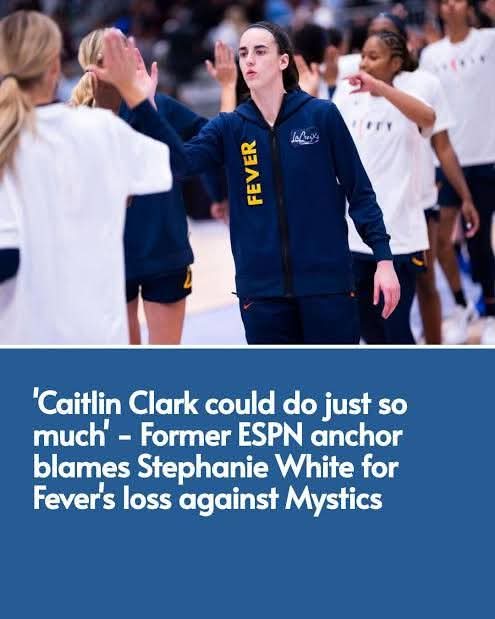
BREAKING NEWS: “Caitlin Clark Could Do Just So Much” — Former ESPN Anchor Linda Cohn Criticizes Stephanie White After Fever’s 93–77 Loss of mystics..“Caitlin Clark Could Do Just So Much”: Linda Cohn Criticizes Stephanie White After Fever’s 93–77 Loss to Mystics
The Indiana Fever’s 93–77 loss to the Washington Mystics has sparked fresh questions about the team’s preparation, defensive execution and coaching at a critical point of the WNBA regular season.
Former ESPN anchor Linda Cohn was particularly critical of Fever head coach Stephanie White following Indiana’s disappointing performance, arguing that Caitlin Clark could only do so much to rescue a team that appeared unprepared from the opening tip.
The Fever entered the matchup with significant playoff-seeding implications at stake. Instead of strengthening their position, Indiana was overwhelmed early by Washington and spent most of the afternoon attempting to recover from a substantial deficit.
Cohn addressed the performance on “The Linda Cohn Show,” focusing on what she viewed as a preparation problem.
“You can’t look unprepared for one of the biggest games of your season,” Cohn said, according to reports of her comments. She emphasized that the timing made the performance especially concerning, given that the game came late in September with playoff positioning on the line.
Cohn ultimately placed responsibility on the coaching staff, saying that when a team comes out flat in an important game, she tends to blame the coaches for failing to have the players ready.
Her conclusion was blunt: “Caitlin Clark can do just so much.”
Mystics seize control immediately
Washington did not give Indiana much opportunity to settle into the game.
The Mystics raced ahead 34–19 after the opening quarter and extended their advantage to 51–30 by halftime. Indiana struggled both offensively and defensively, while Washington played with the pace and confidence that had been missing from the Fever.
The final numbers reflected the difference between the teams.
Indiana shot approximately 36.6 percent from the field and just 21.4 percent from three-point range. Washington, meanwhile, shot roughly 57 percent overall. The Mystics also won the rebounding battle and scored more effectively inside the paint.
For a Fever team attempting to compete for a favorable postseason position, the slow start became too large a hole to overcome.
Caitlin Clark nevertheless produced 25 points and five assists, while Kelsey Mitchell contributed 22 points. The problem for Indiana was that the production beyond those two players was not enough to match Washington’s balanced attack. Makayla Timpson was the only other Fever player reported to reach double figures, finishing with 13 points.
Clark’s frustration becomes visible
Clark’s own reaction during the game added another layer to the discussion.
During the first quarter, with Washington already holding a sizeable lead, Clark was seen communicating toward the Indiana bench and head coach Stephanie White. Reports described the exchange as a visible expression of frustration over defensive rotations and the Fever’s inability to contain Washington.
Clark later made her assessment of the performance clear after the final buzzer.
She said the game did not feel like the Fever’s usual style of play, pointing specifically to stagnant offense and excessive dribbling. She also criticized Indiana’s defensive performance and described the overall execution as sloppy.
Those comments closely matched Cohn’s broader argument that the Fever had not been adequately prepared for the importance of the matchup.
White, for her part, also acknowledged the shortcomings of Indiana’s performance. Reports indicate that she agreed with Clark’s assessment that the team had failed to play to its normal standard.
That distinction is important. Cohn’s comments represent her analysis of the coaching, while White and Clark’s postgame remarks provide direct observations from the Fever themselves.
A costly defeat for Indiana
The loss also had implications beyond a single game.
Indiana entered the matchup at 27–14, while Atlanta occupied the position immediately ahead of the Fever in the standings. The defeat dropped Indiana to 27–15 and left the Fever trailing Atlanta in the race for a top-four position.
Washington improved to 26–16 with the victory, moving closer to Indiana in the standings. The Mystics also secured the tiebreaker between the teams in the event that their regular-season records ultimately finished level.
The Fever now faced a challenging conclusion to the regular season, with consecutive games against the Minnesota Lynx.
That schedule was one reason Cohn considered the Mystics game particularly significant. Indiana had an opportunity to strengthen its position before facing Minnesota, but instead entered the final stretch having suffered a substantial setback.
The coaching debate
Cohn’s criticism does not necessarily mean that every problem in the loss can be attributed to White or the coaching staff. Basketball games involve contributions from players, opponents, tactics, shooting variance, turnovers, rebounding and execution.
But the nature of the defeat naturally raised questions about preparation.
Washington’s early 15-point advantage after one quarter meant Indiana was forced to play from behind almost immediately. By halftime, the deficit had grown to 21 points.
For Cohn, that type of start was the central issue.
Her argument was that Clark, despite being one of the Fever’s most influential players, cannot single-handedly compensate for poor team execution. The quote that became the headline — “Caitlin Clark could do just so much” — therefore reflected Cohn’s broader criticism of the team’s collective performance rather than a claim that Clark herself had played well enough to win the game.
The numbers also show why the Fever needed more than individual scoring. Clark and Mitchell combined for 47 points, yet Indiana still lost by 16. Washington received major contributions from Kiki Iriafen and Shakira Austin, who each recorded double-doubles, while Sonia Citron added 16 points.
Attention turns to Minnesota
The Fever’s next games became even more important following the defeat.
With Minnesota awaiting them twice to close the regular season, Indiana had little room for another performance resembling the first half against Washington.
The Mystics loss therefore created two separate conversations around the Fever: one concerning their postseason positioning and another concerning the team’s preparation and execution under White.
Cohn has made her position clear. She believes the responsibility for an unprepared team begins with the coaching staff.
Clark’s own comments after the game, meanwhile, showed that the frustration was not limited to outside observers. Her criticism centered on the Fever’s ball movement, defensive execution and overall performance.
For White and Indiana, the immediate challenge is turning those criticisms into a better performance on the court.
The 93–77 defeat cannot be changed. What remains is how the Fever respond when the regular season reaches its final games and the pressure of the postseason increases.
For now, Cohn’s central message is straightforward: even a star of Clark’s caliber has limits, and Indiana needs a complete team effort if it hopes to navigate the final stretch successfully.