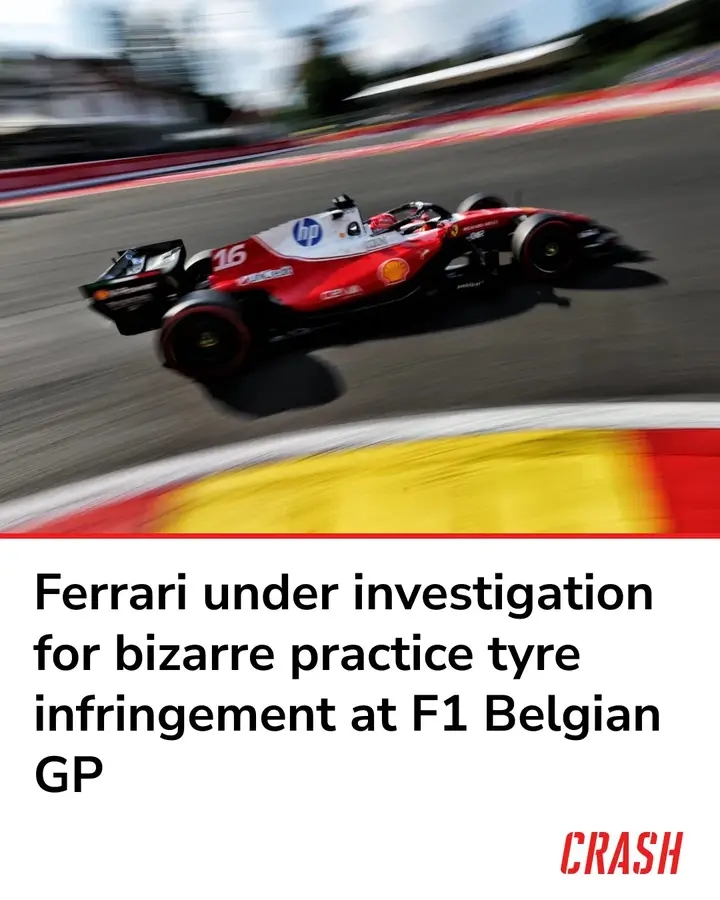
Ferrari’s Belgian Grand Prix weekend began with an unexpected off-track setback after the Scuderia was penalized for failing to comply with the FIA’s tyre return procedures during Friday’s practice sessions. The team received two separate €5,000 fines related to the tyres used by Charles Leclerc and Lewis Hamilton before the second free practice session, bringing the total financial penalty to €10,000.
Although the sanctions carry no sporting consequences, they underline just how closely Formula 1 teams are monitored throughout a race weekend. Every aspect of a team’s operation—from car preparation to tyre administration—is governed by strict regulations, and even a seemingly harmless procedural oversight can result in disciplinary action from the FIA.
FERRARI’S ERROR EXPLAINED
The FIA operates one of the most tightly controlled tyre management systems in world motorsport. Every set supplied during a Grand Prix weekend is tracked, allocated, and returned according to a strict timetable designed to guarantee fairness across the grid.
Ferrari’s infringement was not related to tyre performance, illegal modifications, or attempts to gain a competitive advantage. Instead, the issue centered on the late return of tyre sets allocated to Charles Leclerc and Lewis Hamilton before the start of the second practice session.
Because each driver’s tyres are treated separately under the regulations, the FIA issued two individual fines of €5,000 rather than a single team penalty.
While the punishment is relatively minor by Formula 1 standards, it reinforces the message that procedural compliance is non-negotiable, regardless of a team’s status or championship ambitions.
WHY THE FIA TAKES TYRE PROCEDURES SO SERIOUSLY
Tyres are among the most influential performance factors in modern Formula 1. Managing compounds, wear, allocation, and availability throughout a race weekend can have a major impact on qualifying pace, race strategy, and overall competitiveness.
To eliminate any possibility of unfair advantages, the FIA enforces strict procedures governing when tyres can be used, inspected, and returned to official supplier Pirelli.
If teams fail to follow those procedures—even unintentionally—it compromises the consistency of the regulatory system. Financial penalties therefore serve as a deterrent, reminding every team that operational discipline is just as important as technical compliance.
This incident demonstrates that Formula 1 is not only won through engineering excellence but also through flawless execution behind the scenes.
WHY THIS MATTERS FOR FERRARI
On paper, €10,000 is insignificant for one of Formula 1’s biggest manufacturers. However, the timing of the incident is less than ideal.
Ferrari arrived at Spa-Francorchamps looking to continue its recent momentum against rivals McLaren, Red Bull, and Mercedes. During a sprint weekend, every practice minute is precious because teams have limited opportunities to fine-tune setups before competitive sessions begin.
The last thing Ferrari wanted was unnecessary scrutiny from race officials or administrative distractions while engineers focused on maximizing the performance of the SF-26.
Although the fine itself changes nothing competitively, successful championship campaigns are often built on avoiding exactly these kinds of avoidable mistakes. The strongest organizations consistently execute every operational detail with precision, and Ferrari will be determined to ensure this remains an isolated incident.
NO SPORTING PENALTY FOR LECLERC OR HAMILTON
The positive news for Ferrari is that neither Charles Leclerc nor Lewis Hamilton has received any sporting sanction.
Both drivers retain their qualifying positions, tyre allocations, and championship points, allowing them to concentrate entirely on extracting maximum performance throughout the Belgian Grand Prix weekend.
That distinction is important because Formula 1 regulations often separate administrative breaches from performance-related infringements. Since Ferrari’s mistake did not provide any competitive gain, the FIA limited its response to financial penalties.
For Leclerc and Hamilton, the focus quickly returns to finding the ideal balance between straight-line speed and cornering performance at one of Formula 1’s fastest and most technically demanding circuits.
WHAT THIS SAYS ABOUT FERRARI’S TITLE CHALLENGE
While this incident is unlikely to influence either championship battle directly, it serves as another reminder that title-winning teams are defined by consistency in every department.
Throughout Formula 1 history, championship campaigns have frequently been decided by margins so small that operational excellence becomes just as valuable as outright pace.
Ferrari has shown encouraging progress in recent races, demonstrating improved race management, stronger qualifying performances, and better overall competitiveness. However, maintaining those standards requires every department—from strategy and engineering to logistics and race operations—to perform flawlessly under pressure.
Administrative mistakes rarely decide championships on their own, but repeated lapses can create distractions that successful teams work hard to avoid.
COULD THE FIA TAKE A HARDER STANCE IN FUTURE?
This case is unlikely to escalate beyond the financial penalties already imposed, particularly because there was no evidence of sporting advantage.
However, repeated procedural violations across a season could attract greater scrutiny from FIA officials. Consistent failures to comply with operational regulations may eventually lead to harsher sanctions if governing bodies believe teams are not taking their responsibilities seriously.
That makes internal review and procedural improvements essential, even after relatively minor infringements such as this one.
Ferrari’s management will almost certainly analyze how the error occurred to ensure similar incidents do not happen again during the remainder of the season.
WHAT TO EXPECT FOR THE REST OF THE BELGIAN GRAND PRIX WEEKEND
Despite the fines, Ferrari remains firmly in contention to challenge near the front at Spa-Francorchamps.
The Belgian circuit traditionally rewards efficient aerodynamics, strong power unit performance, and intelligent tyre management—all areas where Ferrari has shown encouraging signs of improvement in recent races.
If the team quickly puts this administrative setback behind it, both Leclerc and Hamilton have realistic opportunities to compete for strong qualifying positions and valuable championship points.
Ultimately, the €10,000 penalty is unlikely to affect Ferrari’s pace, but it highlights an important truth about modern Formula 1. Success is built not only on designing a fast racing car but also on executing every operational detail with absolute precision. As the championship battle intensifies, Ferrari will know that eliminating even the smallest mistakes could prove invaluable in the fight against its biggest rivals.