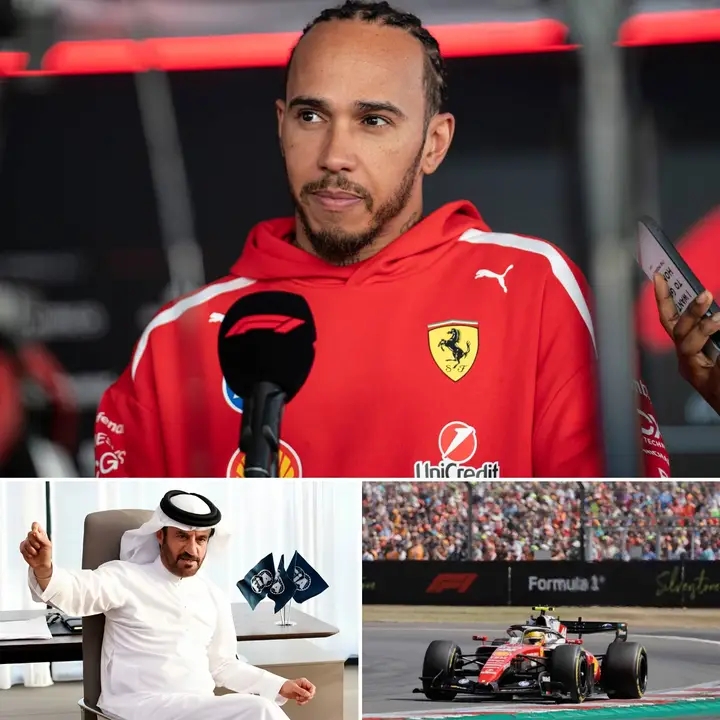
Formula 1 has always evolved through innovation, but the balance between cutting-edge technology and pure driving talent remains one of the sport’s biggest talking points. That debate has returned to center stage after Lewis Hamilton openly questioned whether modern F1 is drifting too far away from what originally made the championship special.
The seven-time world champion expressed concern that increasing technological influence is gradually reducing the importance of driver skill, reigniting a discussion that has divided fans, engineers, and former champions for years. His comments quickly gained attention across the paddock, and the conversation intensified even further after fresh developments involving FIA President Mohammed Ben Sulayem added another layer of controversy surrounding the sport’s future.
HAMILTON BELIEVES THE SPORT IS CHANGING
Hamilton has never hidden his passion for Formula 1, but he has also been one of its strongest critics whenever he believes changes move the championship away from rewarding exceptional driving ability.
His latest remarks suggest he feels the growing reliance on technology, engineering complexity, and increasingly sophisticated car systems risks shifting too much of the competitive advantage away from the driver. While Formula 1 has always been an engineering competition, Hamilton’s concern reflects a wider belief shared by many fans that the human element should remain the defining factor.
Modern F1 machines are masterpieces of engineering, featuring advanced hybrid power units, complex aerodynamic concepts, and extensive data analysis. Although these innovations showcase the brilliance of the teams, critics argue they can sometimes make the outcome depend more on technical superiority than outright driving excellence.
THE FIA FINDS ITSELF UNDER FRESH SCRUTINY
Hamilton’s comments gained even more attention as discussions surrounding recent FIA decisions continued to dominate headlines.
The governing body has faced increasing pressure over several regulatory matters, ranging from technical rule changes and stewarding consistency to broader governance issues affecting the championship. Every major decision now receives intense examination from teams, drivers, and supporters, making even routine announcements capable of triggering significant debate.
Whether justified or not, the FIA’s actions are increasingly viewed through a political lens, with every regulation scrutinized for its potential impact on competitive balance.
WHY TECHNOLOGY REMAINS BOTH F1’S GREATEST STRENGTH AND BIGGEST CHALLENGE
Formula 1 has never been solely about drivers. Legendary teams such as Ferrari, McLaren, Mercedes, Red Bull, and Williams built their success by combining engineering excellence with world-class driving talent.
However, today’s regulations have pushed technological development to unprecedented levels. Simulation tools, artificial intelligence, advanced telemetry, sophisticated tire modeling, and aerodynamic optimization now influence nearly every aspect of race weekends.
Supporters argue these innovations represent Formula 1 at its absolute best. The championship has always marketed itself as the pinnacle of motorsport, and technological leadership is central to that identity.
Others believe the balance has shifted too far. They argue that when one team discovers a significant technical advantage, the performance gap becomes so large that even the most talented drivers struggle to overcome it.
Hamilton’s comments resonate with those who want regulations that create closer competition while ensuring exceptional drivers can consistently make the difference.
WHAT THIS MEANS FOR THE 2026 ERA
The debate arrives at a particularly important time as Formula 1 prepares for its next major regulatory cycle.
New chassis and power unit regulations promise another significant technical reset, giving every team an opportunity to close the competitive gap. The challenge for the FIA will be ensuring innovation continues without creating another period of prolonged dominance by a single manufacturer or constructor.
If the new rules successfully produce closer racing, Hamilton’s concerns may gradually fade. However, if technology once again creates large performance disparities, criticism is likely to become even louder.
THE IMPACT ON THE CHAMPIONSHIP BATTLE
Every regulation change affects far more than lap times.
Teams invest hundreds of millions of dollars developing cars within strict technical frameworks. Small rule adjustments can dramatically alter competitive order, influencing championship battles, sponsorship opportunities, and even driver careers.
Drivers must also adapt continuously as regulations evolve. Those capable of mastering different technical philosophies often gain a significant advantage, while others struggle to extract maximum performance from rapidly changing machinery.
Hamilton’s perspective carries additional weight because he has competed successfully across multiple Formula 1 eras, from naturally aspirated V8s to turbo-hybrid power units and today’s ground-effect cars. His experience gives him a unique basis for comparing how the sport has evolved over nearly two decades.
FANS REMAIN DIVIDED
Reaction from Formula 1 supporters has been mixed.
Some agree with Hamilton, believing races should depend more heavily on driver skill than engineering breakthroughs. They point to classic battles where extraordinary performances could overcome technical disadvantages.
Others argue technological innovation is exactly what separates Formula 1 from every other racing category. Without relentless engineering development, they believe the championship would lose much of its identity as motorsport’s premier technical competition.
This divide is unlikely to disappear anytime soon, particularly as the sport continues expanding its global audience.
WHAT HAPPENS NEXT
The discussion sparked by Hamilton is unlikely to end with a single interview.
As Formula 1 moves toward a new generation of regulations, every FIA decision will face heightened scrutiny from teams, drivers, and fans eager to see whether the governing body can strike the right balance between technological innovation and competitive racing.
Finding that balance may ultimately determine how the next era of Formula 1 is remembered. If the FIA can create regulations that reward brilliant engineering while allowing exceptional drivers to shine, the sport could enter one of its most competitive periods in years. If not, debates over technology versus talent are likely to remain one of Formula 1’s defining controversies for seasons to come.