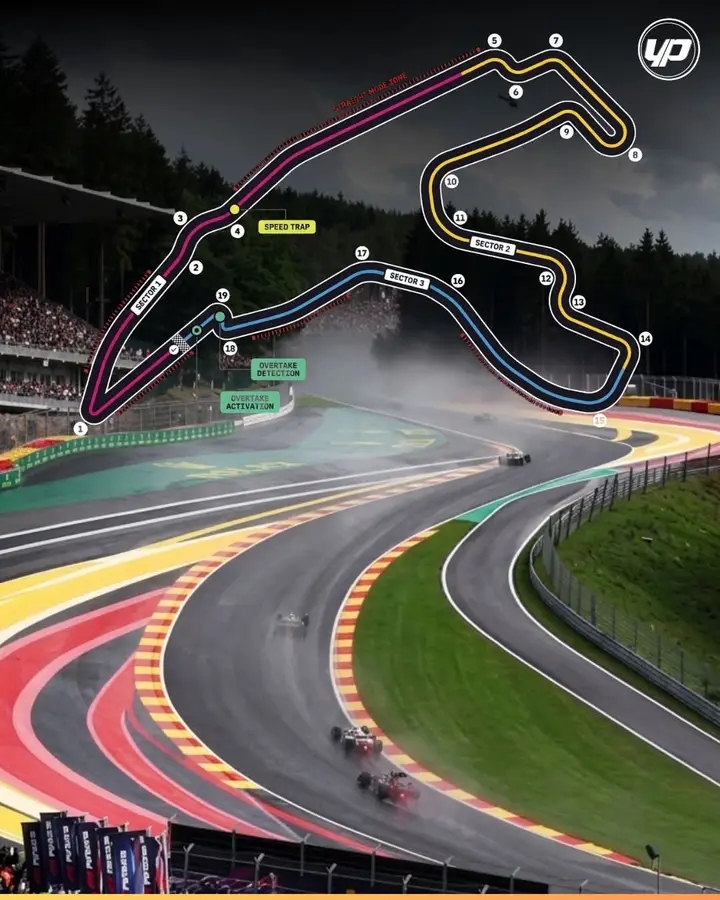
Formula 1 fans were left stunned after reports emerged claiming that the iconic Spa-Francorchamps circuit could feature five consecutive DRS activation zones during the Belgian Grand Prix weekend. If implemented, it would represent one of the most aggressive overtaking experiments the FIA has ever attempted and could dramatically reshape how the race unfolds.
While Formula 1 has continually adjusted DRS layouts over recent seasons to improve racing, the idea of five straight activation zones has sparked intense debate among fans, drivers, and analysts. The Belgian Grand Prix has always delivered spectacular racing thanks to Spa’s combination of long straights, sweeping corners, and unpredictable weather. Adding multiple DRS opportunities could make the action even more unpredictable.
WHY SPA IS THE PERFECT PLACE TO TEST MORE DRS
Spa-Francorchamps is widely regarded as one of Formula 1’s greatest circuits. From the legendary Eau Rouge-Raidillon complex to the Kemmel Straight, the track naturally creates slipstream battles and overtaking opportunities.
Because of its long full-throttle sections, DRS has traditionally been highly effective at Spa. Expanding the number of activation zones would mean drivers spend even more time with reduced drag, increasing straight-line speeds and creating more opportunities to attack.
Teams would also face fresh setup dilemmas. Engineers would need to balance maximum straight-line performance with enough downforce to survive Spa’s high-speed corners, making strategy even more important.
HOW FIVE DRS ZONES COULD CHANGE THE RACE
If the reported layout becomes reality, fans should expect:
- More overtaking throughout the field.
- Increased strategic battles rather than processional racing.
- Greater pressure on drivers to defend intelligently.
- More opportunities for midfield teams to challenge faster rivals.
- A stronger emphasis on race pace instead of qualifying position.
Drivers who excel at managing tyre wear while remaining aggressive in wheel-to-wheel combat could gain a significant advantage.
THE IMPACT ON THE CHAMPIONSHIP
Every point matters as the Formula 1 season enters its decisive stages.
A circuit with numerous overtaking opportunities could reduce the advantage of starting near the front, allowing faster cars to recover from poor qualifying sessions or grid penalties. That could prove crucial in both the Drivers’ and Constructors’ Championship battles.
Teams with exceptional straight-line efficiency may benefit, while those relying heavily on qualifying pace could find themselves under greater pressure on race day.
COULD THERE BE DRAWBACKS?
Not everyone is convinced that adding more DRS is the right solution.
Critics argue that excessive DRS can make overtakes too easy, reducing the skill required to complete passes. Others believe Spa already produces exciting racing naturally and doesn’t need additional artificial assistance.
Supporters, however, believe multiple DRS zones would keep battles alive throughout an entire lap instead of limiting overtaking to one or two locations.
Ultimately, the success of such an experiment would depend on whether it creates genuine racing rather than effortless drive-by passes.
WEATHER COULD STILL BE THE BIGGEST FACTOR
Regardless of the DRS configuration, Spa remains famous for its unpredictable weather.
Rain can affect one section of the circuit while another remains completely dry, instantly transforming race strategy and reducing the effectiveness of DRS. Mixed conditions have produced some of Formula 1’s most memorable Belgian Grands Prix, and that unpredictability is unlikely to change.
FINAL THOUGHTS
If Spa-Francorchamps truly features five consecutive DRS zones, the Belgian Grand Prix could become one of the season’s most entertaining races. The combination of one of Formula 1’s fastest circuits, changing weather, evolving strategies, and increased overtaking opportunities has all the ingredients for a spectacular weekend.
Whether the experiment becomes a long-term success or simply a fascinating one-off, fans can expect plenty of action. If the racing lives up to the hype, the Belgian Grand Prix could play a pivotal role in shaping the remainder of the Formula 1 championship.