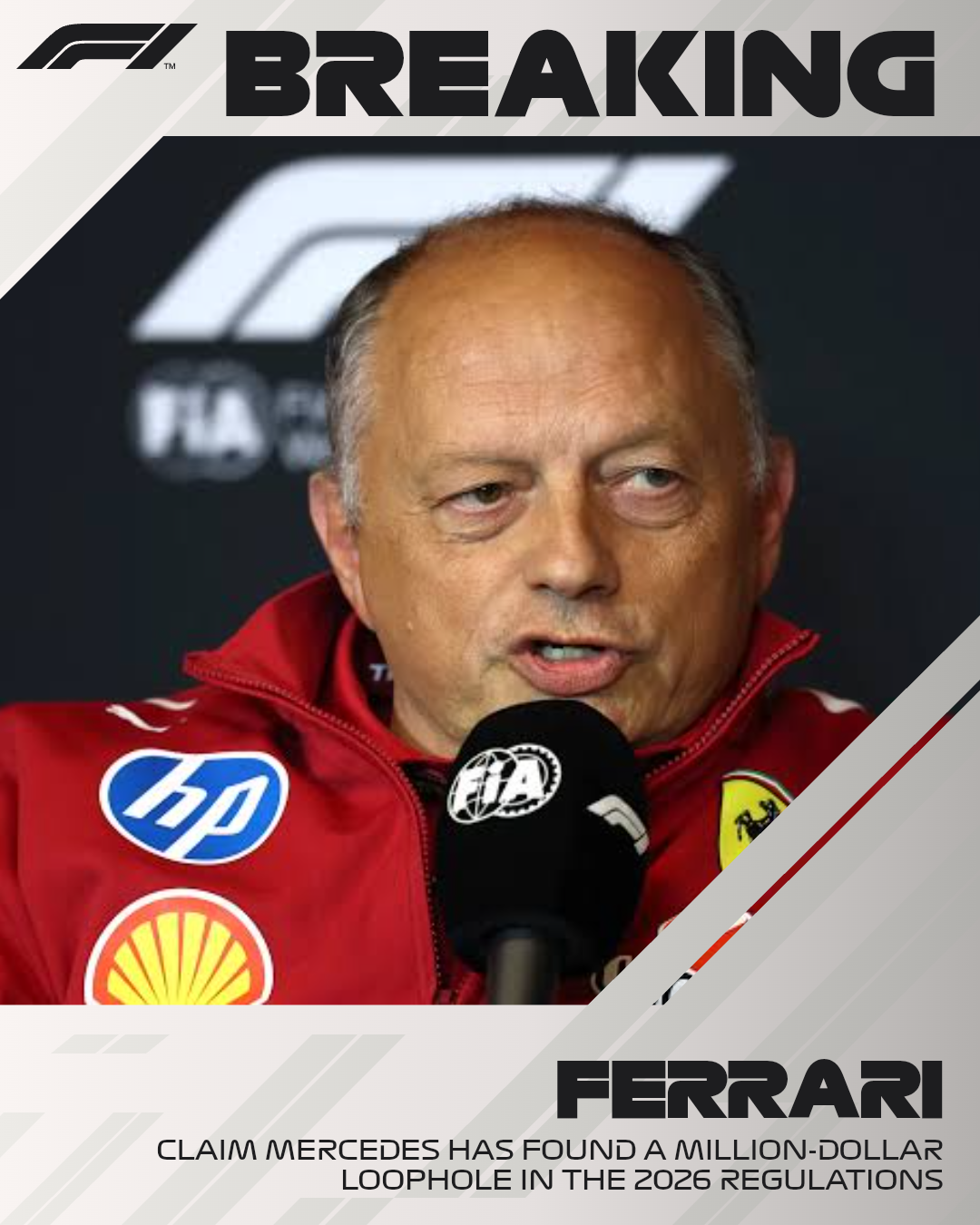
Fresh speculation has emerged in the Formula 1 paddock after reports claimed Ferrari believes Mercedes may have uncovered what has been described as a “million-dollar loophole” within the 2026 technical regulations. At the time of writing, however, there has been no official confirmation from Ferrari, Mercedes, or the FIA to support the allegation, and no evidence has been presented showing that any regulation has been breached.
Despite the lack of official verification, rumors involving technical innovation often spread quickly in Formula 1 because even the smallest engineering breakthrough can dramatically alter the competitive landscape. As teams continue adapting to the sweeping 2026 regulations, every unexpected performance gain naturally attracts attention from rivals.
WHY THE 2026 RULES HAVE CREATED NEW OPPORTUNITIES FOR INNOVATION
The 2026 Formula 1 regulations introduced one of the biggest technical resets in recent history, placing greater emphasis on sustainable fuels, revised hybrid power units, and redesigned aerodynamics. Whenever the rulebook changes significantly, engineers begin searching for creative interpretations that remain legal while offering measurable performance advantages.
Formula 1 has repeatedly demonstrated that championships are often won through innovation rather than outright spending. Concepts such as the double diffuser, F-duct, blown diffuser, and Mercedes’ Dual Axis Steering (DAS) system all showed how clever engineering could deliver a competitive edge before rivals caught up or regulations were revised.
If Mercedes has genuinely found a unique interpretation hidden within the regulations, it would simply continue Formula 1’s long tradition of rewarding engineering excellence—provided the solution complies fully with FIA rules.
WHY FERRARI WOULD BE PAYING CLOSE ATTENTION
Ferrari and Mercedes have spent decades battling each other both on and off the circuit. With the margins between leading teams often measured in hundredths of a second, every technical detail matters.
Should Ferrari believe a rival has identified an area of the regulations that delivers significant gains, it would be entirely reasonable for its engineers to analyze the concept and seek clarification from the FIA if necessary. Such interactions occur regularly throughout every Formula 1 season and form part of the sport’s competitive process.
Importantly, raising questions about a competitor’s design does not automatically imply wrongdoing. Teams frequently ask the FIA to clarify technical interpretations to ensure every constructor operates under the same understanding of the regulations.
THE FIA’S ROLE IN PROTECTING COMPETITIVE FAIRNESS
If concerns are formally presented, the FIA has several options available. Technical officials can inspect components, review design documentation, compare telemetry, and determine whether any system complies with the written regulations.
If the design is deemed legal, Mercedes would be free to continue using it, potentially forcing rival teams to develop similar concepts. If officials determine the interpretation violates either the wording or the spirit of the regulations, the FIA could issue a Technical Directive or amend future regulations to eliminate the advantage.
This ongoing dialogue between innovation and regulation is one of Formula 1’s defining characteristics and continues to push technological development throughout the sport.
WHY A LEGAL “LOOPHOLE” COULD BE WORTH MILLIONS
The phrase “million-dollar loophole” reflects the enormous financial value of gaining a legal competitive advantage under Formula 1’s cost-cap era.
Rather than spending vast sums chasing multiple development paths, discovering one highly effective solution could save valuable resources while delivering immediate performance improvements. Over an entire season, even a few tenths of a second per lap can translate into race victories, championship points, increased sponsorship value, and higher prize money.
In today’s Formula 1, where teams operate under strict financial limits, efficient innovation can be just as valuable as raw engineering investment.
THE BIGGER PICTURE FOR THE CHAMPIONSHIP
Whether or not this particular claim proves accurate, it highlights the intense technical competition unfolding behind the scenes during the 2026 season. Every leading constructor—including Ferrari, Mercedes, Red Bull, McLaren, and Aston Martin—is searching relentlessly for advantages that could determine the outcome of both the Drivers’ and Constructors’ Championships.
Until official statements or FIA findings are released, fans should treat reports of technical loopholes with caution rather than fact. What remains certain is that Formula 1’s engineering battle is as fierce as the racing itself, and the teams capable of interpreting the regulations most effectively often place themselves in the strongest position to fight for championship glory.